
bout de papier, Vol. 13, No. 1 (1996) — Spring 1996 // Printemps 1996, pp. 23–25
by Richard Kohler
It’s all a matter of perspective: where is this information thing taking us? We discovered fire; Gutenberg turned his publishing pernicity loose; the Industrial Revolution, the Cotton Gin, electricity, the light bulb, Coca-Cola, television, nuclear fusion, Three-D, the Selectric, the PC and now the Net: soothsayers all said that the “new” technology would change the world; some said “for the better”; as many said “for the worse”. Tea, with its first explosion of market penetration was variously treated as dangerous, addictive, aphrodisiacal and positively heavenly.
A letter I once read lamented: I cannot understand the youth of today; they drink too much; they stay up too late; they do not respect their elders; they are not interested in their studies; they do not share our values. What will happen to tomorrow?
I was bemused to learn that it was written around 350 BC. It has become an underpinning of my Weltanschauung: so it goes; nothing new under the sun; technology changes, people don’t. Technology may bring “marginal” changes that affect us peripherally but not fundamentally. Some may argue that the periphery can become fundamental but that is when the species evolves (Tennyson’s Divine event to which all creation moves) into another iteration: the planet, however, most likely stays.
We’re operating today in the midst of an ironic profundity, an unpredictable certainty: no one know what’s going to happen — all they know is that it’s going to happen. At Foreign Affairs, we look at the changes that have been wrought since we closed down the “communicator” function (CM) and started facing the down-sizing music that has been (and will stay) with us for years, with mixed emotions — somewhere between bewilderment and perplexity. There are fewer of us in the Department including fewer and fewer secretaries and clerks; officers are being awkwardly charged with duties support staff used to do when there was support staff.
Has the introduction of technology been all that helpful we ask in the midst of adjusting to the frustrations of sometimes fickle machines and networks, and meagre preparation for the future? As with all major jump-shifts in culture, the continuum from beginning to completion can be painfully sluggish. In the case of information technology, we are in the middle of a lengthy and slow swing of the pendulum (despite all the bezazz about hyper speed) that is moving us from (as a British ESO has said) the quill to the satellite. At the “quill” end, we had telexes, memoranda, Bouts de Papier, Aides Mémoire, letters, diplomatic bags, pouches, couriers, and cypher. Today, probably about half-way to the “satellite”, we have sporadic instability at the network, scattered freezing at the work-station, less than loving secure communications, no-one at missions who can “take care of” communications “matters” writ large, and an uneven appreciation around the organization for the magic that has been fashioned for us. There is a collective cry for the good old days, or at least for a “working” present. The chronologically challenged at DFAIT (commonly known as the “new digital homeless”) yearn for simplification, for dictation, filing cabinets and telex packs; the recent recruits can’t believe how backward their office tools are (their home-kits generally being far superior) – couple that with starting salaries and we’re stretching a new definition of “competitive”
We are not there yet but hang on to your hat — far fewer organizations are there than one would imagine. At DFAIT, the technologists have linked us together with a network of telephone and computing connection — riding atop dedicated digital links — that is the dream of other foreign services. None of our G-7 nor OECD partners has DFAIT’s comprehensive connectivity; they verily drool at the power of Consular’s COSMOS application or at the homogeneity (read “interoperability”) of our intranetwork. It is true that the Internet is cheap (not “free” however: there are entry-point subscriptions) but is it reliable? Is it secure? Calculations show handily that the Department sends its data virtually free on leased MITNET digital lines — if we were to go to a non-leased environment it would cost exponentially more to process the voice and data traffic DEAIT currently handles (about twice as much for voice; data would be out of sight).
If it is true that changes are only at the periphery, what are those changes and are they worth it? How are we managing change and are we going about it the right way? Andy MacDonald, the Treasury Board’s former Chief Information Officer has said: “the impact of informatics consists of five percent technology and 95 percent change in culture”. And that is what we face at Foreign Affairs. E-mail is with us; it is informal; it is addictive; and it is spreading with prolific fecundity. The ease with which e-mail can be dashed off the key-board and sent to a recipient immediately generates personalized networking; almost gone are the days of “organizational” mail — although it is fading, we will be wrestling with the transition for some time yet at DFAIT. With personalization comes the levelling of organizations — the downward push. This was an objective when Public Service 2000 had the PCO favouring concepts that allow managers to manage; at the time it was intellectually right but emotionally, the environment was not conducive. E-mail is such an engine of mutation (sic, in lieu of change agent): we are now attaining real flattening. With this comes real de-layering — notice the reduction in numbers of Directors General (DGs); notice the move to “staff” as opposed to “line” DGs. Horrible as the word “empowerment” is — you choose an alternative (enablement, delegation…) – its concept is truly coming as surely as the Country Desk. And both are developments for the better. As people communicate easily with other people personally, they tend to accomplish business and they accomplish it more directly and effectively than they used to when this business had to go up the line and back down. Now, one copies the line thus comforting superiors that they are in the communications loop but not necessarily blocking it.
And the price that we pay is that we become accountable. That too is good: it fosters management. Because everyone is on-line and all can see what the other does with the data they manipulate, there is no hiding: accountable, gotcha!
The circles that surround us go round and they come round. An astrophysicist I once met in a pub in the Brompton Road, answered the question “where does a rocket that is shot into space eventually end-up” by saying that it probably comes back in a circle. We have been told that we are moving from Push to Pull architectures — FSOs used to “push” shot-gun limned information to users at headquarters whether these clients needed it or not; now, we are told that clients only need to “pull” the specific information that is needed at a given moment from that great ether-net foreign service out there: this is supposed to radically change the virtual way we work: added specificity; cinema or TV programming on-demand will work this way from our digital satellite provider. Wait a minute; before we get too comfortable with that, hang on, we’re back to “Push” again: corporations are becoming “work-flowed” or “mail-enabled” which means we can fill out a travel removal form, press SEND and it goes on its merry way from desktop (notice we don’t say “desk” anymore, we knowledge-workers) to desktop, garnering authorities and tombstone data in the process: this is the new “push”. I suppose it means we will bark at the TV some sub-conscious inner-liking and we will be “pushed” into watching a never-ending menu of Roentgen bombardments.
SIGNET was an architectural breakthrough when we decided to leave COSICS behind in 1991: we moved from the “mainframe” world to the “client-server” world. Well, are JAVA and its down-loadable “applets” leading us back into an enhanced “mainframe” world? Will PCs get smaller and less expensive again? Who knows, nobody knows. A famous French philosopher said: c’est difficile de prévoir, surtout, l’avenir. There were many who predicted that the media of telephone, TV and computer were converging, but they don’t know anymore than they knew what the fate of 8-tracks and cassettes or Betamax and VHS was prior to the determination of the technological market place.
What we are pretty sure of is that there is no winning technology yet — what counts is speed/high bandwidth. In a way, the World Wide Web (WWW) is the premature arrival of the future. We’re not ready — until fibre is laid, we may have years of slower loading. Nicholas Negroponte at the MIT MediaLab has predicted his famous “switch”: what used to go through the air (TV signals) will go underground in the future (unlimited bandwidth for video in fibre-optic technology) and what used to go through wires (telephones) will go through the air (cellular, digital technology). In fact the ability to break virtually everything into digits makes everything virtual. Computing and telecommunications are becoming inseparable; customers are no longer bound by a geographic “footprint” but are demanding instant global access. Local versus long distance and geography are no longer relevant: the fact of convergence (continental drift metaphor) is in the lead. The web is the Information Highway and the Internet is organic — they are defining the fundamental frequencies of change.
There are puzzles that we haven’t thought through yet. The picture of financial data flowing around the globe 24/7 begs the question of “waiting for the Hang Seng to open” — the financial marketplace is open all the time now. In this context, where is the headquarters of a multi-national if all its staff is linked virtually through some biotic internet; does the headquarters move with the sun? Where, then, will the corporate entity pay taxes? And to which government? If the corporation’s borders become seamless, what impact does this have on the nation-electronic-state? Will the UN become UN Inc.?
How will corporations deal with their new web-enemy: disintermediation? This disembowelment of the middleman-by-Internet removes revenue: banks get about one third the profit from processing an electronic transaction over the handling-fees of a paper cheque. The US Post Office is re-engineering its electronic self by offering to sell post-mark validations and by introducing one-stop, electronic window-on-government service to clients.
A major multi-national of Swedish origin that has over 200,000 employees globally is a big user of groupware software — over 25 % of its staff are “leveraging their productivity” through the conferencing facilities of an internal web. Things are moving so fast, they say, that employees are asked how many web-months they have been with the organization. Another large US corporation has 400 web-servers; of these: five are connected to the Internet; 395 are for internal web use.
At the Swedish facility, video conferencing is popular through hyper-stream frame relay; it also reduces travel costs. They have bandwidth on-demand which promotes plenty of telecommuting: working from home through computer on-line connection. If we don’t have fibre yet, the evolution of fast bandwidth is making work at home the same, if not better than working at the office. (There are around 10 million telecommuters in the US today. The Swedes say there is less congestion; less office space and parking needed (reduction of corporate overhead); more job satisfaction; employee retention; staffing flexibility; less absenteeism; the development of more effective managers; the development of more trust-based communications; and a move in loyalties from “the project” to “me”. The “hoteling-moteling” that they call using the office for regular meetings sees workers joyous at the prospect of weekly reunions “at the drinking fountain”
The “me” generation was supposed to have been behind us but maybe it’s ahead of us too. Telecommuting will foster a new breed of self-reliant free-agent-for-hire; Have Laptop, Will Transmit. In 10 years, someone says they are from “Company X” and one’s reaction is likely to be “I guess that person couldn’t cut it as an independent…”. The implication is that there will be much more security in contract work than indeterminate work; the latter will fear down-sizing and will languish. The former of the virtual world will have high morale; control of their agenda; more time at home. They will be less stressed and more focused on their jobs. Their discipline will be blending work with personal pursuit. The dissenting view, however, is that in a world where the competitive arsenal is “knowledge” ’, cutting it as an independent may grow less plausible and less idyllic. This one will have to soak for a while.
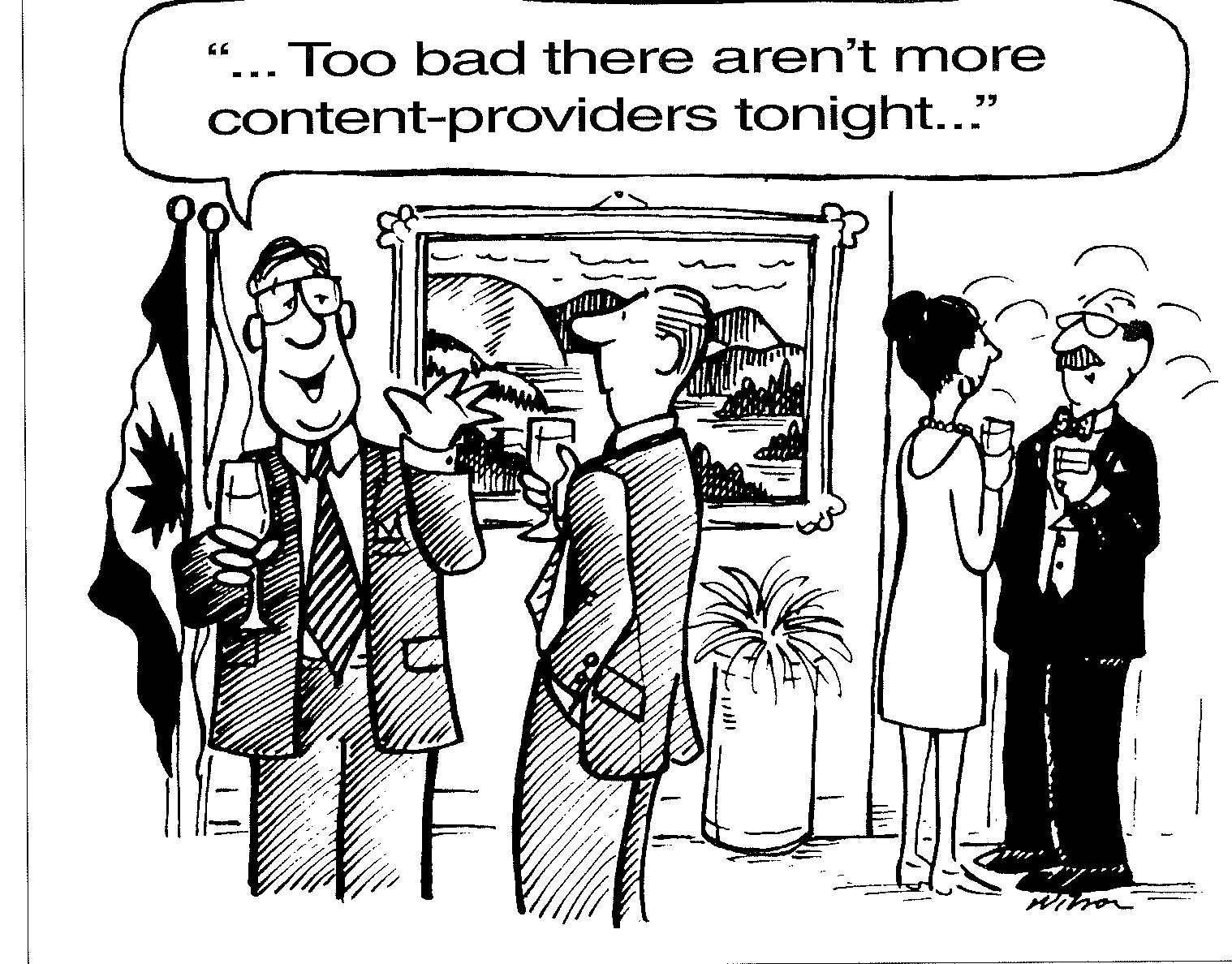
Through all this there is a move to focus on the substance, not the technology. Visualize the party with two cheery cynics exchanging over the chink of ice-cubes: “too bad there aren’t more content-providers tonight..
And we have those who lament the impact of technology on our society: new jobs (the information sherpa culture) are being created at the front of the food-chain as old jobs (less skilled, routine jobs) are being eliminated at the back end but, like the frog jumping up the well (one jump up/two sliding back), there are more being eliminated than being created. Drucker and Rifkin are saying this will result in the shorter work week (AT LAST!) in order to attempt to spread employment a little better and it will give rise to the social market of pervasive “volunteerism” — community service with salaries paid to the unemployed by tax deductible contributions of philanthropic motive from the few knowledge-based, remaining and successful corporations. I go back to that missive from 350 BC; I don’t agree with this; new work will replace old work. Pop-economist Nuala Beck tells us that there are more people working in Alberta today in the Financial Services sector than in the Oil and Gas sector, and more in British Columbia in the Telecommunications sector than in Forest Industries. Yes, we must continue to clean-up the messy rooms of our ecological house, but let technology flourish.
At Foreign Affairs, we will attain technological stability first; and we will keep stability (and effectiveness) in view at ALL times. We will benefit from the spirit of being a learning organization — an approach to managing that puts people and money on an even playing field. Technology that is client driven will enable employees to feel valued and in control. Their raw materials are their intellect; their assets, their innovation. Their ability to teach themselves makes their organization richer. Training as we know it, will change if we manage the change. Web-months breed career up-skilling or a continuing validation of an employee’s professional relevance. We will become more comfortable with the concept of Personal Development (the PD “me”) which is a dark horse that is growing quickly; recruitment will be driven by what training is being offered in an organization and it will have to be just-in-time. PD coaches will emerge to help one develop his/her personal strategic plan; training needs will become mentor sessions, and this could be anywhere in the world, on the web.
And the Desktop of the Future? Four concepts: unlimited bandwidth (read the day of ubiquitous fibre-optic connectivity; consequent unlimited video-conferencing (although other elements under the rubric dissemination of ideas include multimedia, animation and hypermedia); a universal data-base available on-line, all the time; and intelligent agents (or artificial intelligence AI). And this will have brought us full circle: that CM we used to rely on at missions as a kind of technological and communications assistant will take shape again, many years later, in the form of our own intelligent agent (or automated sherpa who will be out “crawling” the web for our own customized information needs). The precursor already exists in software like Windows 95 with the “wizard”,, a little character that shows, in a very friendly manner, novice users how to do complex things, easily. Fighter Pilots in the cockpit today have pop-up displays that allow them to “see” almost holographic images before their eyes. These voice-activated “angels” (or avatars) will become our assistants as they respond to oral requests to turn on the lights, list our phone messages, answer the easy ones, find out what Bloggins wants to discuss at tomorrow’s meeting (by consulting Bloggins’ intelligent agent) and telling us how to do what we’re not sure how to do.
But, as Kathryn McCallion (ADM, Latin America and the Caribbean) says, “one man and one machine does not equal 10 men” Our kids will still drink too much, not study enough nor show us the respect we deserve; and we will still be carping about how many more web-months before we can get off the merry-go-round. And by then I’ll be retired and I’ll probably say, “Frankly, my dear, I just don’t give a digit”.
Editor’s note: the cartoon that illustrates this article arrived at the editor’s desk via SIGNET. It took two ESOs, assisted by one secretary and one Co-op student approximately forty minutes to download and print. When the editor tried to save the cartoon on a new diskette, to be passed on to the printers, his desktop of the future informed him — after ten minutes of grinding its teeth — that the diskette was full. Clearly bout is already suffering from insufficient bandwidth.
View the original scanned pages →
Originally published in bout de papier, Vol. 13, No. 1 (1996) — Spring 1996 // Printemps 1996, pp. 23–25. Read the rest of this issue →



