
bout de papier, Vol. 13, No. 4 (1996) — Winter 1996 // Hiver 1996, pp. 25–28
In the first instalment of this article (bout de papier, Volume 13 No. 2), the author described a visit by Barbara McDougall, then Secretary of State for External Affairs, to the former Yugoslavia in May, 1993. This was the first and longest leg of an overseas trip taken by the Minister for the purpose of meeting Canadian peacekeepers in the field and doing whatever could be done to help resolve the disputes they were trying to stabilize. The trip also afforded an opportunity to assess whether the UN, injected with renewed energy by the end of the Cold War, was up to the challenge posed by two seemingly intractable conflicts. A week in Croatia and Bosnia had both high and low points. The morale of the soldiers was heartening; the difficulty of penetrating the masks assumed by the interlocutors for the contending parties discouraging. Then the scene shifted to East Africa and a set of circumstances quite different in their evolution but equally harrowing and complex.
Saturday, May 8, Nairobi
Putting off a visit to Nairobi National Park, I sit on the hotel terrace with Colonel Serge Labbé, Commander of the Canadian Joint Force Somalia. We are working on the speech McDougall will give tomorrow in Belet Huen, three hundred kilometres north of Mogadishu near the Ethiopian border. The Canadian Airborne Regiment Battle Group, numbering approximately 850, is based there, having arrived last December and January to participate in the Unified Task Force (UNITAF). UNITAF, as Colonel Labbé pointedly reminds me, has conducted an enforcement operation intended to provide a secure environment for the delivery of relief supplies throughout a “Humanitarian Relief Sector”. Now it is giving way to a revived peacekeeping force (UNOSOM II) and, as the government has repeatedly had to make clear to the UN, almost all the Canadians will be leaving
The Colonel ticks off the Force’s accomplishments: regenerating the police force in Belet Huen; efforts to establish a local judiciary; mine awareness training; use of our Hercules in a humanitarian airlift; two schools reopened and work going forward on a third and fourth. A lot of ingenuity has been shown in devising ways with NGOs to stretch pitifully small funds. “We went to the World Food Program (WFP) and CARE to get money for labourers. We went to UNICEF to get vocational training for teachers.” At the same time, there is a litany of horror stories about dealing with the Somalis, which is why the record of accomplishment cannot help but leave a residue of scepticism.
Entering Belet Huen
Sunday, May 9, Belet Huen and Mogadishu
The guard drawn up to greet the Minister at Belet Huen includes members of the local police force reestablished by the Canadians. We have been joined by reporters, including Martin Seemungal of the CBC, whom press secretary Scott Mullin has taken under his wing. The morning sun has not yet crystallized the desert and the freshness staves off thirst, at least for the moment.
Croatia and Bosnia confronted us with a scene of primitive morality where history hung heavily on the actors but, even in besieged Sarajevo, it took time for the sights and sounds to shape a coherent impression in our minds. By contrast, Belet Huen floods the senses all at once and prompts the immediate realization that we have stepped into a different century and social order. As our vehicles commence to rumble down the main road bisecting the town, blinding sun gives way to cool, dark oases where the tall trees have grown over the road and puddles still remain from the last torrent of rain. We encounter serried ranks of shacks of corrugated metal and flaking whitewash, punctuated by crumbling Italian arches, with parts of their pompous Latin inscriptions still visible. Despite being grotesque, they lend the convoy an imperial aura. What must be a large part of the town’s population crowds the side of the road to watch us pass.
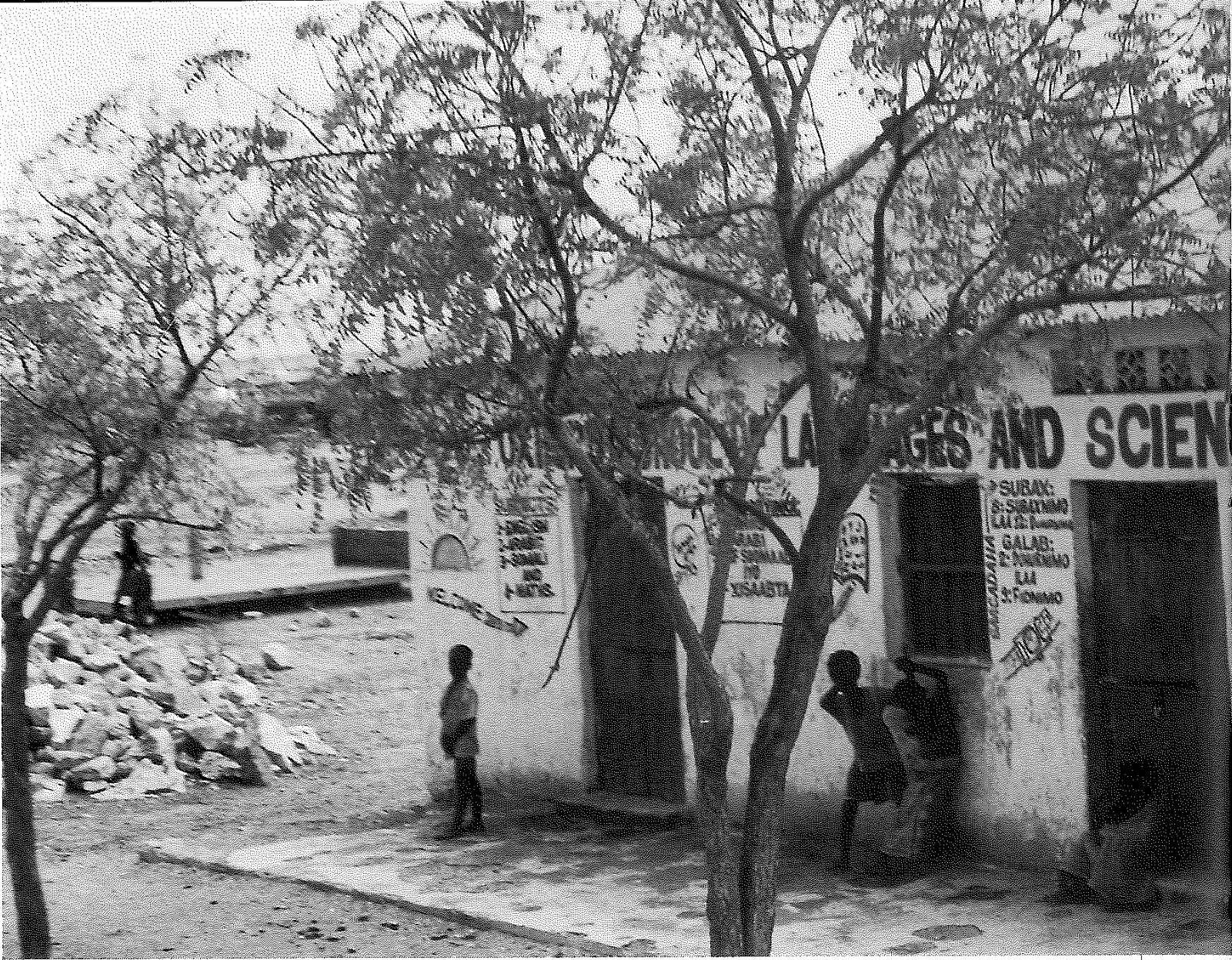
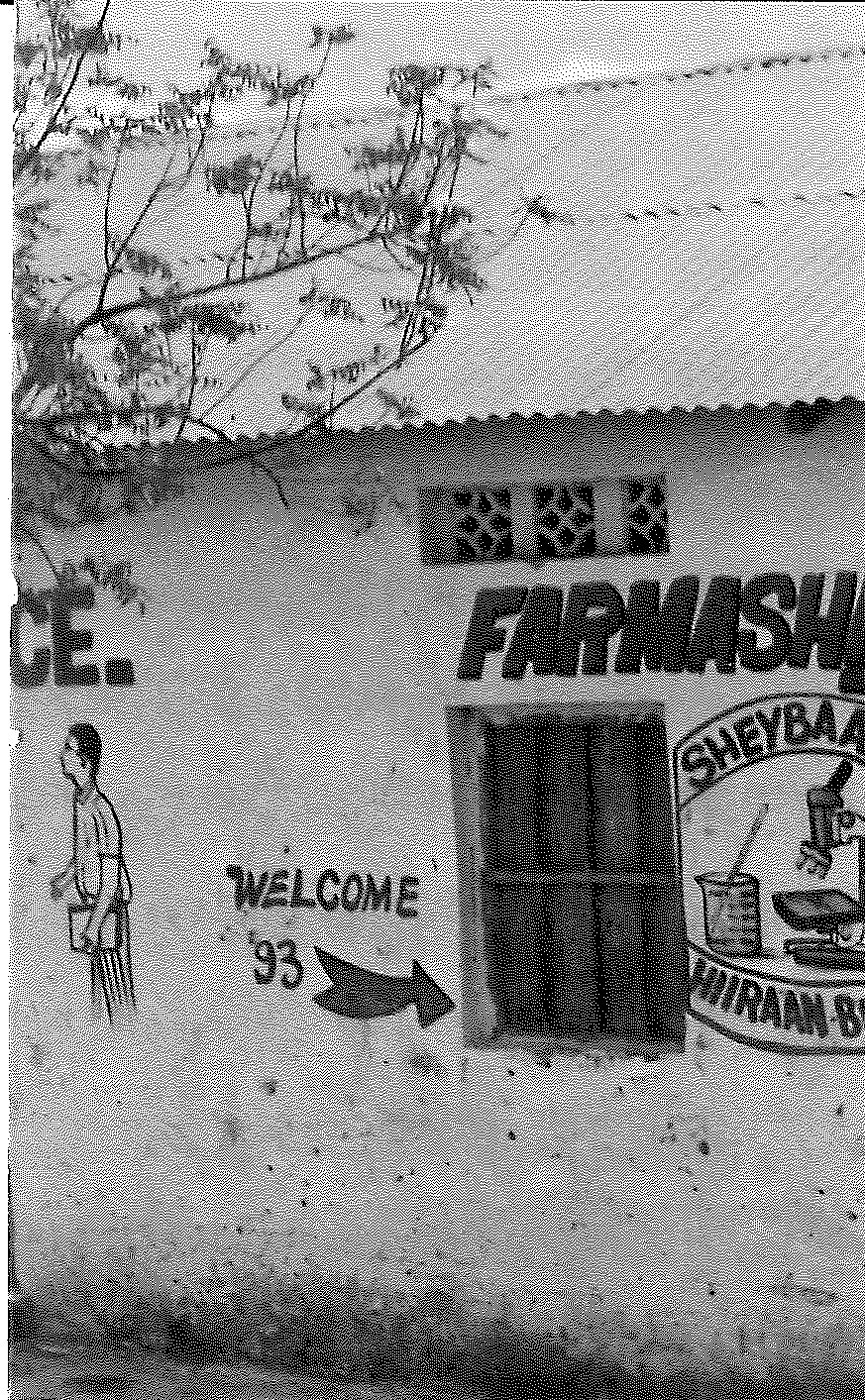
Where Belet Huen tries, ever so pathetically, to accommodate the West, it succeeds in reaching an apotheosis of gimcrackery. Mystifying are the precise functions of the “Vancouver School of Languages and Science” and of its close-by competitor, the “Oxford School of Languages and Science”, which, in turn, stands next to a “Farmashi” with a microscope painted on the wall. The ricketiness of some of the structures reminds me of a scene in one of the “Ma and Pa Kettle” comedy films of the fifties in which “Pa” lofts a small stone at a barn, which is enough to bring it crashing down in ruins.
There are, however, signs of a community that springs from indigenous roots and exhibits a kind of dignity that is more compelling when you encounter it among the dispossessed The thatched houses that have been built out of local materials are aesthetically pleasing. So too are the swaths of fabric in which many of the Somali women have clothed themselves. The mix of colours is so stunning that it would make a Paris couturier jealous! The women exhibit a striking self-possession as they pick their way through the mud puddles and try to avoid getting splashed by the tiny vehicles, the ramshackle buses and the trucks overloaded with people that are manoeuvring around our convoy.
Almost sub-consciously, these images create a glimmer of understanding that, despite the mendicancy of which we have heard a lot already and the whimsical shoddiness apparent all around, a native culture persists, an invisible wall separating Belet Huen from outsiders. There must be the remnants of a once proud society that clings to its own values and recoils from the imposition of alien mores. Does that explain the hostility that seems to be coming in waves from the streets? From our latter-day chariots we look down on a populace that is silent and unsmiling. At periodic stops soldiers quickly interpose themselves between our group and the spectators, fingers hovering over the triggers of their weapons. It would hardly be surprising to hear that the locals regard us as overbearing.
The teachers and medical workers who witnessed the good works the Canadians have done will, of course, think otherwise. Our convoy stops at two schools and a hospital so that McDougall can meet those involved and, in addition, get Canadian press coverage for the projects. From the road we can hear the schoolchildren chanting their lessons, memorization by rote being, out of necessity, the favoured teaching method. Inside the schools the children sit
26 bout de papier Vol. on dirt floors, the shutters double as blackboards and it is almost pitch black.
Leaving Belet Huen, the maple leaf flag shows up on the horizon, flying over the drab tents of the Canadian camp. There is a green scrub that stops the desert from becoming relentless. The parade is drawn up when we arrive, phalanxes of red berets ready for McDougall’s address. Out comes the speech, every word of which has been assiduously massaged. All for nought, however. On the spur of the moment, she decides to jettison it, delivering instead an off-the-cuff morale booster, telling the troops that they can go home with their heads held high.
Doubtless a morale booster is needed. Everyone’s mind is on the incidents in which Somalis appear to have met their deaths at the hands of Canadian soldiers. As the parade is dispersing, a young lieutenant takes a few of us aside and angrily demands to know why the press at home has come down so hard on the Somalia force “all because of a few bad apples”
Lunch is on! The only discernible preparations have been to boil a large pot of water under the shade of a canvas awning. Our hosts are relishing the chance to make their hot, dusty and somewhat disoriented visitors see what it’s really like out here. The menu offers a choice between five aluminum foil packages of field rations, one of which, ham omelette, is especially recommended or, more accurately, is particularly notorious. Twenty or thirty packages bob around in the water and soon I have lost track of mine but I snatch one out anyway and proceed to digest the glutinous mess inside.
Eating with soldiers, as I have already discovered, is a good way to take the pulse of a unit. A couple of corporals and a private join me but eat nothing themselves. Months ago, their appetites evaporated, they explain. They have hang dog expressions to go along with a rendition of the woes of service in Somalia: the blistering heat (to their evident disappointment, the temperature is a balmy 100 degrees Fahrenheit today); the venomous snakes and the enormous insects. Sure, they can get away on leave — the older ones head for Nairobi whereas the younger are lured to Mombassa — but that only helps a bit. The worst privation is the behaviour of the Somalis. Thievery is endemic. Just hours after its completion, the Bailey Bridge constructed for the benefit of the community was vandalized! Shovels are regularly snatched from APCs! Such flagrant ingratitude, they say, is hard to swallow.
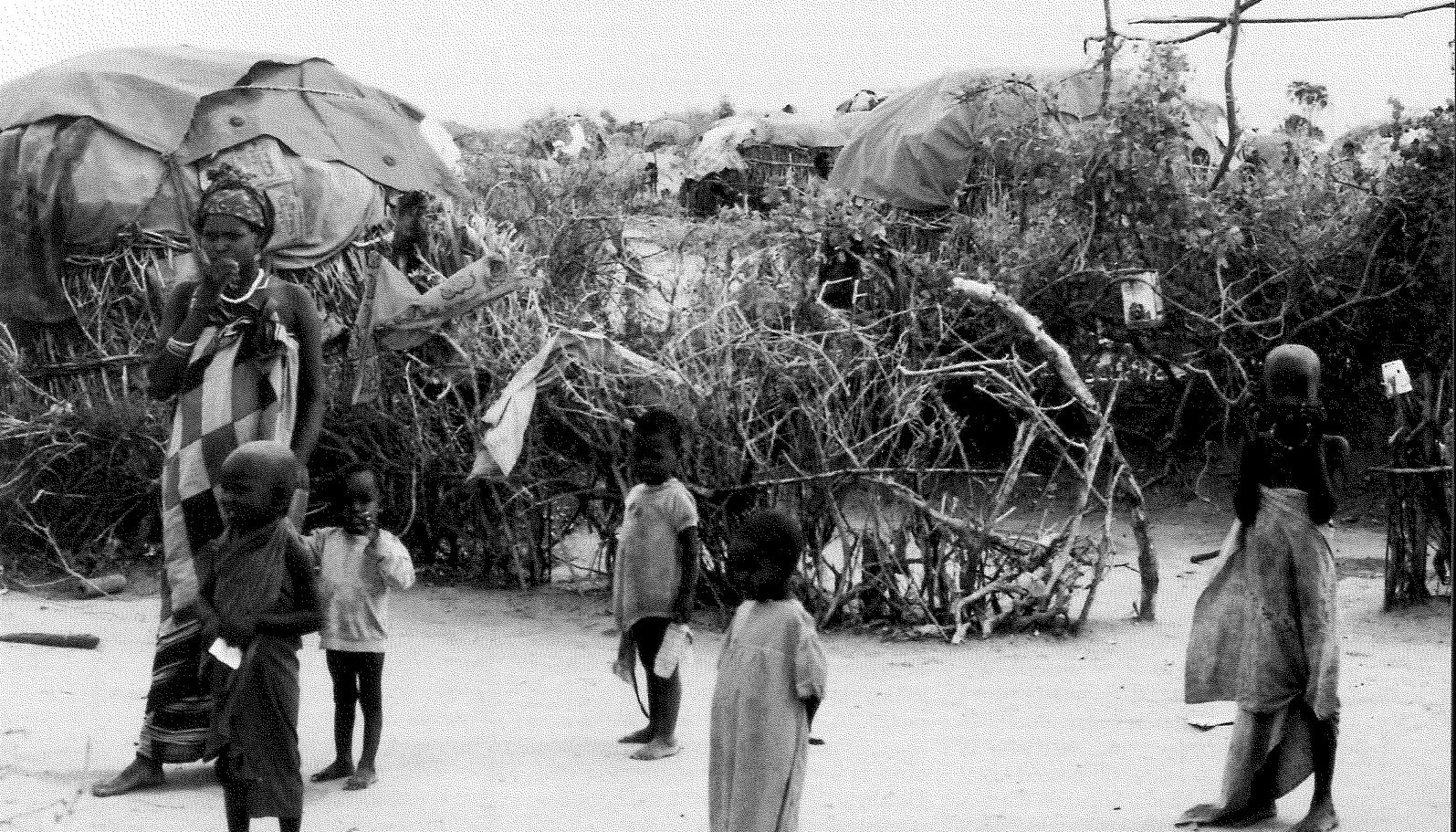
The return trip to the Belet Huen landing strip takes us by a camp for Ethiopian refugees. They live in makeshift houses of sticks and twigs, with colourful sheets stretched over the top to protect them from the rain. In a long low shed a CARE worker dishes out a gruel of diet supplement to masses of children. Some appear more interested in stirring than eating the contents of their bowls. The kids will no longer be nourished this way once they attain a certain weight. By and large the refugees are expected to fend for themselves.
Last stop is the cantonment where the clans’ armaments are stored. The sight of rusting guns, APCs and tanks, many of ancient vintage and non-western origins, parked at every possible angle and with parts missing or half off, is as macabre as the most gloomy graveyard. One thing is sure. The longer the weaponry stays here, the less useful it will be.
On board a Hercules for the flight to Mogadishu on the Indian Ocean, the final item on the Minister’s working agenda. Last week’s tour of Sarajevo demonstrated the ravages of war; by contrast, Mogadishu is a scene of rampant vandalism. Two single-engine jets that used to frame the entrance to the airport are drunkenly propped against their former pedestals, their cockpits looted. Our APCs make their customary racket navigating dirty streets of smashed homes on the way to the former finance ministry, which now houses the Special Representative of the UN Secretary General, the sole authority in this ill-starred land.
Admiral Jonathan Howe, the Special Representative and a former Deputy Assistant for National Security Affairs to US President George Bush, is both engaging and proconsular. He scoops up the Minister for a private talk, which renders Scott Mullin apoplectic at the thought of what might be going on outside our ken. Waiting to be admitted, we encounter a young political analyst, late of the US Government, who is trying his hand in the field before settling in at Washington’s Center for Strategic and International Studies. A whiff of the Bush Administration-in-exile.
No sooner has the meeting started than Admiral Howe says he would like to introduce us to his political deputy. The deputy turns out to be April Glaspie, the onetime US Ambassador to Iraq who, according to some (disputed) accounts, gave Saddam Hussein the impression that he could invade Kuwait with impunity. “April knows how to dialogue and strategize”, affirms Howe. She will commence the political reconciliation initiative next week.
Howe can’t say enough in praise of the Canadian troops and what they’ve done for humanitarian relief. He enters a plea for them to stay beyond their intended departure date of the end of July. As he knows she will, McDougall turns him down. Undaunted, the Special Representative presses on with his plans for Somalia’s economic recovery. Economic assistance must complement a process of reconciliation. “We’ve got to show that it pays off to have peace.” His language conveys a mixture of optimism and urgency.
The most pressing requirement is for infrastructure. “We’re moving away from food aid. We want crops to be the source of food, but we need police forces, health and education facilities. We have teachers all over the country and the only ones being paid are the fundamentalists.” He is battling the UN bureaucracy for flexibility in budgets and trying out ideas for getting governments to come up with additional funds. What if cities of the world were to sponsor Somalia’s municipal fire departments? Would Canada adopt Belet Huen and help build its infrastructure? McDougall says she will look at the idea.
When the talk turns to security we get a presentiment of an aggressive approach. UNOSOM II is by no means a standard UN peacekeeping mission. “We’re Chapter Seven people. (Chapter Seven of the UN Charter authorizes the use of force). I won’t
28 bout de papier Vol. tolerate attacks on our people, on NGOs and expatriates. We’re taking on extortionists, bandits, criminals” and, regarding murders already committed, “We’re going to get the killers.”
Admiral Howe professes confidence that the UN can leave Somalia in a position to sustain itself. Moreover, Cambodia, where the UN has just supervised elections, is in rocky shape. Yugoslavia is a mess. The UN badly needs a success.
Tuesday, May 11, Casablanca to St. John’s
Yesterday evening in Casablanca we started to unwind. The travelling party arranged itself on cushions around platters of lamb in a small blue-tiled restaurant that managed a hint of snake charming and intrigue. This morning, back out to the airport and on our way to the next touchdown in Newfoundland On the plane McDougall is reading John le Carré’s A Small Town in Germany. One of le Carré’s characters, speaking about diplomatic life in fifties Bonn, makes a remark that has stuck in my mind: “They’re about the only ones left who still believe in it all, the Canadians. They’re like the British in India.”
No denying that our diplomats and soldiers are, like the British in India, relishing engagement with large issues and the chance to tap reserves of mental and physical energy they hardly knew they had. They are buoyed by any success and it is hard not to get caught up in their bouts of enthusiasm. Throughout this trip we have been constantly asking ourselves whether it is the successes or the setbacks that show where events are leading. Though rarely would we have admitted as much, we have been dogged by the fear that deep-seated enmities and ambitions might ratchet up the violence and mortally endanger belief that the international community can keep its house in order. It is the very fact that the portents are conflicting, that sometimes it looks possible that what we’re doing now may work, that goes far to explain why governments cannot be more assertive, either in restraining internal conflicts or in pulling out of them altogether. Will that be understood when judgements about western indecisiveness begin to ring out confidently?
Not much chance for reflection on this last leg of the journey, though. On board the Challenger decorum has crumbled altogether, due to McDougall’s choice of taped music that forces the hilarity to a level of half-feigned hysteria. Somewhat later, a soporific blanket envelops the cabin as we soar back into a blander world.
View the original scanned pages →
Originally published in bout de papier, Vol. 13, No. 4 (1996) — Winter 1996 // Hiver 1996, pp. 25–28. Read the rest of this issue →



