
bout de papier, Vol. 14, No. 1 (1997) — Spring 1997 // Printemps 1997, pp. 47–48
“Ah, might I have a word with you, Liebnitz?” came the hesitant voice of Dryan Tweedie, the Centre’s archivist. He stood in the doorway of the office where ace logician LDC Liebnitz was staring morosely at a table on which were placed two dried herring, a can of pipe tobacco (“Old Warthog” by the smell), a live mouse, the Categorical Imperative reproduced in bitter chocolate and what appeared to be a ruby-encrusted kumquat.
“I’d be delighted,” replied Liebnitz. “So far, I can’t even figure out whether this is Jimmy the Turk’s latest report or my new diet from that hack, Dr Quackenbush. Distraction would be most welcome. And I’ve been meaning to talk to you anyway. Are you all right these days? You seem pale and wan — even for a librarian — and you are increasingly prone to staring at sunsets and flowers with a goofy smile on your face, consuming Rod McKuen’s poetry as if it actually meant something, and listening to Mozart’s soppier sonatas. Mozart, by God!! I’m beginning to worry about you, Tweedie.”
The archivist blushed and stammered something inaudible, then sat down on the corner of the table, buried his head in his hands and finally looked up at Liebnitz with desperation on his face. “Liebnitz, I think I’m in love,” he said. “Well, that would certainly explain the symptoms. Who’s the, ah, fortunate person?” asked his friend, taking a healthy slug of tea from a mug on his desk.
“Mabel Stanley,” Tweedie said. “What?” cried Liebnitz, spluttering tea in all directions. “All right, Tweedie, she’s young, she’s beautiful, she’s smart — so far so good — but she’s also the lead singer for a grunge rock group named Edible Granite, the only band to be declared a health hazard by the United Nations, a musical disaster area so egregious that it makes most of its money by accepting payments from major cities to perform in other time zones (and if possible on other continents).”
“Yes,” replied the archivist in the same dreamy voice, “and she has invited me to come to her next concert.” He suddenly sat up straighter and frowned.. “Which is why I am here, Liebnitz. I have written to tell her of my love, but she has chosen to test me. Instead of telling me where the concert is being held, she has said only that it is somewhere in the Central Asian Republics, and sent me this puzzle by way of elaboration. I am no good at these things. You must help me,” He held out two pieces of paper smelling faintly of mint and chili pepper.
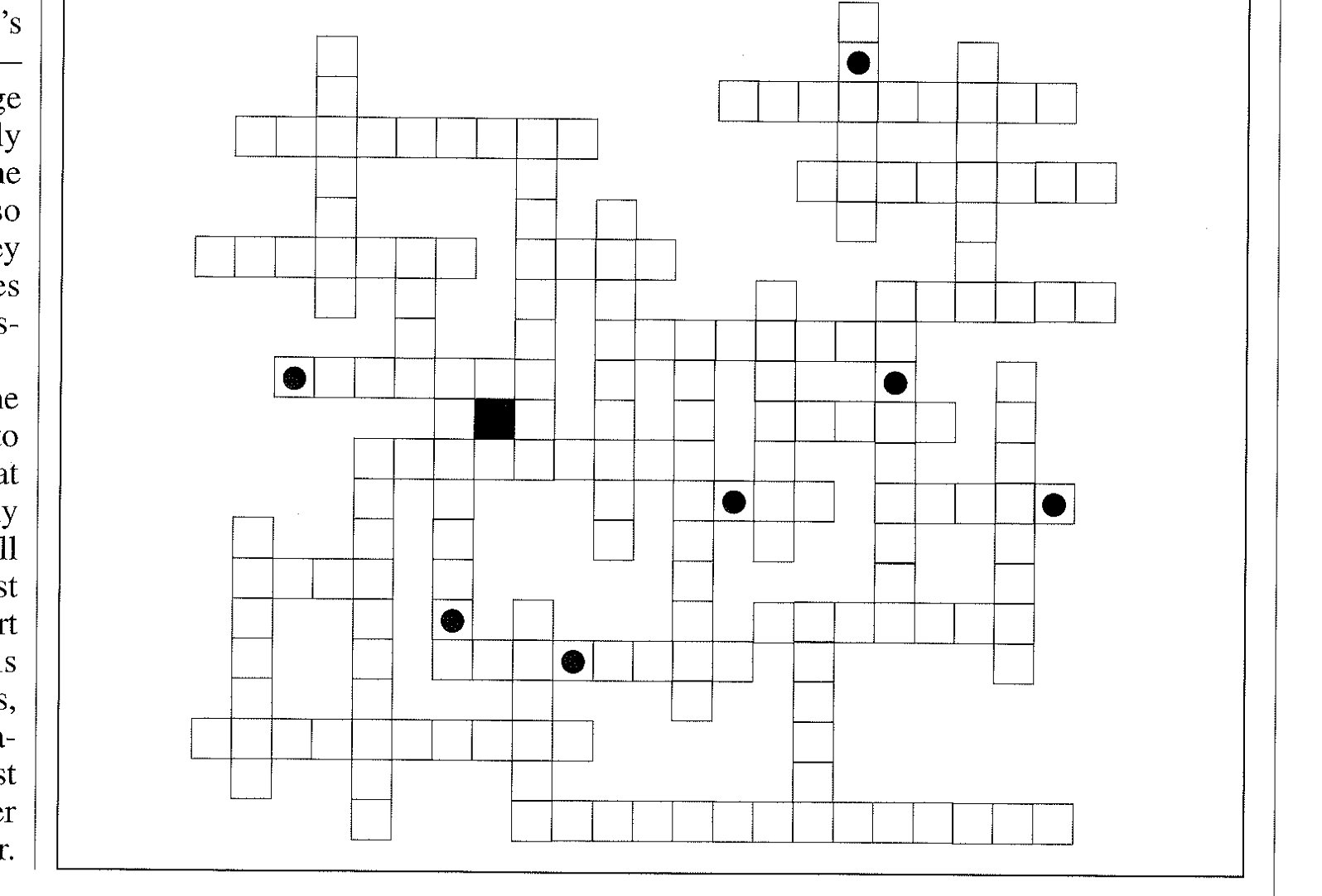
One was a puzzle skeleton, empty except for seven small marks; the other had the following message:
Reading from left to right, the marked squares in the skeleton reveal the seven letters of the town where our next gig is happening — at least they will do so when the skeleton is filled in. The words for the skeleton are defined by the following thirty-two DEFINITIONS or clues, linked directly or indirectly to Central Asia. Sometimes the answer to a clue is two words, but they are written as one. It is not a crossword: you aren’t told where to put each word — but it is possible to deduce. Three hints. First, the number after each clue is the number of letters in the word. Secondly, if you work out the clues correctly, the words come out in alphabetical order. Finally, the same thirty-two words are also given as ANAGRAMs, organized by number of letters. Hope to see you at the concert!
DEFINITIONS
(1) Macedonian conqueror: nine letters. (2) Language group to which Turkish and Mongolian belong (close to the name of a major mountain range on the Mongolia/ Siberia border): six. (3) The longest river in Central Asia, known in antiquity as the Oxus, flowing northwest from the Afghan border: eight. (4) The large inland sea on the border of two Central Asian states: four. (5) City of the Thousand and One Nights and a major stop on the Silk Road, sacked by the Mongols in 1258, now a MidEast capital: seven. (6) Long narrow lake north of Alma Ata: eight. (7) Russian composer of “On the Steppes of Central Asia”: seven. (8) The largest inland sea, into which the Volga empties: seven. (9) Old European name for China: six. (10) What it isn’t, now it’s Istanbul, one end of the Silk Road: fourteen. (11) Another Silk Road centre and current MidEast capital, said to be the oldest major city in the world, famed for swords: eight. (12) Oasis town and ancient caravan centre in China’s western Xinjiang province: seven. (13) Largest of the Central Asian Republics: ten. (14) Turkish, Tartar or Mongol supreme leader: four. (15) Islamic religious college (or Indian city plus “a”): seven. (16) Medieval Venetian merchant-explorer and Asian travelogue writer: nine. (17) Muslim place of worship: six. (18) A Persian Christian sect with many converts in Mongolia before the arrival of Islam, also in China: nine. (19) The east, or to find one’s direction: six. (20) Turkish governor, military commander or other high official: five. (21) “Golden” fruit for which the oases of Central Asia were famous: five. (22) Ancient Central Asian city of high culture and luxury, destroyed by Genghis Khan in 1220 and restored by the lame conqueror as his capital in the 14th century: nine. (23) Persian monarch: four. (24) Ancient trading route from China through Central Asia to the Mediterranean: eight. (25) Sandy desert in western China filling most of the Tarim Basin, the name means “They go in but they don’t come out”: ten. (26) The lame conqueror of Central Asia and beyond, famous for piles of skulls: nine. (27) Old European name for Central Asia (or fish sauce plus “y”): seven. (28) The largest city in the then Soviet Central Asia: eight. (29) The old collective name for Central Asia and adjacent areas of China (or one of the new Central Asian Republics minus “m”, “n” and “i”): nine. (30) The majority Turkic people of Xinjiang province, with their cousins to the west: seven. (31) One of the new Central Asian republics: ten. (32) Modern name of the old Chinese city of Chang’an, at one end of the Silk Road: four.
ANAGRAMS:
Four letters: LARA, NAXI, ANKH, HASH
Five letters: CHEAP, ASAPH
Six letters: QUOMES, CALITA, TORINE,
AYACHT
Seven letters: RAMADAS, GADDBAH,
DROOBNI, TRATYRA, PSICANA,
SHIGURU, GRAKHSA
Eight letters: KILSODAR, YUMARADA,
SHABLAKH, MADCAUSS, TEN-
THASK
Nine letters: RUNKSTATE, ALTERMANE,
RENOSAINT, LAXEDRANE, MASA-
DRANK, POORCALMO
Ten letters: SHANKZAKAT, TANKA-
MALKA, KUNZIBEAST
Fourteen letters: PLASTICNONTONE
“Ah, playing hard to get, is she?” asked Liebnitz. “Well, she must be interested in you, or she wouldn’t go to all this trouble. So let’s work it out…. “ So saying, with the help of the Oxford Concise, the Britannica and a good atlas from his bookshelves, the ace logician polished off the puzzle in short order. “Well, some of her entries are a bit obscure, but she’s given you a break — the skeleton letters that form the name of the concert site are found among the easier words. So, Tweedie, no time to lose — let’s get our plane tickets booked.”
“Our tickets?” stammered the archivist, rising from his seat on the table. “But I thought you hated her music.” Replied his friend, “And so I do. But in your state, I can hardly let you traipse off to foreign parts without a chaperon. And do take time to change your clothes. For the past half hour, you’ve been sitting on my herring.”
So it was, some days later, that the two friends found themselves front row centre at another unforgettable (God knows people have tried) Edible Granite concert. Tweedie listened raptly as Mabel belted out the group’s latest hit, “Deconstruction Fungus (Don’t You Eat My Shoes)” from the Toxic Derrida album. Liebnitz hoped that the archivist’s vacant expression was just the result of being brained by one of the iron butterflies the band was scattering to the audience (which had been tied into its seats by the promoters). The logician himself was distracted by the persistent mutterings of the man on his right, a freelance Tuvan prestidigitator who had been booked to open the show but had been pulled at the last minute. “No chance,” he said to Liebnitz. “I can do all the usual vanishes — coins, cards, rabbits, glasses of wine, even the occasional elephant — but these people can make an entire hall of people disappear.”
Can you duplicate Liebnitz’s feat — solving the puzzle, not surviving the concert — by naming the city in which Mabel was performing? (Providing the completed skeleton would be a bonus, but is not necessary for the solution.) bout de papier will decide the winner by drawing from a box containing all correct entries received by June 1st 1997. The winner will receive a CD of Tuvan throat singing (the national music of Aalto’s homeland) and a book on modern Asia.
View the original scanned pages →
Originally published in bout de papier, Vol. 14, No. 1 (1997) — Spring 1997 // Printemps 1997, pp. 47–48. Read the rest of this issue →



