
bout de papier, Vol. 14, No. 1 (1997) — Spring 1997 // Printemps 1997, pp. 33–36
From 1979 to 1983, I served as Canadian Ambassador to Romania. In April 1995, my wife Glenna and I went back. I wanted to do some research on Ceausescu, and I had asked my wonderful host, ambassador Murray Fairweather, to arrange a programme for us.
Revisiting Ceausescu
I had been thinking for some time about doing a book on Romania. The New Romania seemed out of the question: I did not know it well enough. I would be a total amateur at Romanian history before Ceausescu. I didn’t like the idea of a travel book, although we had explored the country thoroughly. So I decided to do a book on Ceausescu, partly because I knew him a little, partly because I thought he had been dumped too unceremoniously into the dust-bin of history. I had and have no intention of making excuses for his awful record. But he did run the country for 25 years, he did start many things — most of which the new government is pursuing – and he needs, in my view, to be looked at a bit more thoroughly than he has been since his death. There was a tendency, in Canada at least, to say, well, they’ve shot him and his wife. Good work. Let’s forget them both and get on with real business. My idea was to examine the record a little more closely, especially since Canada was so involved in it through the CANDU nuclear project. So, before setting off for Romania, I asked my friend Fairweather, and his senior Romanian staff members Costea and Filipoiu, whether they thought there was the slightest chance of interviewing former ministers of the Ceausescu regime, other former senior people, and some artists and intellectuals, to find out what they thought of the old conducator. They made some telephone calls, called me back and said that there was a chance. No promises, but a chance. So Glenna and I took the plane for Bucharest.
The upshot was something of a miracle. On my table when I arrived was a program: 9 am Stefan Andrei (former foreign minister); I am Cornel Mihulecea (former minister of nuclear energy); Cornel Burtica (former minister of foreign trade); Ilie Verdet (former prime minister); Dan Grigore, the great Romanian pianist. And so on through five days of non-stop meetings. Only one of the 20 or so on the list did not turn up, and one whom I had hoped to see, Georghe Oprea, also a former prime minister and a bit of friend as far as one had friends in Romania in those days, could not be found. In addition to my private interviews with them, they all came to a splendid reception given by the ambassador, and quite literally poured out their hearts. Maria Groza, former deputy minister of foreign affairs responsible for Canada and the United States, telephoned from her family home at Deva, in Transylvania, and besought us to call her back. We did. She is the daughter of the first communist prime minister of Romania, Petru Groza, installed by Stalin soon after the war. She went to Moscow with her father in 1946, saw Stalin, and maintains to this day that without her father’s intervention Romania would have been much worse off.
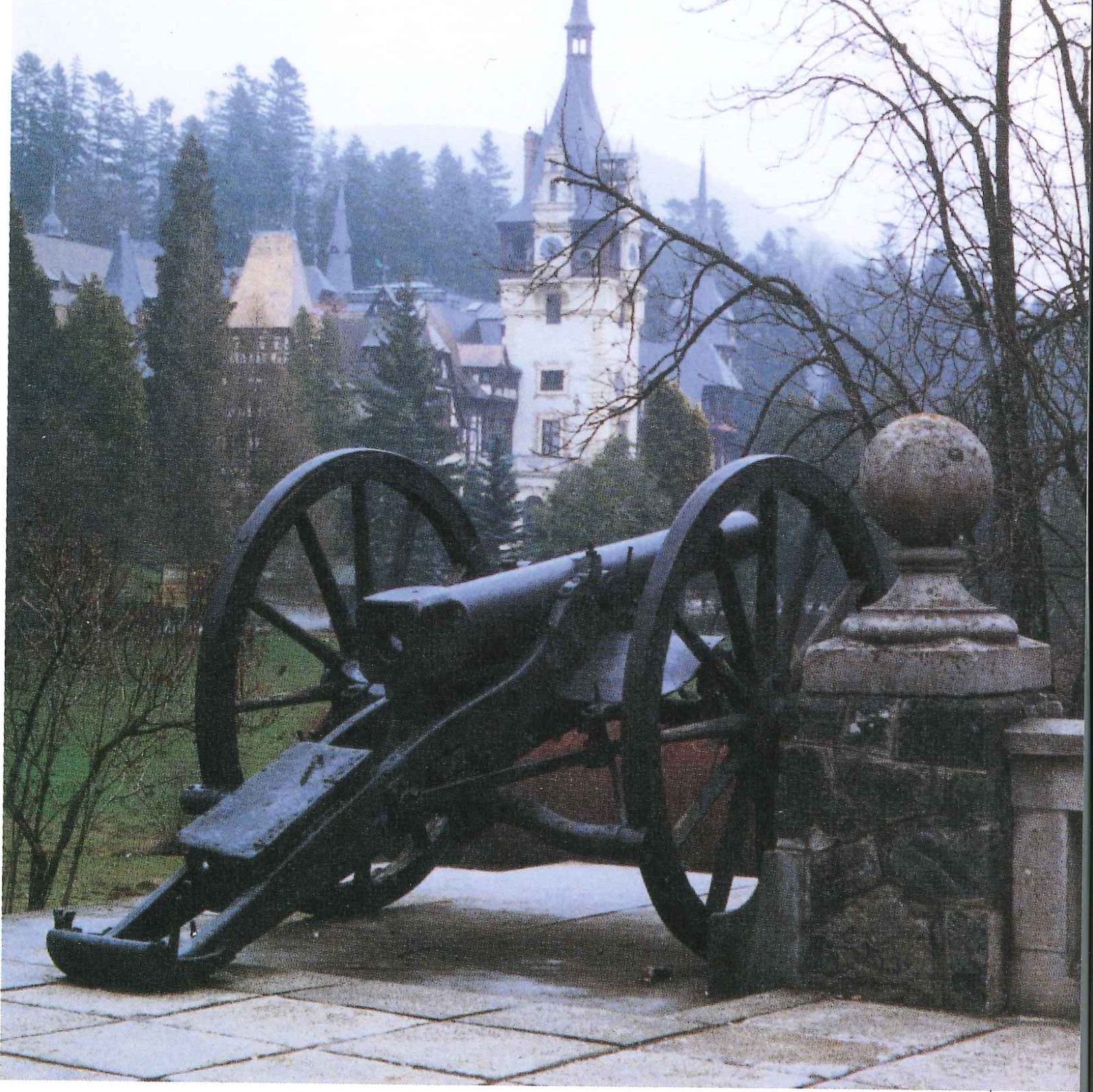
Some of these people had done time in prison after the execution of Ceausescu. Stefan Andrei had done 29 months, he told me. The first six, he said, were the worst. He was phlegmatic. “On fusille le tsar; on met le gouvernement en prison. C’est normal.”
The ambassador and his very experienced staff had been apprehensive that these formerly powerful men and women (and some still powerful) would not want to come to the embassy to meet me. Even in the new Romania, foreign embassies were terra incognita, and maybe not entirely safe. His staff conceived the idea of taking a hotel room where I could receive them without the opprobrium of an embassy visit. All this turned out to be wrong. They were delighted to come to the ambassador’s house, to be given coffee, cake, or a drink, to walk in and out like free men and women. They were even happy to be recorded. For the Romanian speakers I used an interpreter to make sure I got things right. Some of them, like Stefan Andrei, were very poor and arrived on foot, looking down-at-heel. (Andrei told me that his and his wife’s joint income — she a known actress in Bucharest — came to $85 a month.) Others, who had not been in prison, were better off. One or two, like Burtica, were running highly successful businesses. Verdet was running a political party. For me and my wife, remembering the Bucharest of 1980, the entire effect was staggering, humbling, amazing.
The tone of my private conversations with them was set not so much by the former grand persons, but by Lydia, the ambassador’s butler, originally the upstairs maid whom we had promoted in 1980. As we arrived and embraced, she rejoiced: “We are free, and it’s so nice.” And that was the essence of my five days of conversation with the former tyrants of Ceausescu’s regime.
They did not all say the same things, but there were several common ideas.
All except the artistic people agreed that the Ceausescu record needed to be revisited, both for what was bad in it and what was good. As the Romanian ambassador in Ottawa pointed out, Ceausescu was indeed a very evil man, but it can’t all be bad, because we are continuing today with practically everything he started in the economy — except of course the terrifying “systematization” program.
The people from cultural, artistic life, were less sure. Dan Grigore, a marvellous pianist, had suffered severely under Ceausescu. I suggested a parallel with Shostakovich under Stalin, but on reflection I think Grigore’s lot was worse. Stalin at least took an interest in what Shostakovich was doing, even if he tried to order him how and what to compose, and threatened him with prison or death if he did not conform. Grigore, who refused consistently to give any sign of public support for Ceausescu, was denied permission to travel and perform abroad – professional death for a pianist of his stature — and was hounded and persecuted at home, deprived of even the basic decencies of life. I recall his coming to our house in the early 80s, fearfully and surreptitiously, to ask us to help obtain formula for his baby. No nomenclatura privileges for him. The two other men from the cultural world whom I interviewed, a painter and an archaeologist, had much the same view: Ceausescu is dead, and the sooner we forget about him, the better.
The political figures, those who had known him personally (which of course the artists had not), had more to say. They all agreed that at the end of his life he was quite mad – paranoid, intolerant, inaccessible, totally closed to advice. He sent the country into disaster by insisting on repaying every dollar of the foreign debt (there was no domestic one), at the expense of the wretched man and woman in the street. He was obsessed with debt, as he was with his own health. But it had not always been so bad. In his early years as president and head of the party he had made good decisions. He had been prepared to listen — although only in private. He had always been intolerant of advice in meetings. In those years he would put up with being told he was wrong so long as nobody was listening to the criticism. The good things: the decision not to join the Warsaw Pact intervention in Czechoslovakia in 1968, the decision to maintain relations with Israel, Albania and China, when Moscow had ordered all its clients to break them, the decision to buy a Canadian nuclear system when Moscow was forcing its Chernobyl-type reactors down the throats of all its clients – these were his decisions, and they were taken on the basis of advice to which he paid attention. A number of my interlocutors described these decisions as courageous. Tough, dogged, ruthless, cold, distant, impersonal – these were the terms I heard from the people who knew him best.
On one other matter they all agreed. He had no friend in the world except his wife Elena, and she was far more evil than he. (His friendlessness, Burtica told me, became total after the defection to the West of the secret police chief Pacepa, the one subordinate he had trusted absolutely. After that he trusted only Elena.) One woman I talked to pointed out that when the whole world was watching the two of them being condemned to death and shot, on television, he was trying to protect her, physically shield her. But she was, according to them all, unmitigated evil. She had an area of power in which she was absolute dictator, and she used her power ruthlessly and with a total lack of humanity. Romania’s demographic policies, resulting in the appalling orphanage scenes which we all saw on television in 1990, were entirely her doing. He knew nothing about them and did not want to. So said his colleagues and collaborators. Is there an element of self-justification in this? Probably.
I saw nothing of Bucharest but Cotroceni and a quick whirl-about in the car. My whole time was spent in rather exhausting interviews, in the ambassador’s “petit salon”. Most of my conversations I captured on tape, with the willing, indeed enthusiastic agreement of my interlocutors. There were language complexities. With Stefan Andrei everything was in French, as when he was minister and I ambassador, and that was easy. One or two others were competent in English. But most of my friends (if I may so speak of them, and some were real friends) bellowed at me in Romanian through an interpreter, and quite fried my brains, as we used to say when I was young.
The point I am making is that I cannot report much about Bucharest — not even about the Amzei market, where Glenna and I were married in 1980. I failed to see it. Glenna however did. I hand the computer to her, and she will tell you all.
Revisiting Bucharest
(Glenna continues) Two things Peter forgets he saw in Bucharest: the patriarch’s church on Sunday morning with singing as good as ever; and a restaurant called the Golden Apple where the ambassador, Elena Filipoiu, Peter and I were the only guests, serenaded by the wonderful Radu Simion and his three musicians, as in days of old when they came to the embassy for diplomatic dancing. We danced again. It seemed like old times, but the populace obviously preferred the “peep show” which started later in the evening. In New Romania, folk art is out and jeans and jazz are in.
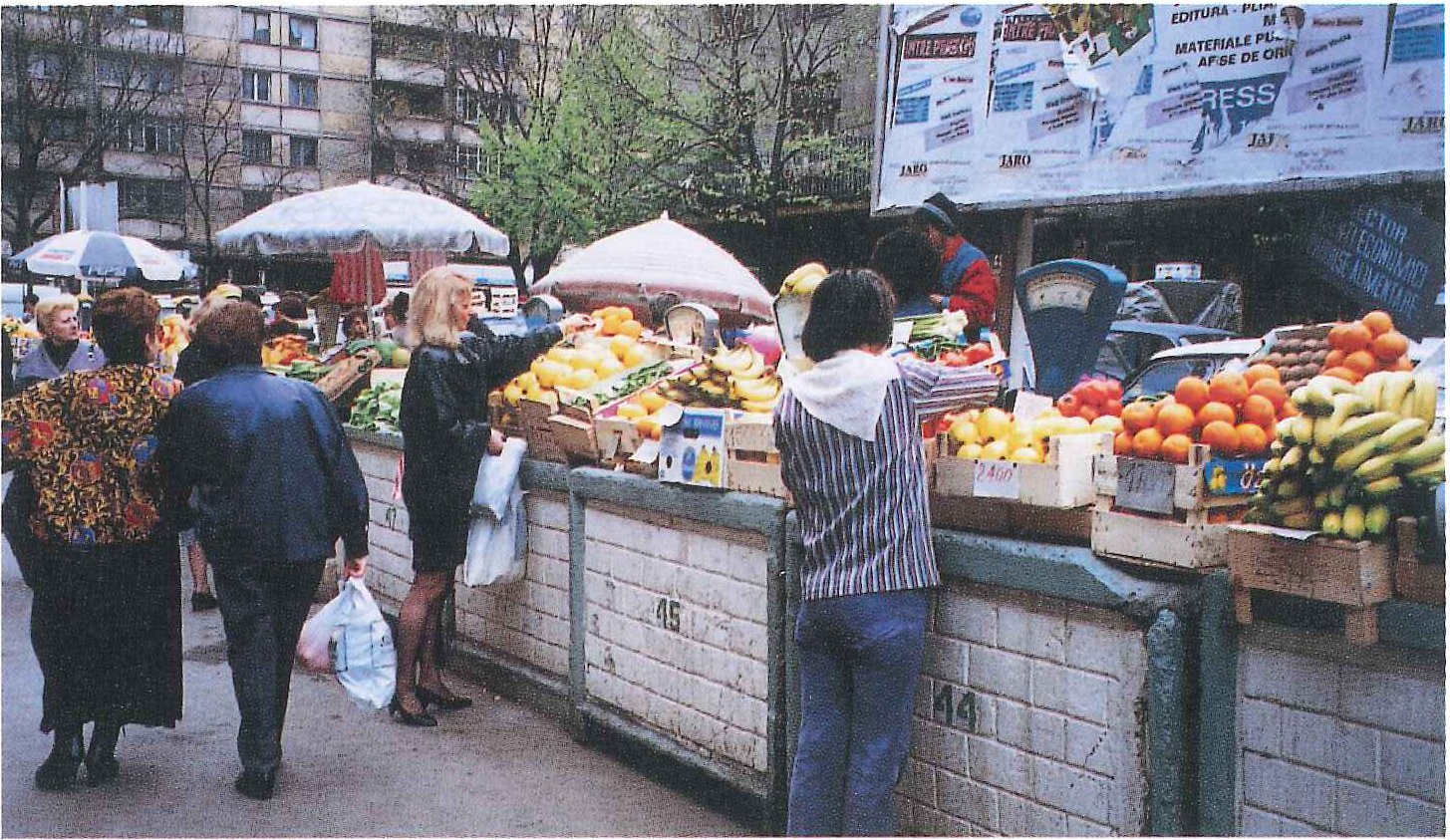
What else is in and new? Bananas, grapefruit, oranges, kiwi, avocados, all at the market, but, being imported, much more expensive than local radishes, green onions and nettles (for soup to clear the blood in spring). No lineups for anything —perhaps because the cost is high for the average Romanian — except for a short wait to get into the Canadian Embassy for a visa. Other outward and visible differences: advertisements for every western product you can think of; a metro system that covers the city but was on strike three days of our week there; stands selling necessaries and un-necessaries; gypsies with flowers: not local daffodils, thank you, but imported roses, orchids. Kiosks everywhere to change valuta for lei, but most didn’t want Canadian bucks. Western cars so common (on sale in show rooms on Magheru) that no-one notices our official Mercedes. But on the road before you get to Otopeni airport there are still horse-drawn wagons with loads of corn stalks and people. The city is as dusty and polluted as ever, but the plots of land still fruitful, literally: plums, cherries, apples, peaches in full blossom. We were told that people have reclaimed and rebuilt on their village plots which were razed in Ceausescu’s crazy “systematization” campaign.
I had a glimpse of the care being given children with AIDS when I attended a celebration of the 5th anniversary of the programme at the Colontia Hospital with Nancy Fraser, whose husband was the political officer at the embassy. About 40 cheerful and blossoming kids sang and danced for a small audience, thanks to the efforts of two music teachers who had been visiting regularly. Interspersed in the audience, however, were a number of very weak little people, and even more tragically, a number of parents who clearly knew that their children would not be among the survivors. Nuns from Ireland and Scotland were the nurses who had been trying to train Romanians in nursing tasks. Nursing is not a profession in Romania, which helps account for the fact that new cases of AIDS continue to appear. Injections of blood plasma are still considered a good thing for weak children – a quaint substitute for food and medicine – and although they no longer re-use needles, they think it is all right to re-use the syringe. Hence one dose of infected blood goes a long way.
Back to the Embassy. The added staff mean that the embassy buildings are very crowded, but the Moosehead Club is still opening its doors on Friday nights, to the delight of the international community. The Club is not as necessary as it was in our day, because there are many new restaurants, bars and clubs, not to mention a Pizza Hut and, of course, a soon-to-be McDonald’s. One could even stay home and watch TV with four or five channels, including CNN.
For the most part the programming is subtitled English- and French-language films, which should help the many Romanians eager to practise their language skills. The foreign language classes which were being cut in the schools in the 80s have been reinstated. Or one can read one of the twelve or so newspapers which were being published. The ambassador suggested that a little censorship might be a good idea; some of these papers would qualify as hate literature in Canada.
What is certainly the greatest change since we lived here is that people talk to foreigners without fear. Whereas things were bad and getting worse while we were there, in 1995 things are better and getting better. People feel they are still “paying for” the new liberty, but they are basically optimistic. They wonder why Romania is being ignored by the West, why, despite all their efforts, tourism is not bringing in people and bucks as hoped for. Hotel conditions may have improved — we had good meals at modest costs in Sinaia – but there was no water in the morning because of a frozen pipe. Plus ça change. Street sweeping and park maintenance seem still to be a job for troops of gypsy women. There are beggars on every corner. Coming out of the airport is like running a gauntlet, with men snatching at your suitcases to carry them for you to “my” taxi. Most intersections have squads of young car window washers, who insist on cleaning your windshield, like it or not. Capitalist enterprise taking over. “Before, everyone was equally a victim; now some are more victims than others.” And different people have privilege. Someone must afford those pricey items that the pensioners cannot.
Is there hope?
(Peter returns to the keyboard) Romania remains, despite the wounds and scars inflicted by war and, even more, by the dictator himself, one of Europe’s loveliest countries. There is nothing anywhere to compare with a dreaming Transylvanian mountain village: thatched roofs, blue-painted eaves, abundant gardens, flocks in pasture, stooks of grain in the shape of humans, a warm and cheerful welcome for the foreigner, even though it was forbidden.
The conducator is dead and gone — gone with the permission of Gorbachev and the Russians, who kept him and his predecessor there through 45 dreadful years, the last ten the worst. Although there is profound confusion in the economy and in political life, there is some reason to hope. As in Russia, much modern talent has emerged, a great deal of it from the old communist apparatus. Ceausescu’s former chef de cabinet is, for example, running a highly successful large-scale computer business, in collaboration with a French firm. He is young, and full of ideas about Romania’s future, and about the future of the region.
Solzhenitsyn has said about Russia, “We have gone downhill for 75 years. How long will it take us to get back where we started?” The same could be said of Romania. No other east-European country, not even the former GDR, lived through anything quite so dreadful. In the other eastern countries the grip of tyranny was already loosening some years before the explosion of 1989-90. Not so in Romania, where it was getting worse right to the bitter end. Recovery will be slow, and a hard path, uphill all the way. But the Romanians, most of them, are optimistic. We too might permit ourselves a measure of hope.
View the original scanned pages →
Originally published in bout de papier, Vol. 14, No. 1 (1997) — Spring 1997 // Printemps 1997, pp. 33–36. Read the rest of this issue →



