
bout de papier, Vol. 14, No. 3 (1997) — Fall 1997 // Automne 1997, pp. 29–31
by Roger Lucy
In July 968 the Holy Roman Emperor, Otto I sent his emissary, Liudprand, Bishop of Cremona, to the East Roman (“Byzantine”) Emperor in Constantinople, to arrange an imperial marriage for his son and to define the two empires’ respective spheres of influence. Liudprand’s mission was not a success, but his report so brilliantly trashed the Byzantines’ reputation that many of today’s popular impressions of their duplicity are based, as much as on anything else, on Liudprand’s skilful spin-doctoring.
Late tenth century Europe was dominated by two expansionist rulers, one a unilingual Greek, the other a unilingual German. Both claimed to be “Emperor of the Romans”. Basileios Nikephorous Phocas based his claim on an unbroken continuity with the old Roman Empire of Augustus and Constantine. Kaiser Otto’s claim stemmed from his coronation by the Pope in 962 after liberating Rome from a local dynasty of robber barons. Otto, however, was not just content with Rome, he wanted all of Italy and the south of the peninsula was controlled by the Byzantines or by local Lombard dynasts, whose allegiance shifted with the balance of power. Otto, seeking to tidy up the situation, proposed that his son and co-Kaiser Otto II marry a Porphrygenita (an imperial princess “born in the purple” i.e., her father had been a reigning emperor) and receive as a dowry the Byzantine holdings in Italy. The ambassador, sent to Constantinople to propose this, was out-negotiated. He came away, not only sans princess, but committing Otto to respect Byzantine holdings and vassals in Italy.
Otto did not accept this agreement, and taking advantage of a revolt by Pandolf, “Ironhead” Duke of Capua (a nominal Byzantine vassal), invaded southern Italy laying siege to the chief Byzantine stronghold, Bari. The siege made little progress and in the spring of 968 Otto decided it was time to return to diplomacy. This time he entrusted the mission to his principle foreign policy advisor, Liudprand, the son and the stepson of a diplomat. Liudprand had led two earlier diplomatic missions (in 949 and 960) to Constantinople. He was witty, articulate and, unusually for a westerner, spoke Greek (and was inordinately proud of the fact). Choice of a bishop as a diplomat may seem odd today, but in the dark ages holy orders was synonymous with higher education. Liudprand’s bishopric came as a reward for such services to “king and empire” as betraying his earlier master Berengar, soi disant “King” of Italy and engineering Otto’s coronation in Rome.
Under the rule of Nikephorous Phocas the Byzantine empire, after centuries of “down-sizing” and restructuring, was on a roll. Nikephorous was leading his armies deep into Armenia and Syria, retaking cities lost to the Moslems three centuries before. Suddenly it seemed possible that the Empire could be restored to its ancient glory and extent. There was little room in Nikephorous’ Weltanschauung for Saxon princes with imperial pretensions. Nikephorous was himself a usurper, a professional soldier from the landed aristocracy of eastern Anatolia. In 963 fresh from crushing victories over the Saracens he overthrew with the connivance of the dowager empress Theophano (whom he married) the regency governing for the child emperors Basil and Constantine. Nikephorous was a rough-cut soldier, not terribly comfortable with imperial pomp and trappings, deeply religious and ascetic (hairshirt and all) — he was a stark contrast to the refined and courtly bishop from the “barbarian” west.
Liudprand and his delegation arrived in Constantinople late in the afternoon of June 4, and after a wait in the rain were admitted and conducted to a house set aside for them. Liudprand complains (his report reads like an extended justification for a level 4 post differential allowance) that the Byzantines forbade them to ride their horses in the city, that their quarters (which seem to have been elegant and spacious with a good view of the harbour were drafty and waterless, the staff assigned to look after them insolent and extortionate and that armed guards kept visitors away and watched their every move. Worse still, he had taken a dislike to Greek cuisine, in particular to retsina.
Liudprand came to present his credentials, two days later, to the Emperor’s chancellor and brother) Leo. This did not go terribly well. Leo insisted on referring to Otto as King (Rex), not Emperor (Basileios). He did not buy Liudprand’s philological argument that basileios meant both, and in the end refused to accept Liudprand’s credentials directly insisting he hand them to the interpreter — a major insult. Liudprand was received by the Emperor the following day. Liudprand paints a very unflattering lengthy) portrait of Emperor Nikephorous — he was fat, ugly, swarthy, and ill-dressed, in sum: nasty, brutish and short. Their conversation (if faithfully recorded) was a free and frank exchange of views. Nikephorous accused Otto of overthrowing the legitimate government of Rome and committing numerous human rights abuses there. Liudprand rebutted that it had been done in the interests of protecting the church and restoring good governance, freeing Rome from the rule of tyrants, debauchers and harlots. Otto had assumed an imperial duty that the Byzantines had abdicated. Nikephorous (reportedly) accepted there was some justice in this and moved on to reproach Otto’s invasion of Byzantine Italy. Liudprand, on instructions, indicated that in return for the wanted princess, Otto would in future respect Nikephorous’ holdings there. Discussion broke off so the Emperor could participate in a religious procession (the tawdriness of which is mockingly described by Liudprand) and host a banquet (which Liudprand clearly found far inferior to those he had attended almost twenty years earlier) where he resumed his slanging match with Liudprand (fifteen places away!). This ended with Liudprand ordered back to his quarters, where he languished several days suffering the local equivalent of Montezuma’s Revenge.
Historians have long noted the great difference in tone between Liudprand’s reports on his missions of 949 and 968. The first time round he was a novice, going largely (at his step-father’s expense) to polish his Greek. Essentially it was a courtesy call, there were no major issues of contention between then Emperor Constantine Porphrygenitous and Liudprand’s then master, Hugo of Arles. Constantine was a courtly and intellectual soul, who spent much of his time writing protocol manuals. He prided himself in pulling out all stops to impress visiting delegations, borrowing art works from churches to embellish the audience chamber, itself dominated by gilded mechanical lions and peacocks and an elevating throne which whisked the Emperor high over the astonished heads of prostrating envoys. This was all very much to Liudprand’s taste and Constantine’s kind attention appealed to his snobbish temperament. Two decades later, this had all gone: the empire was on a war footing, the mechanical toys scrapped for their gold, the ceremonial robes recycled until threadbare, and, one suspects, army cooks running the palace kitchen. This was all to Nikephorous’ taste, certainly not to Liudprand’s.
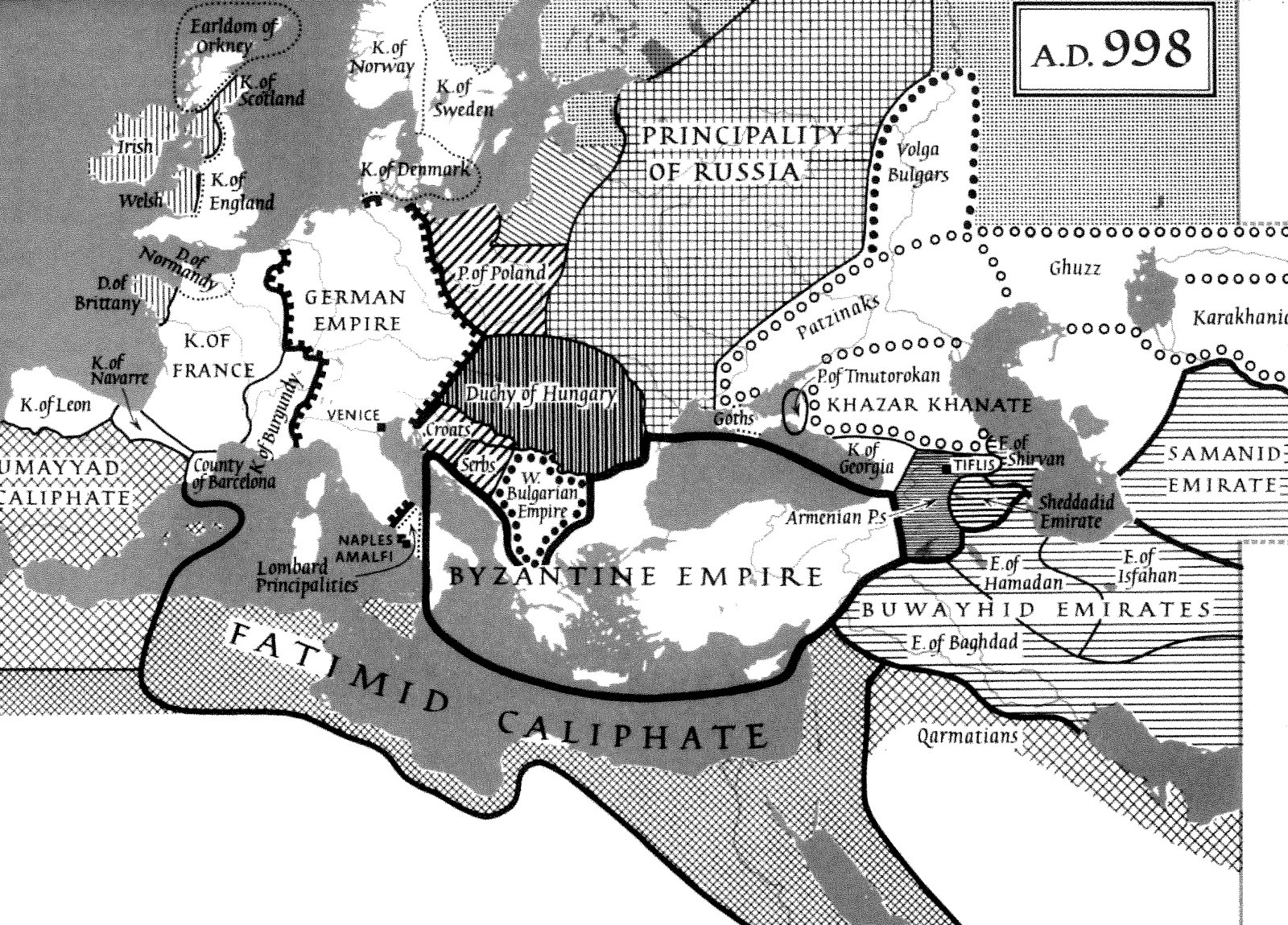
A week later, after threatening to leave Constantinople (on grounds of ill-health) if the question of the imperial marriage was not resolved, Liudprand was granted another audience with Chancellor Leo Phocas and his advisors. The Byzantines took the position that it was unheard for a foreigner to marry a porphygenita. So huge a concession would demand a corresponding quid pro quo — the cessation of all of Otto’s Italian holdings, including Rome and Ravenna, and the surrender of the rebel Pandolf Ironhead. In counterargument, Liudprand cited the (spurious) Donation of Constantine, claiming that in 337 the first Christian emperor had willed Italy and other western domains to the then Pope, Sylvester. By virtue of this the present Pope, John, had re-endowed these lands to Otto. This cut no ice, the Byzantines knew perfectly well that Constantine had made no such concession. Likewise, Leo rebutted Liudprand’s argument that the Tsar of Bulgaria had just married a Byzantine princess, the Tsar’s bride bout de papier Vol. was no porphrygenita. He dismissed Liudprand back to his drafty quarters.
There he cooled his heels for the next few weeks, being allowed out only for other official banquets. There he found, to his fury, that the Bulgarian envoy had been granted precedence over him. Liudprand professed his dismay somewhat too tactlessly. Chancellor Leo took him aside to point out that Bulgaria enjoyed a special relationship with Constantinople and no matter how deplorable the Bulgarian envoy’s dress and table manners, he outranked a mere Frankish bishop. If Liudprand did not like it he could dine at an inn with the servants. To mollify Liudprand’s wounded pride the Emperor sent him his favourite dish — a fat goat, richly stuffed with garlic, onion, leeks and swimming in fermented fish sauce. The goat cannot have reeked any less than does the sarcasm of Liudprand’s description of this morsel. Despite his behaviour, Liudprand continued to receive dinner invitations from the Emperor, who seemed to delight in their vituperative exchanges, be it on the relative merits of western and Byzantine soldiery or on whether Greeks or Saxons were the more orthodox Christians. Nikephorous tried to bribe Liudprand, promising a rich reward if he confirmed the arrangement agreed to by Otto’s previous envoy. Liudprand replied he could not agree to this as it would exceed his instructions (on his first mission he had been far less scrupulous, openly soliciting a pound of gold from Constantine). Nikephorous threatened to escalate the war in Italy if Pandolf Ironhead and other rebels were not handed over to him; openly treated with Adalbert (the deposed Berengar’s son) and ostentatiously despatched an expeditionary force to Italy in mid-July. At the same time he hinted that if Otto departed southern Italy, Adalbert would be delivered up to him, along with a liberal donative.
By now, it was clear that Liudprand’s mission was going nowhere. Now, his main concern was to get back to Italy as soon as possible. He was still feeling ill, and was less and less enchanted with the food when he could get it. A food shortage in Constantinople doubled the price of grain. The Emperor ceased providing rations for Liudprand and his 25-man delegation. The Byzantine guards prevented both the local Latin community from sending supplies in for Liudprand, or allowing out any member of the delegation to buy provisions except its unilingual Italian cook, who was roundly cheated by the market vendors. Finally, Liudprand managed to secure the emperor’s permission to depart and the promise of an imperial war galley to take them to Ancona. This, despite Liudprand’s refusal to make an undertaking on Otto’s behalf not to provide further help to Pandolf Ironhead and his fellow rebels. Nikephorous then departed for the east to beat up the Saracens again, but not before showing Liudprand his game park and treating him to another meal of chevreau a l’ail.
Unfortunately for Liudprand, it was another two months before he could take his leave. The sea route was rendered unsafe by Arab pirates and the overland route by Hungarian raiders. While he was waiting, emissaries arrived from the Pope, with a letter asking Nikephorous “emperor of the Greeks” to conclude an alliance with the Pope’s “dear son, Otto, August emperor of the Romans”. Someone in the Vatican chancery had blundered, and very badly indeed. Liudprand’s dismay was palpable and the Byzantine reaction ballistic. The Papal envoys were immediately incarcerated and messengers sent to Syria to find out what fate Nikephorous wished to mete out to them. There was talk of sewing them in a sack and dropping them in the sea. The Byzantines were convinced that Otto was behind this horrendous slight. Liudprand was called in and asked for an explanation and a disavowal. Liudprand insisted that it was an innocent mistake. The Pope could not know that a people who spoke no Latin and differed in every way from the people of Rome, still insisted on being called Romans. He undertook to ensure that this lapse would be brought to the Pope’s attention, and would not happen again.
Finally on October 2, Liudprand and his delegation were able to depart with letters (sealed in gold) from Nikephorous to Otto, and (sealed in silver) from Chancellor Leo to the Pope (who had rendered himself unfit to receive direct correspondence from Nikephorous). Even now, Liudprand’s troubles were not over. While he claimed Imperial permission to purchase and export them, a store of purple vestments he had acquired in Constantinople was confiscated The delegation had to go overland to the Adriatic (a two month trip). The Byzantines had provided horses for Liudprand and his entourage, but he had to shell out another 50 gold pieces for baggage animals. All along their journey through the Balkans, the Latins were subject to slights and extortions from local officials and clergy (the latter Liudprand admitted were dirt poor). When they finally reached the Adriatic, the master of the ship which took them to Italy shook Liudprand down for one of the few purple cloaks which he had managed to smuggle out.
The war between Otto and Nikephorous dragged on till 970, only being resolved after Empress Theophano arranged Nikephorous’ murder and replacement by another general, John Zimices (who, promptly and prudently, got her to a nunnery). In the end Otto II married his princess and no territory was lost by either side. Liudprand, despite his professed distaste for all things Byzantine, was part of the embassy which brought this to fruition, but as he died en mission or soon thereafter he left us, alas, no account of it. It would have been interesting to see if success would have moderated the tone of his reporting. Also, was it the Byzantine cooking that finally did him in?
Liudprand’s mission of 968 was not a success, but the odds were not in its favour. Byzantine treatment of visiting envoys may seem very Soviet one should never forget the formative influence Byzantium had on the Russians, then on the verge of conversion to Byzantine orthodoxy), but this was an empire that had been surviving by its wits for four hundred years and had every reason to distrust foreigners. Besides, a state of war provoked by Otto existed between the two empires. In his dealings with Liudprand, Nikephorous comes out as a tough and skilful negotiator, but by his austere standards, he was very hospitable to this prickly Latin envoy. Liudprand may not win marks for adaptability, flexibility, or cross cultural sensitivity and he is by no means the first, or last, diplomat to fill his despatches with whingeing complaints. In his favour, however, his advocacy skills were strong and he defended Otto’s position forcefully. Unlike his predecessor, Liudprand made no concessions. While some may fault Liudprand for lack of tact (or perhaps for reporting what he wished he’d said, not what he actually said one gets the impression that Nikephorous enjoyed their wrangles. In any event, he kept inviting him back for more. The Byzantine treatment of the unhappy papal envoys shows that diplomatic immunity was far more tenuous a thing 1,000 years ago than it is even today. Liudprand, at least highly sensitive to Byzantine pretensions to Romanitas, deserves top marks for saving them from an exceedingly unpleasant fate JA
View the original scanned pages →
Originally published in bout de papier, Vol. 14, No. 3 (1997) — Fall 1997 // Automne 1997, pp. 29–31. Read the rest of this issue →



