
bout de papier, Vol. 14, No. 3 (1997) — Fall 1997 // Automne 1997, pp. 12–15
photos and story by Daryl Copeland
It has become the conventional wisdom that the world’s economic centre of gravity is tilting towards the Orient, which is emerging as the dynamic centre of the new global economy of the 21st century. It stands to reason that if Canada is to enlarge its sovereignty, diversify its dependence, and share in that region’s prosperity, then we must do everything possible to realize the full extent of our potential as a player in the Asia Pacific.
The past few years have certainly seen a significant expansion of activity and exchange, and Canada’s profile on the other side of the Pacific has risen accordingly. There has been a commensurate increase in the appreciation of the importance of that region in this country: 1997 has been designated as Canada’s Year of Asia Pacific. Canada is chairing APEC, a broad international consortium working to build trade and investment ties, and will host the APEC leaders’ meeting in November. Three Team Canada missions – to North, South and Southeast Asia – a series of ministerial visits, cooperative security and development assistance initiatives, burgeoning tourism and immigration flows, and, especially, a surge in two-way trade and investment have all contributed to the advance of Canada’s long term strategic position in the Asia Pacific region.
In business and government circles across Canada, there has been an increased emphasis on mobilization, coordination and policy coherence. These signs of a more integrated and sophisticated approach are welcome, especially in terms of the successful management of political and economic relations with key bilateral partners and the major regional groupings. Even in the best of circumstances, however, the intensification of Canada’s trans-Pacific embrace could produce some vexing challenges. In particular, getting closer to the countries and institutions across the Pacific would appear to require some bridging of the alleged values gap, and the sensitive handling of divergent approaches to a number of highly charged issues which not all parties regard as universal in nature.
Western societies, for example, have a very strong commitment to the International Bill of Human Rights, and a cluster of human rights related issues are on the forefront of the East-West divide. In the West, the Bill is seen as the foundation stone of a set of immutable and indivisible values which apply equally to all, regardless of location or background. Not all societies, however, and certainly not all governments, accept the absolute place of the provisions of the Bill as a benchmark against which standards should be set and performance measured. In Asia, in particular, the point is made that “Asian values” sometimes differ from “Western values,” which, some maintain, are at the core of the International instrument. Without denouncing explicitly the internationally agreed principles, leaders from China, Malaysia, Singapore and elsewhere in the region have questioned their strict applicability to Asian states which, they declare, are constituted and governed on the basis of shared social, rather than individual values.
The seeming preoccupation of Western governments and NGOs with human rights issues has frequently been branded by Asians as an attempt to impose culturally biased standards and norms which are not only alien to the region, but prejudicial to local economic development. The more ardent exponents of this argument go so far as to accuse human rights advocates of participation in a conspiracy intended to keep Asian developing countries “down” At international fora and in the popular media on both sides of the Pacific, acrimonious exchanges and claims of superiority have not infrequently drowned out genuine dialogue and exchange.
With the strength of Asia’s power in world affairs growing at least in parallel with its impressive economic strength, the possibility of Asian states derogating from accepted global instruments as a result of “different value systems” is a prospect which must be taken seriously. At least equally worthy of protracted contemplation is the possibility that “Asian values” could one day emerge ascendant and thus contribute to new norms which the West might then have to accommodate. If that were the case, what would be the implications for the current set of global human rights set out in various international agreements?
At the centre of this debate is the question of the extent to which a clear distinction between core Asian and Western values can be sustained. Proponents of the divergent values argument suggest that over the course of history a set of fundamentally divergent precepts and assumptions has evolved and led to the development of irreconcilably different, even conflicting standards of cultural, religious, political and social behaviour and belief.

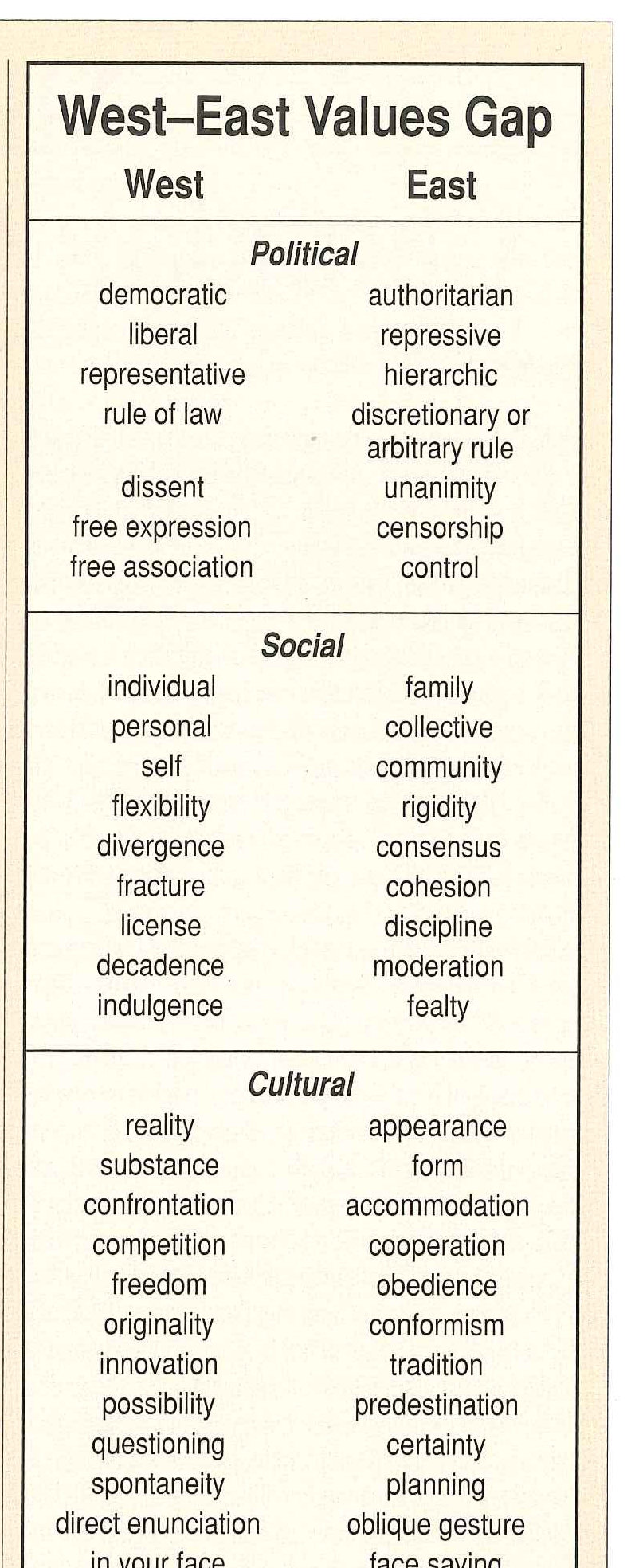
What are some of these values, how are they expressed, and just how different are they? A preliminary survey is annexed.
At a superficial, and in many cases at a visceral level as well, the sorts of distinctions set out in the chart seem to ring true. Analyzed against the circumstances of particular countries, however, such sweeping generalizations are much more difficult to defend. Indeed, many are reduced to stereotypes and caricatures. By way of illustration, let’s review some commonly adduced examples.
In North Asia, for instance, the Confucian heritage stresses the dignity of learning, obedience to authority, and respect for elders. This constellation of values is often held as distinctively Asian. But is it? These priorities, even if expressed in somewhat different language, are commonly held in many parts of the world associated with Judeo-Christian convictions, and are hardly rare among Canadians. The short of it is that some central elements of major Eastern religions find wide resonance elsewhere.
Veneration of “the family” is another trait frequently described as somehow especially Asian. To be sure, in many North American cities, the old model of the nuclear family does seem to have been overtaken by events. But wait. In Japan marriage and fertility rates are the lowest in the world; traditional families there are becoming an endangered species. In China, female infants are frequently abandoned or killed. Meanwhile, the sanctity of the family remains deeply ingrained in southern Europe, is worshipped by the religious right in the United States, prized by the Reform Party in Canada, and defended staunchly by the Catholic church. Again, serious reflection suggests that any real East- West distinction is unclear.
Decadence, degradation, decay?
Hmmm… assessed according to what? Explicit sex may be off the movie screens n strait-laced Singapore, but it is on tap in hotel videos most everywhere else in the region. Meanwhile, ten years of unconstrained double digit growth have given rise to environmental pressures which are near, at or in excess of tolerable limits in many Asian locales. The crucial harmony between man and nature, which is at the very centre of many eastern religions, is being stretched beyond recognition. Spent any time in the capital of an “Asian tiger” lately? Bring your gas mask

Asian societies are often portrayed, on both sides of the Pacific, as rigid, authoritarian and deterministic. Over the past several decades, however, capitalism and free enterprise have introduced an unheard-of degree of upward social mobility into both revolutionary China and traditional Thailand. But in North America, especially for those employed in sunset industries, the public sector, and middle management, stagnation has been the rule and much of the movement has been downwards. Burgeoning middle classes all over Asia are clamoring for political power and modern services from the state, even as many in the West want government reduced. No easy generalizations here, either.
What of the oft-cited observation that the putatively values-based quality of life in the East is morally superior to that of the West? Well, that is difficult to square with the epidemics of prostitution, drug abuse and the exploitation of children which flourish in Thailand, the Philippines, and southern China. And violence? The crime rates in Korea and Pakistan rank with leading US cities. Nepotism and patronage are landmarks of the political landscape in Malaysia and Indonesia, yet political integrity and social cohesion epitomize the Nordic model. So again, the evidence is mixed.
I am struck by the fact that much of the debate on values seems to spring from a set of circumstances which no longer obtain. Public finances are improving and the work ethic is enjoying a resurgence in the West, even as the newly wealthy in Asia are spending more time on golf courses, at swank clubs and aboard yachts. Can the pot call the kettle black? And the economy of the United States, written off in the late 80s by declinists on both sides of the Pacific, has perhaps never looked more robust and promising.
It may be that many of the characteristics of Western society, and particularly the more dissolute aspects so trumpeted in some Oriental capitals, have more to do with longer periods of urban-industrial gestation than much of Asia has yet to experience. Inner city decay, single parenthood, an aging population and special-interest politics may be delayed in Asia, but they will not be denied. When they arrive, so too will demands for welfare and expanded government spending, enlightened public policy and progressive programmes. This is one of the less explored aspects of globalization.
All of which is to say that while it is possible to identify some values which are more prominent in some parts of Asia than in some parts of the West, and vice versa, it is difficult in the extreme to generalize. All countries are particular, and, at the end of the day, are best understood according to the dynamics of their own discreet histories.
However obvious this may seem, the problem remains that in international fora and in the popular media on both sides of the Pacific, acrimonious exchanges and claims of superiority have too often been substituted for genuine dialogue and exchange. In many cases, moralizing has been substituted for morality, and propaganda for principles. None of that achieves anything very helpful, or advances anyone’s brief.
Perhaps there is a role for Canada in helping to move the discussion beyond this sterile and counterproductive impasse over the — non-existent? – values gap. chaos order surely time to identify the means by which the parameters of the debate might be shifted from the divisive issue of divergence to a more wide-ranging and systematic search for those values which are shared. Once identified, these pillars could be built upon as the basis for a more harmonious trans-Pacific relationship in the next century.
At minimum, a more thoughtful consideration of these vital issues would be particularly timely in the midst of Canada’s Year of Asia Pacific. Given the stakes, the least we can do is try.
View the original scanned pages →
Originally published in bout de papier, Vol. 14, No. 3 (1997) — Fall 1997 // Automne 1997, pp. 12–15. Read the rest of this issue →



