
bout de papier, Vol. 15, No. 1 (1998) — Spring 1998 // Printemps 1998, pp. 35–39
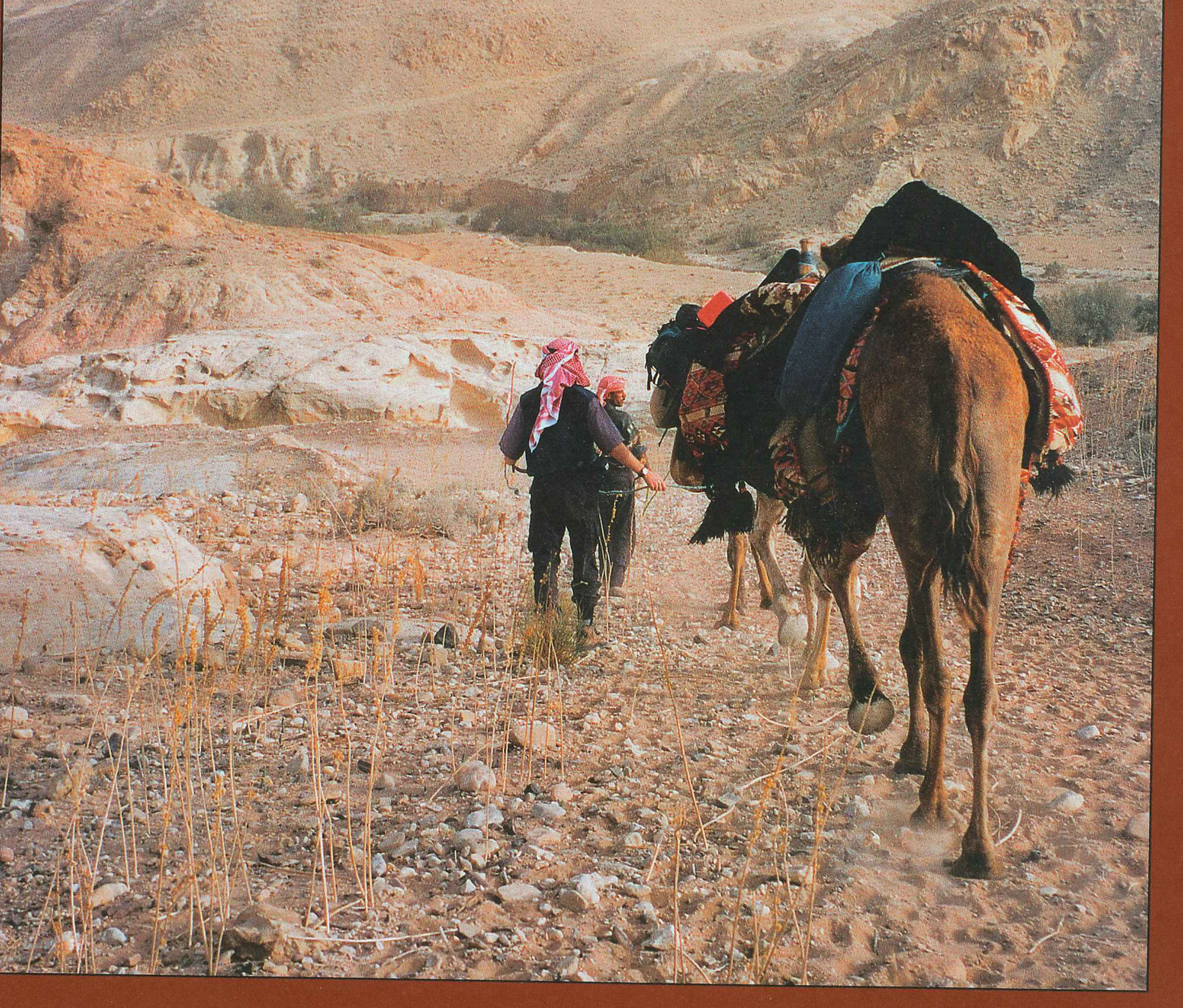
It’s 5:30 am when the bray of a donkey greets the new day. As the sun peeks above the horizon, other donkeys, roosters and dogs join the chorus. Unable to sleep, I open the tent and watch the morning light unveil the rose coloured cliffs and ancient temples of Petra in the valley below. Once the capital of the Nabetean people, it is now a tourist destination and source of income for the local population. The family of our host, Duklahlah, has prepared a fine breakfast of oranges, hummus, bread and tea. We eat this meal slowly hoping to delay our departure. However, impatient sounds from our camels remind us that it is time to begin our transportation for the next week as we travel from Petra to Wadi Rum through the mountains and deserts of Jordan.
I had been thinking about undertaking such a journey ever since I had seen the movie “Lawrence of Arabia”. Filmed on location in Jordan, the movie contains some magnificent scenes of the desert landscape of the region. Jordan has still not developed its tourism industry, meaning that it is possible to experience the culture and see the country without the large crowds or trappings associated with many destinations. Unfortunately, this lack of a tourism infrastructure also makes it difficult to plan trips outside the major centres. Having a friend when setting oft into unfamiliar territory. So Al Sutherland and I agreed to meet in Jordan and see what we could arrange.
The capital of Jordan, Amman, has a bustling city centre filled with a multitude of shops selling spices, jewellery, clothing, and household goods. Mosques are located throughout the city and use loudspeakers to call the residents to prayer five times a day. In Roman times, the city was an important commercial and political centre known as Philadelphia. Evidence of its historical roots can still be seen in its 6,000 seat amphitheatre and the palace grounds of the citadel located close to the downtown area. It was in this amphitheatre that Al and I met Mohammed, a PhD. student in archeology who offered to take us on a tour of some of the sights outside of Amman. Given our interest in seeing the country and learning about its people, we quickly took him up on his offer.
Early the next morning from a windy hillside northwest of Amman, we caught our first glimpse of the Jordan Valley. An important agricultural area, the valley is actually the northern end of the Great Rift Valley of Africa. High above the valley is Ajlun, a 13th century Arab fortress built to protect the region against the Crusaders. Walking through the rooms of this castle is like finding hidden treasures as each apparent dead end gives way to a whole new series of chambers and corridors. Further to the east is Jerash, one of the most extensive sets of Roman ruins in the region. Amphitheatres for dramas and animal fights, impressive temples to Roman gods, and stately boulevards lined with columns can all be found here. Looking closely at the boulevards, it is possible to see grooves left in the paving stones by Roman chariots.
As a guide, Mohammed was interesting and informative; as a contact, he was invaluable. Learning that we were planning to take a camel trek in the south, he called his friend Duklahlah in Petra and arranged for a car to take us there the next day. Along the way, we stopped for a swim in the Dead Sea, the lowest point on the surface of the earth.
The water of this sea contains so much salt that one actually floats on top of it. As we awkwardly attempted to swim, we were reminded of our proximity to the border by the sound of Israeli jets taking practice bomb runs on the other side. Along the King’s Highway to the south of Amman, there are a large number of Byzantine churches and monasteries. The stone mosaics of these churches are a wonder to see in terms of their detail and colour. One of these monasteries, Mt. Nebo, is said to be the burial place of Moses and is portrayed in the movie “The Ten Commandments”. Later in the afternoon, we made a final stop along the road to see Kerak, an enormous 12th century Crusader castle that was captured by Saladan in 1188.
Arriving in Petra, we were warmly greeted by Duklahlah and his family. A descendent of the Nabeteans, Duklahlah is an expert stone carver and has been working on the restoration of many of Petra’s temples and tombs. His large house has a spectacular view of Petra and is often used as a base by visiting archeologists. On this occasion, a large
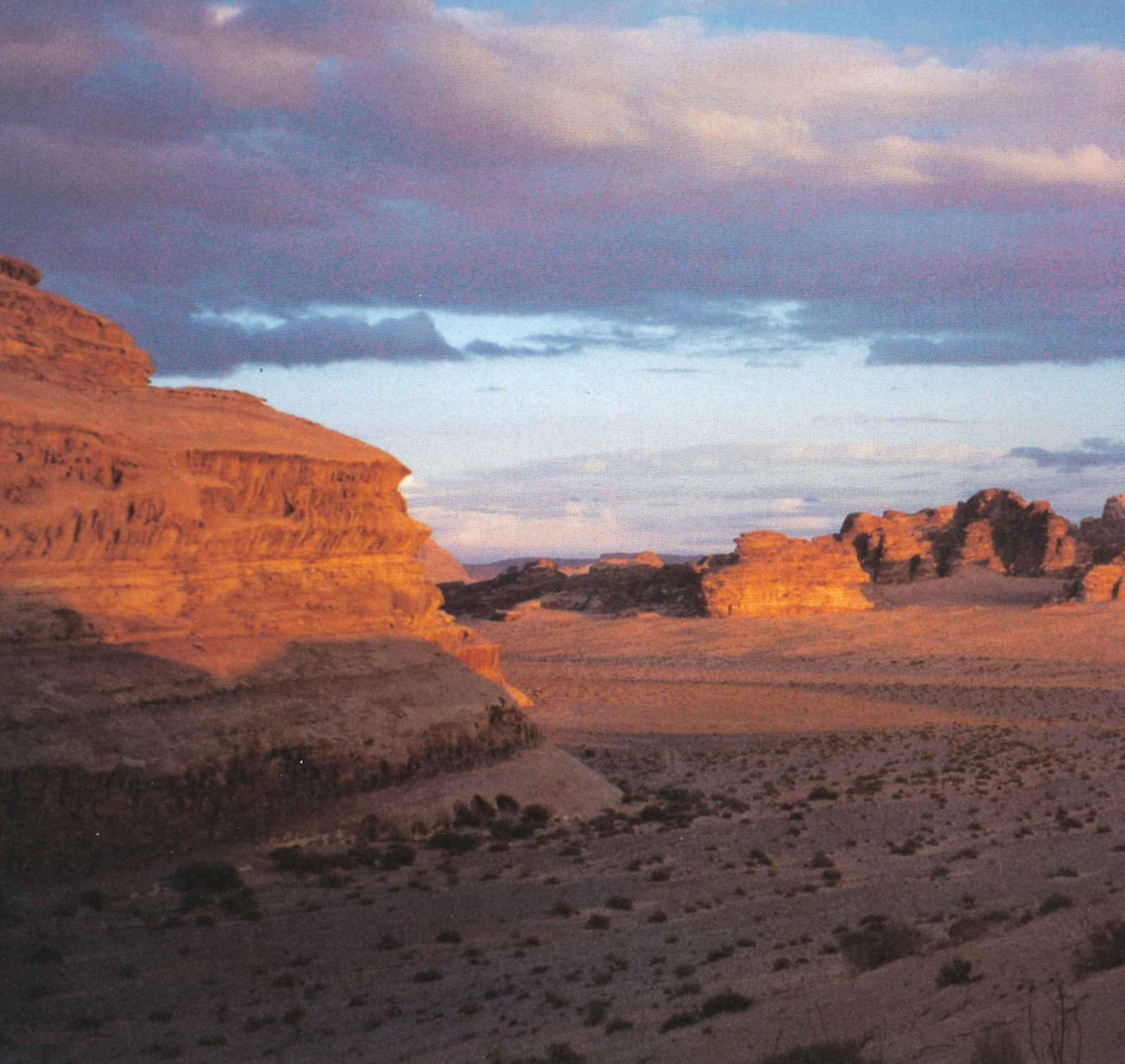
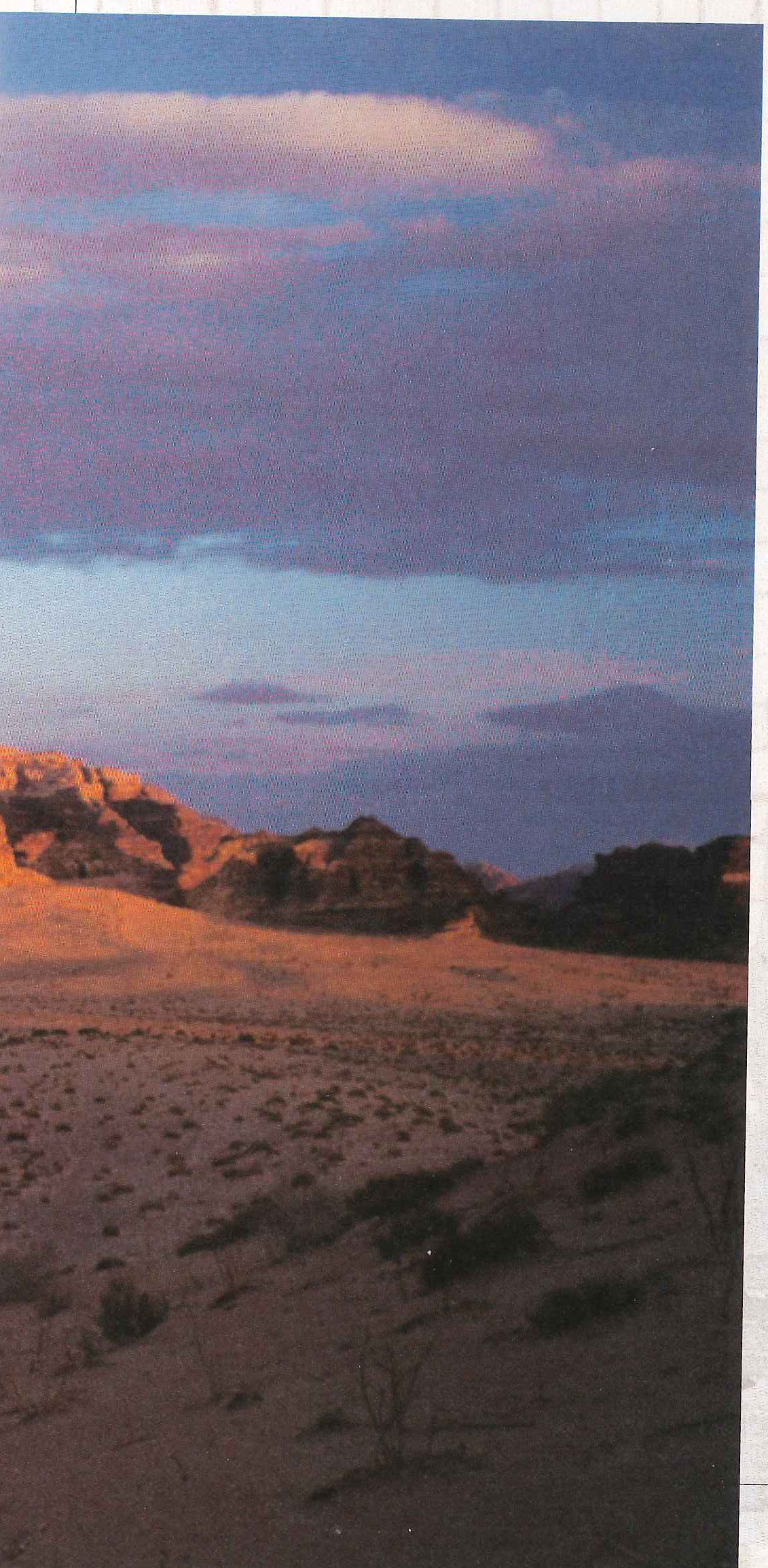
Title page: A long day ahead – This page: Wadi rum – The u group of Dutch archeologists were present, and we shared with them a traditional “mensaf” dinner. This meal consists of lamb, rice, yoghurt and pine nuts and is eaten by hand from a large communal dish. Following the meal, we watched some of the celebrations of the King’s birthday on television and began to discuss our plans for the coming week. Despite the offbeat nature of our request, Duklahlah agreed to organize camels and provisions for our journey and asked Auda, one of his eleven children, to be our guide. To our great surprise, he also arranged for Saad, the Sheik of the local tribe, to accompany us.
With these arrangements in place, we were able to spend a few days exploring Petra. At various times, this valley has been home to Edomites, Nabeteans, Romans, Byzantines, Islamic
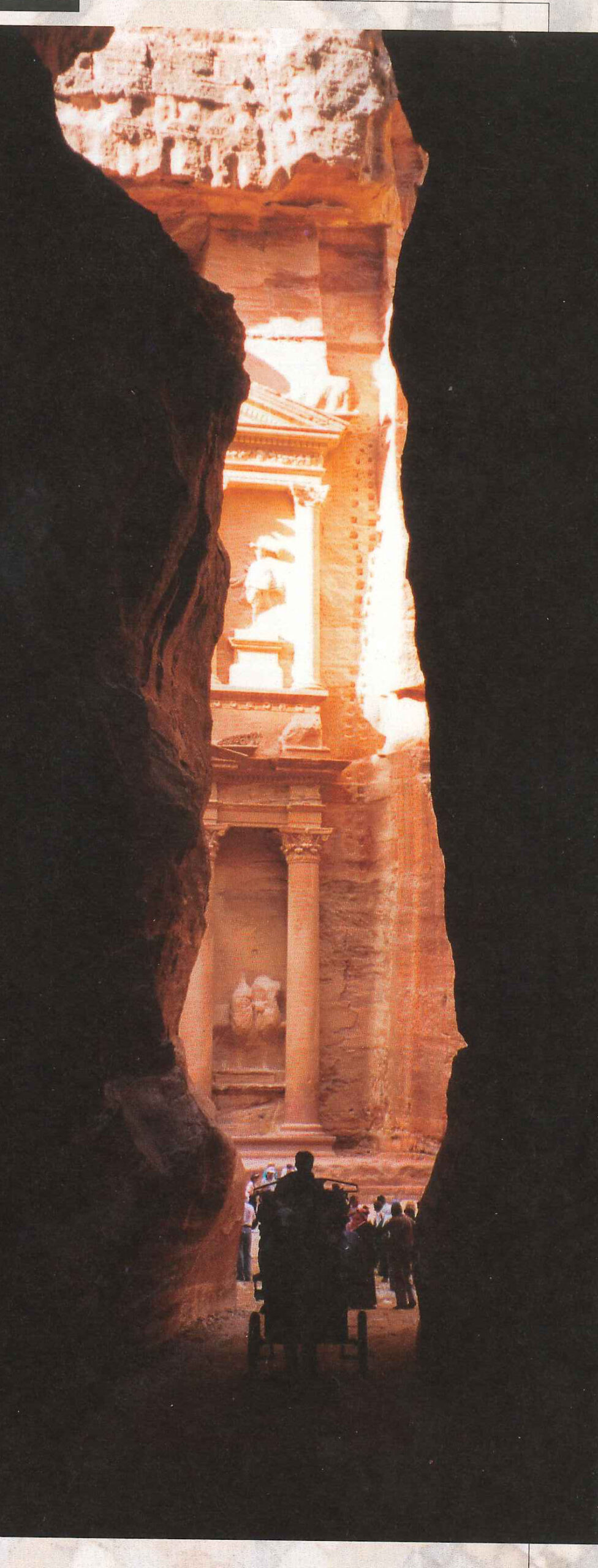
Arabs, Crusaders, and Bedouin. The primary 3 entrance to Petra consists of a very narrow gorge known as the “Siq” which winds through the mountains for a few kilometres before opening in dramatic style to reveal the 40 metre high facade of the Treasury. This monument provided the backdrop for some of the final scenes of “Indiana Jones and the Last Crusade”. There are similarly impressive temples and tombs carved in the sides of cliffs throughout the valley along with smaller openings that were once used as dwellings. The many levels of these dwellings resemble a kind of ancient con-of the cliffs, it is possible to see Nabetean dominium complex. Climbing to the top burial sites carved in the stone as well as the high mountains of Wadi Arabi which border the valley. Two days is barely enough time to see the main features of this spectacular valley.
As we loaded our gear onto the camels, I found that I was feeling a little bit apprehensive. Never having ridden a camel before, the thought of spending a full week travelling on one of these “ships of the desert” was somewhat intimidating. Camels have a well-earned reputation for being ill-tempered and, unlike tour buses, they are not designed for comfort and safety. The name
– Jordan’s desert mountains warm glow of a desert sunset of my camel was Reeman which means “gazelle in the mountains”, and, according to Auda, he could run like the wind. Al’s camel was Shurhan which stands for “strong in the desert”. Shurhan had a bit of an attitude and tried to eat everything in sight including plastic bags, rags, and his own saddle blankets. Noting this peculiar habit, Al expressed a strong desire not to find himself on Shurhan’s rather varied menu. The name of Saad’s camel was Aliann which refers to his village of birth in Egypt. He was the largest of the three camels and carried most of our supplies as well as our two guides.
Despite our apprehension, travel by camel turned out to be most enjoyable. On the way out of Petra, we stopped at the snake monument to have tea with Auda’s grandmother. In the 1980s, Jordan moved most of the Bedouin out of Petra to the village where Auda and his family now live. However, his grandmother refused to leave and still lives in one of the ancient stone caves. After tea, we carried on through some rolling hills and by some beautiful mountains including one with a white mosque high above on the summit, Jebel Haroun. Some hours later, we stopped at Wadi Sabra, a pleasant place close to a Bedouin camp with an oasis. As we set up camp, we noticed that there were pieces of pottery, stones from walls, parts of columns, and other artifacts in the sand all around us. Saad explained that this was one of many old Nabetean and Roman cities in the region that has yet to be excavated. In the meantime, Auda cooked a wonderful meal for all of us consisting of chicken, onions, peppers, tomatoes, potatoes, salt and cumin. As a light rain began, it was time to turn in for the night.
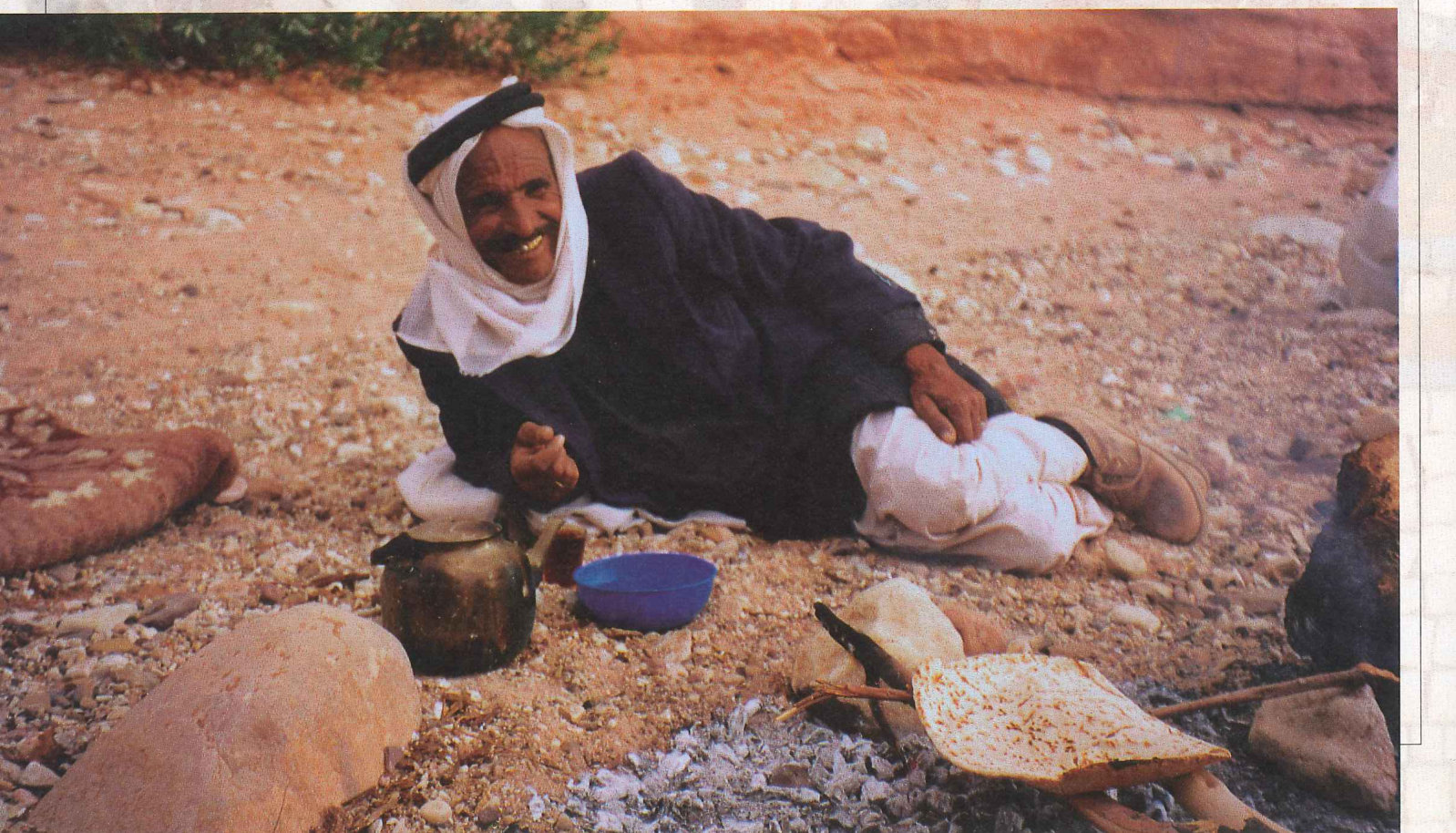
Proceeding through the mountains the next day, we were thankful for the presence of Auda and his knowledge of the region. There are many trails through this area but no markers. On occasion, we came across some incredibly lush areas of vegetation. However, the land was mainly barren rock and sand. Auda began teaching us some of the words he uses to communicate with the camels. A hissing sound directs the camel to kneel, a clicking sound tells him to move forward, and a sharp “shakrun” orders him to stop. That evening while Saad fed the camels, Auda showed us how to bake flat bread in the coals of the fire. Flour, salt and water are kneaded and then buried directly in the coals. After 20 minutes on each side, branches are used to remove the ashes, and you have fresh bread. After dinner, Auda also demonstrated the use of reeds from the oasis to make flutes. The sound of his music echoed in the valley of our campsite.
There was some light rain again the next morning as we began a long climb up a relatively steep path. Part way up the mountain, we came across a road construction crew using bulldozers to build a new road into the area. There was some interesting symbolism as the crew shut down their equipment to make way for our camels to pass. It was a tough day to be a camel as the climb continued for more than three hours. We finally reached the top of the pass and gave them a well-earned rest. This break also allowed us to stop and admire the incredible view we had in all directions. As we slowly made our way down the path on the other side of the pass, the soil gradually become more sandy, and we began to see large sand dunes in the distance. A cool wind was blowing, and the land in this area appeared particularly stark. Nevertheless, that evening, we had clear skies as we set up camp overlooking what Auda called a “million star hotel” “, the desert.
After dinner, Saad began to tell us about his people and the role of the Sheik. He is a Sheik of the Howeitat who were previously lead by Auda Abu Tayi of “Lawrence of Arabia” fame. Today, the Sherif of the Howeitat is Nasser, the nephew of King Hussein. There are over three hundred tribes of the Howeitat living in Jordan, Egypt, Tunisia and Saudi Arabia. Each tribe has a Sheik a hereditarv nosition of considerable importance in their society. If a crime has been committed, the Sheik determines the punishment. For example, a murder could be punishable by death, payment of a fine to the family of the deceased, or exile of the perpetrator’s entire tribe for many years. In such matters, the decision of the Sheik is final, but he can choose to ask the government to decide an alternative punishment such as imprisonment. This interesting mix of traditional and modern legal systems apparently functions well as crime does not seem to be a significant problem in the country.
There was a strong wind most of the night, and I awoke to find to find Aliann curled up next to the tent seeking shelter. His toothy grin was there to greet me as I opened up the tent. Based on this experience, I can confirm that camel breath is not one of the most pleasant smells in the morning. As we made our way down from the hills to the desert, we stopped at a busy oasis. While we were there, it was visited by 15 camels and about 200 goats and sheep. The mood of our camels changed dramatically when we reached the desert. Rather than plodding along at a slow pace, they suddenly wanted to run at high speed, and it took considerable strength to keep them in check. The desert in this area was relatively flat, and it was possible to see for many kilometres in all directions. An interesting aspect of this flat landscape was that it allowed the setting sun to cast incredibly long shadows. However, a significant downside was that it provided little in the way of shelter to protect against wind storms.
During breaks over the next few days, Auda and Saad talked about some of the many Nabetean and Bedouin myths of the area. In one story, they spoke about treasures of gold in Petra that are guarded by a tall red horse, a black snake and a man dressed in black. In other conversations, they referred to the “symtar”, a large tiger-like animal that carries people off in the night and the “nissar”, an enormous bird that has a life span of more than 1000 years. In addition to these mythical beasts, they spoke of foxes, wolves and hyenas. I was surprised to hear that hyenas could be found this far north, but Auda confirmed that there had been numerous sightings around Tafila, a town north of Petra. This town is also known for the oddness of its residents, and there were numerous “Tafila jokes” told throughout the trip. These stories and jokes made for enjoyable evenings around the campfire.
As we approached Wadi Rum, we had to cross the Desert Highway which connects Amman with Agaba. Dressed as we were with some traditional clothing to protect against the sun and sand, we must have looked like Bedouin coming out of the desert to a busload of 1- tourists who stopped to I- take photos. We were pleased to leave behind the noise of the highway as we ventured into the desert once again. We set up our last campsite on a sand dune with a wonderful view of Wadi Rum in the distance. That evening, the setting sun turned the sand and high cliffs around us a brilliant orange. The next morning we proceeded towards Wadi Rum and rode beneath the 5,000 foot cliffs of this spectacular valley. I was reminded of Lawrence’s first impressions of this valley when he wrote, “our little caravan grew self-conscious, and fell dead quiet, afraid and ashamed to flaunt its smallness in the presence of the stupendous hills”
Having arrived at the end of our journey, we said our farewells to Auda and Saad and made our way to Aqaba for some much needed rest and relaxation of a more modern kind. In Aqaba, there was time for scuba diving in the Red Sea and some souvenir shopping. As Al and I made our way into one store, we noticed something familiar about the shopkeeper. It turns out that he had been Omar Sharif’s stunt double in “Lawrence of Arabia”. Despite its apparent size, it seems that the desert is a small world after all.
View the original scanned pages →
Originally published in bout de papier, Vol. 15, No. 1 (1998) — Spring 1998 // Printemps 1998, pp. 35–39. Read the rest of this issue →



