bout de papier, Vol. 15, No. 1 (1998) — Spring 1998 // Printemps 1998, pp. 7–10
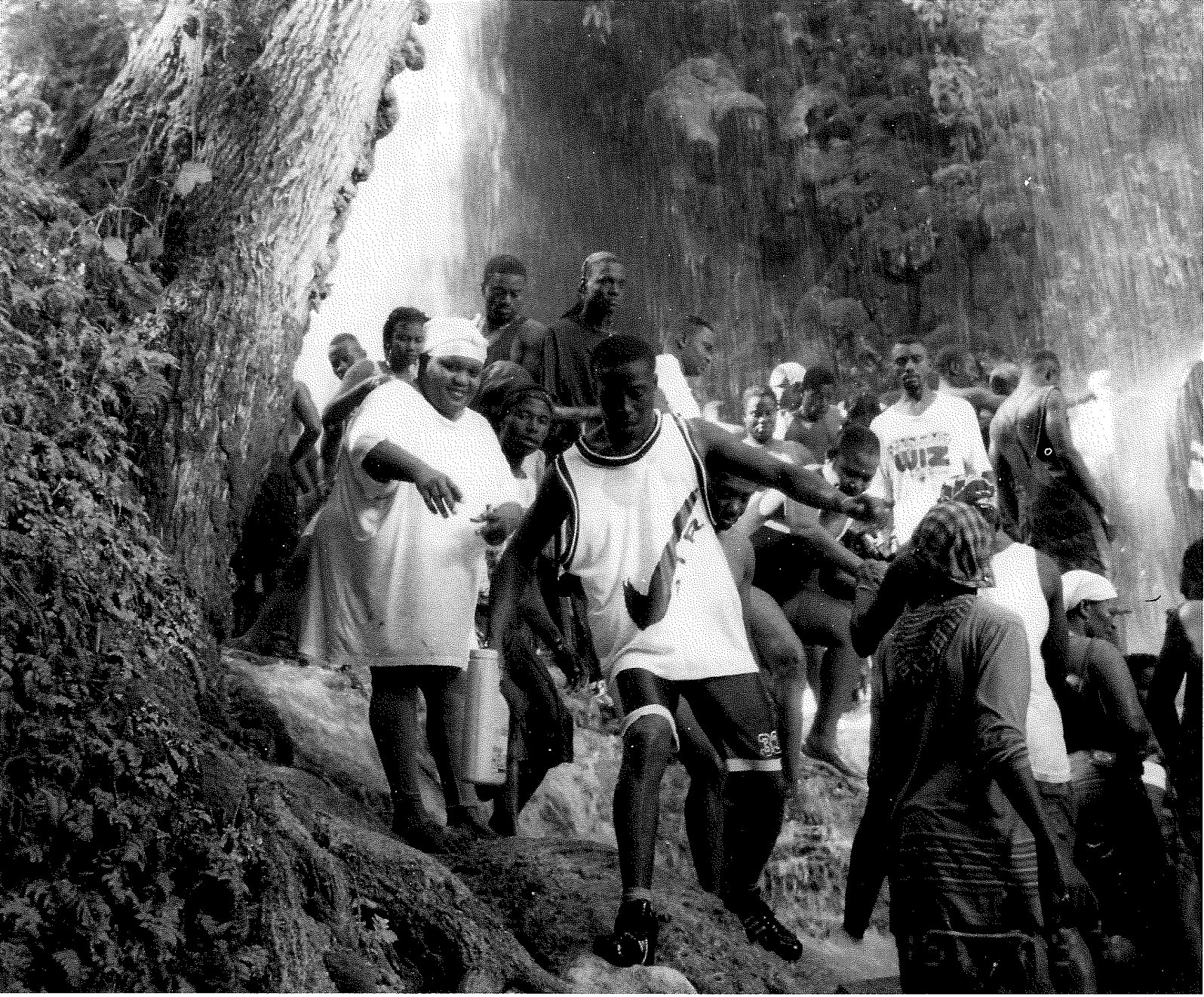
Attending the festival in Sceau d’Eau was an experience which will never be forgotten. It is one of three or four festivals (fet champèt) which take place during the year. These are interesting in that they show the dichotomy in religious beliefs of Haitians — vaudou and Christian — which are often held in parallel. The journey, itself, was equally unforgettable.
While, officially, it takes place 16 July, it in fact lasts the better part of a week. On Tuesday the 15th, four of us piled into my Jeep Cherokee to make the trip which, It was relatively easy for the first halt hour, until we reached Croix-des-Bouquets, just outside of Port-au-Prince. After that, Route Nationale #3 becomes little more than a bone-jarring dirt road which goes up and over Morne Cabrit. All along the route were people yelling at the passing cars, begging for money (their one big chance for the year).
By the time we made the turnoff just before Mirebalais, I had been lulled into a sense of relative complacency (the road wasn’t as bad as I had been led to believe — the potholes were no deeper than six inches). I had a rude awakening when feet across, with no bridge. In the water on the other side were three stalled trucks, with only a narrow passage between them. The pick-up ahead of us had some difficulty getting up onto the bank on the other side, but eventually made it with its waterlogged passengers in the back. We decided to go ahead, despite the fact that the water was almost to the window sills of the Cherokee. We made it and were even complimented on our achievement by other passing motorists (“Blan te condui dous”).
Once we had forded the river, the road was bad for the rest of the trip to our destination.
As it was all black rocks, we could not gauge the bumps and we hit bottom several times. Then, I looked in the rearview mirror to discover that the back windshield had popped out because of the jarring and was being held by the rear wiper and the defroster wires. We stopped to fix it (successfully), but the rocks hitting the trailer hitch had moved the rear floor and bumper up a touch so that the hatch door would no longer close. We managed to get it over the rubber bumper guards, which then held it mostly shut (there was only a two-inch gap).
On our arrival at Sceau d’Eau, our first sight was a couple of burned out hulks of vehicles. We later learned that two people had died in them. It seems that a lad from Sceau d’Eau, who lived in Port-au-Prince, had returned to his home town to get money to pay for his exams. While he was at a dance, standing next to a girl he didn’t know, two guys from Croix-des-Bouquets asked her to dance. She didn’t want to, grabbed the hand of the local lad (an innocent bystander) and asked him to tell the two others that she was with him. Not taking rejection well, they took him and killed him. The two were arrested but a crowd of locals stormed the jail and took them out, chopped them up with machetes and burned them in their vehicles. No-one else was arrested. However, the incident did not end there. The people of Croix-des-Bouquets were so in sensed that they blocked the highway there so that pilgrims going to or from Sceau d’Eau could not pass. It lasted only a day.
We had accommodations at the Sceau d’Eau home of some people from Port-au- Prince (one of whom turned out to be a major macoute). As a friend had made the arrangements, we had no idea where it was located. In a small town such as this, there would normally not be a problem finding a particular house — all you have to do is ask. For the festival, though, the population had grown from a handful of people to tens of thousands. After several tries, we were lucky enough to find a young fellow who lived at the house in question. Into the car he came and we eventually arrived at our destination (despite several blocked streets).
Then, it was time to go to the waterfall, scene of the festival and of an apparition of the Virgin in 1848. As it was a few kilo-meters away (uphill), we decided to take horses. As I was climbing onto one of the poor beasts, I slipped and bruised a rib on the saddle. I got on anyway, only to have the horse start bucking after going a few yards up the hill. We ended up walking after all, along with thousands of others, dodging the horses galloping up and down.
When we finally arrived at the waterfall, it was difficult to move because of the press of people. What a scene! Everybody (including us) pushing to get under the falls in order to receive their grace. The vaudou aspect having taken over this part of the venue, some pilgrims were possessed by one loa (spirit) or another. We stayed for about an hour, then made the long trek back down to the village.
For the rest of the evening and all night, the streets were filled with pilgrims and bandes (groups roving the streets playing some strange musical instruments and dancing). As well, there were troubadours going from house to house, entertaining the people in them and hoping to make a little money. One group played in front of our house until about three o’clock in the morning.
The next morning (Wednesday — the official day of the feast of Notre Dame du Mont Carmel), pilgrims gathered at the local church for the Christian part of the festival. Unfortunately, my rib was very sore, and I found it difficult to move. I also started to feel somewhat ill, so I did not go with the others. There was an up side to this — I did not end up trudging through the mud-filled streets (thanks to the heavy rain overnight) and didn’t end up with three inches of the stuff caked to my shoes. My friends assured me they said a prayer and lit candles for me (a comfort, I was feeling more and more like I needed it). I did get the flavour of the occasion though, as throughout the day the people in the house spent much of their time singing religious songs. As well, a lady next door was possessed by the spirit of Cousin, a loa.
At about 2:30, we packed up the car to head home. By this time, I was feeling worse than ever and the heat didn’t help. The air conditioning couldn’t be used because of the rear door that would not shut. The temperature outside was in the 40° Celsius range. We needed to use a different route to leave than the one via which we arrived, because with the rear door open, we could not cross the river without swimming — inside the car. Of course, several roads were blocked (not the same ones as before) and we stopped frequently for directions to the road to Mirebalais. Suddenly, things started to look familiar: we were back on the road with the roches noires, the one which had damaged the car and with the river we had crossed on the way in. This, combined with my increasing illness, brought us to the conclusion that I was in no condition to drive the four to five hours back to the Capital and no one else in the car could drive (one did have a Haitian driver’s permit but had never driven anything — confirming suspicions I had about some motorists). We returned to the house we had just left (almost as difficult to find this time as it was the first), unpacked the Jeep, and settled in for a second night.
We also had to advise people in the Capital that we would not be back that night as planned. We didn’t want them worrying that we had been kidnapped or killed.
One lady stopped by to tell us about the blockade in Croix-des-Bouquets (the aftermath of the dance-killings in Sceau d’Eau), saying that she had been told that a coup d’état had taken place. We calmed her by telling her that we had just spoken to the Capital and everything was in order. Besides, we believed it would be difficult to have a coup until after the 1300 UN troops left.
It was also becoming more evident that I wouldn’t be up to the drive the next morning either. In one of our calls a friend was asked to come up the next day, hitching a ride with someone coming to pick up our hosts. I was put to bed with a fever. Late in the evening I awoke to the strains of songs sung by the troubadours from the night before. This time they were only there until about 2.
Our new driver arrived from Port-au- Prince at about 11:00 the following morning. After he had paid his respects at the church (no time for the waterfall), we again loaded up the Cherokee and headed out. This time we found the other road. While it was smoother than the first, we still managed to hit bottom several times. As well, my fears were confirmed: you cannot go to or from Sceau d’Eau without having to cross a river. I had visions of all our possessions being waterlogged because of the open door.
We were lucky, though, the water only came to just below the rear bumper. Besides, the wake behind the moving vehicle was even lower, so that we escaped unscathed.
The rest of the trip was slow (it took five hours to get back) but relatively uneventful, other than having the rear window pop out a couple more times and having the rear door open on us once or twice (we only lost a few straw hats that one of our companions had purchased to resell in Canada). The damage to the Jeep turned out to be minor, and was easily repaired on return to Port-au-Prince.
All in all, an adventure. I’m just sorry I never got the chance to attend the events in Souvenance (at Easter) and Soukri (in mid-August). These are even bigger festivals, sometimes with attendance by royalty such as the King of Dahomey. Maybe next time.
View the original scanned pages →
Originally published in bout de papier, Vol. 15, No. 1 (1998) — Spring 1998 // Printemps 1998, pp. 7–10. Read the rest of this issue →