
bout de papier, Vol. 14, No. 4 (1997) — Winter 1997 // Hiver 1997, pp. 22–25
As I write, I am nearing the end of a one year assignment with the Mexican Foreign Ministry. Just last year, Foreign Affairs and International Trade Canada and the Secretaría de Relaciones Exteriores — México (SRE) agreed to begin an exchange of diplomats. This is Canada’s first with a developing country and Mexico’s first with any country. It’s been a fascinating experience.
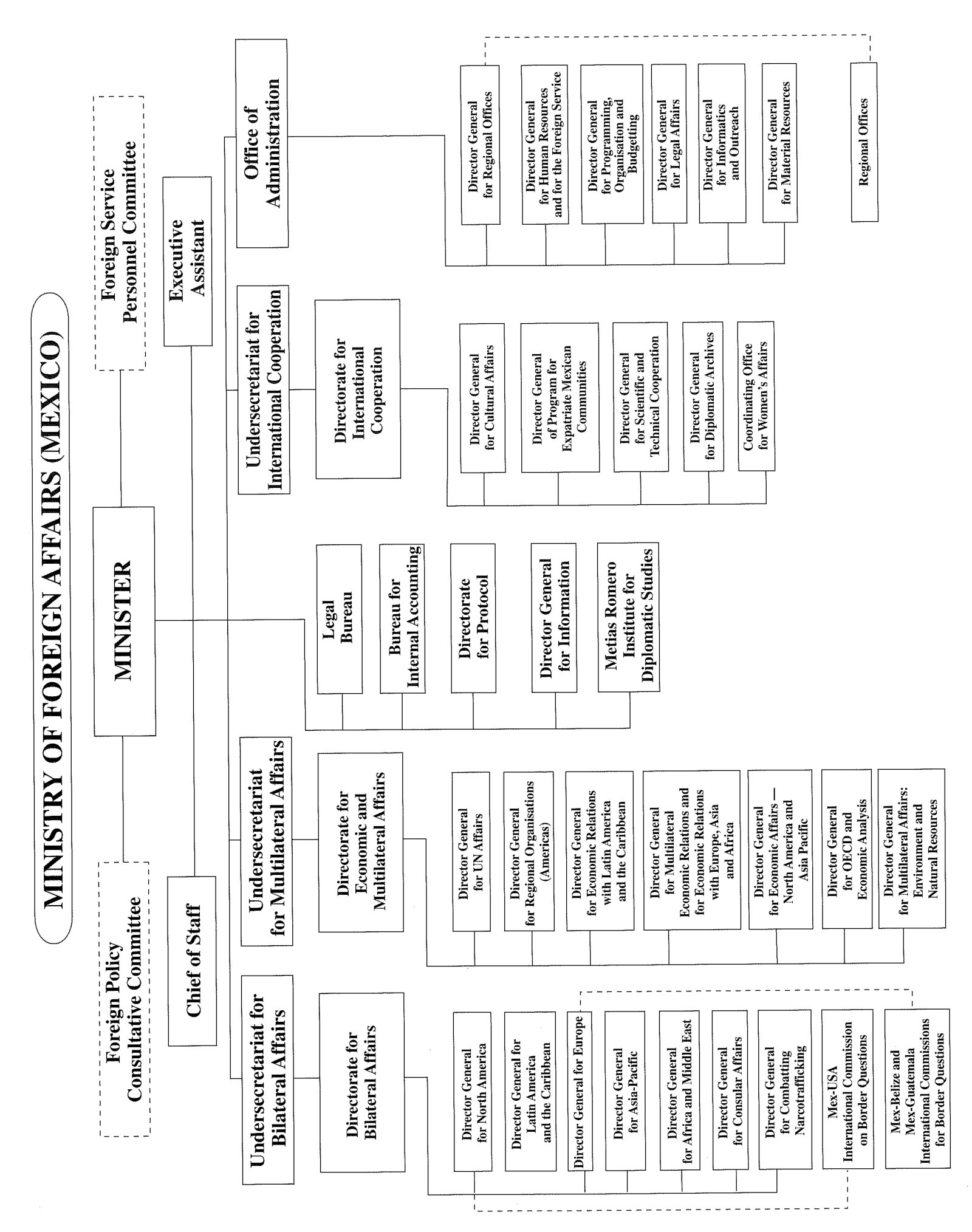
The Mexican Foreign Ministry is divided into four major areas: Bilateral Affairs, Multilateral Affairs, International Cooperation, and General Administration. I work for Andrés Valencia, Director in Chief for Bilateral Affairs, more or less our equivalent of an Assistant Deputy Minister. A small group of advisors in his office cover the different geographic areas of the world. My area of responsibility is the Western Hemisphere south of the United States. My job consists in keeping the Director in Chief abreast of important developments in the region, serving as liaison with the geographic desks, and reviewing briefing material for the Foreign Secretary and the President. It should be noted that international trade is handled by a quite separate ministry, known by the acronym SECOFI there is cooperation between SRE and SECOFI but the degree of separation is considerable and extends to Mexico’s overseas posts, where SECOFI officers function almost independently of the main Embassy.

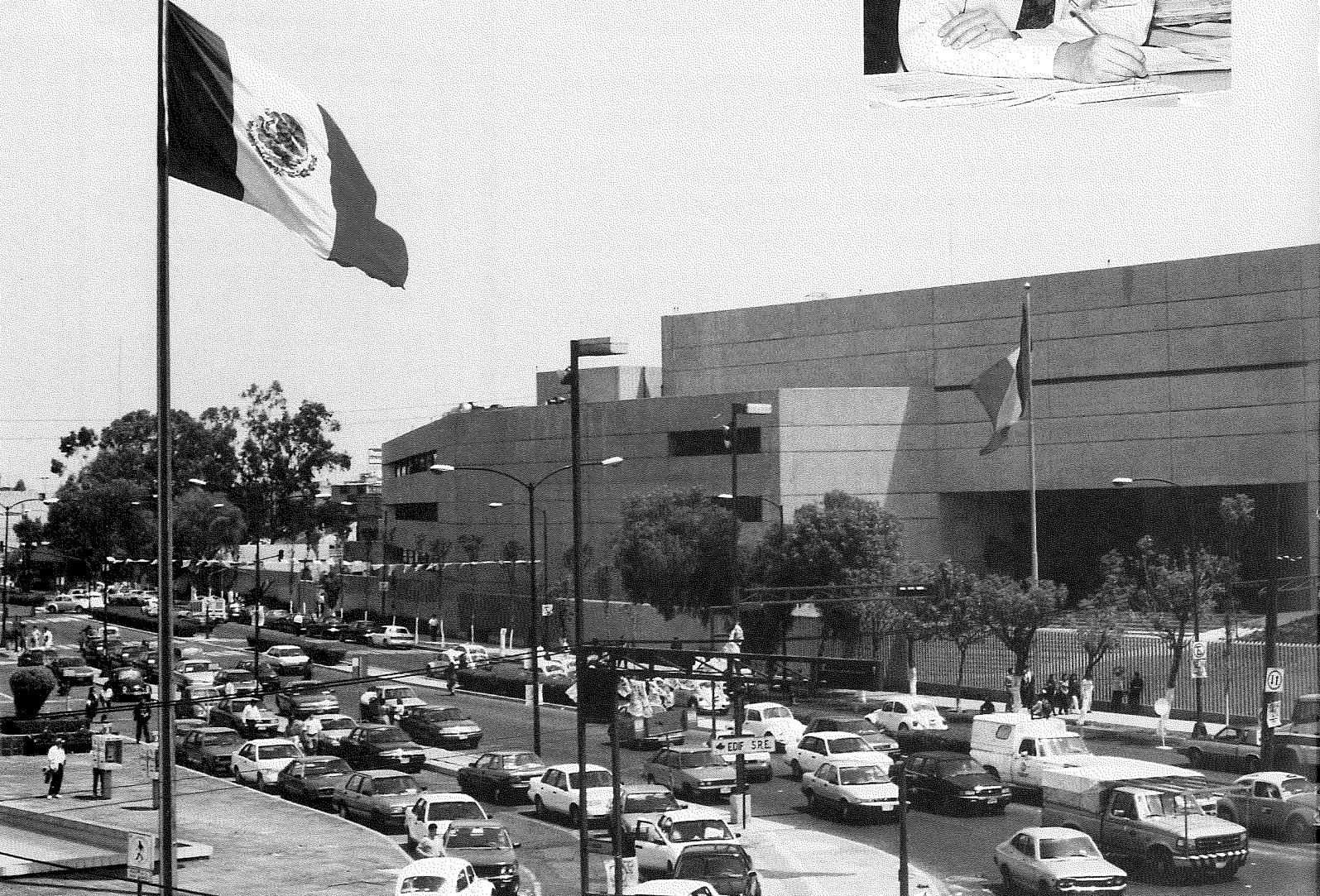
Assigning me the Latin American file was no accident. Canada has a growing interest in Latin America and DFAIT hoped to gain a better insight into Mexico’s perspective on the region. While I’ve certainly learned a lot about Latin America, I think that I learned even more about Mexico. Hopefully, the following paragraphs will be of some use, and consolation, to those who are sometimes baffled or frustrated by Mexican positions in international fora and elsewhere.
The Mantra: Sovereignty and Non-intervention
Respect for sovereignty and the principle of non-intervention are fundamental to Mexican foreign policy. It’s not too hard to understand why. Time and time again during the century following independence, Mexico suffered at the hands of foreign powers. It lost over half of its territory to the USA, following the 1846 invasion. During another intervention, the French installed a member of the Hapsburg family as emperor for three years from 1864-67. In stark contrast, Canada hasn’t had to defend itself from serious foreign attack since the War of 1812. Not only was the USA unsuccessful in its plans to occupy Canada, but Washington DC was raided and the White House burned down.
Out of its historical experience, Mexico developed a defensive foreign policy that stressed strict adherence to a set of principles, the most important being noninterventionism. Revolutionary leader Carranza was the first to articulate the fundamentals of Mexican foreign policy. He also proved the value of negotiating from a position of principles. Despite intense pressure from the USA, determined to influence the outcome of the Mexican Revolution, he refused to yield. Of course, it helped that the USA was being drawn into World War I and had other things to worry about.
Over the years, new principles have been added and finally enshrined in the Constitution. They now include: non-intervention, self determination, pacific resolution of conflict, proscription of the threat of use of force, equality of states, and international cooperation. Mexican diplomats have worked hard to gain at least formal acceptance in the UN of the principle of nonintervention. They have been less successful in the Organization of American States, dominated as it has traditionally been by the USA. As a result, Mexico continues to view the OAS with some suspicion. Mexico is also proud of its “peace” accomplishments, most notably the negotiation of the Treaty of Tlatelolco, prohibiting nuclear weapons in Latin America and the Caribbean.
A “doctrinal” foreign policy has its weaknesses. First of all, it limits your scope of action. Mexico has avoided seeking membership on the UN Security Council. Being a Security Council member would force it to take a stand on a number of issues that clash with its traditional commitment to non-interventionism.
Second, foreign policy principles are not carved in stone and need to be re-evaluated in the light of changing environment. This is hard to do as principles become assumed truths. Certainly the time seems ripe to reconsider concepts like sovereignty and self determination in the light of globalization. One way out of this dilemma is to treat foreign policy principles more like guidelines. This is what former President Carlos Salinas was doing when he approved the negotiation of the NAFTA.
New Policies for the Nineties?
The decision to negotiate a free trade agreement with the USA and then Canada was revolutionary in Mexican foreign policy. However, Salinas was determined to go ahead for much the same reasons as Canada in the FTA: there was a recognition of the increasingly limited ability of governments to dictate patterns of trade and development, a desire to secure access to the USA market and limit its propensity for unilateral trade actions, and a guarantee was sought against the possible failure of the Uruguay Round of trade negotiations. At the same time, Salinas sought to reassure Mexicans by stressing that he was acting in “strict accordance” with Mexican foreign policy.
The end of Salinas’ term in office (1994) was a heady time in Mexican foreign policy. There was a sense that Mexico was setting the example to the world of how to make the transition from the Third to First World. However, events proved otherwise. The December 1994 economic crisis exacerbated a situation already fragile due to the Zapatista uprising in Chiapas, the assassination of presidential candidate Luis Donaldo Colosio and PRI Secretary General Ruiz Massieu. The ensuing devaluation and capital flight plunged Mexico into crisis and wiped out many of the gains under Salinas.
Mexico was forced to turn to the USA for financial guarantees but this in turn heightened Mexican concerns about their vulnerability. The relationship with the USA, always prone to tension, was made worse by the increasingly controversial certification of Mexico’s war on drugs and new USA legislation cracking down on undocumented migration. Mexican foreign policy retreated to its more traditional, defensive emphasis on sovereignty and non-intervention.
Mexico is now making a renewed effort to diversify its international and commercial relations. First, it is seeking to negotiate a comprehensive agreement, but particularly a free trade agreement, with the European Union. Mexico is also trying to regain the influence that it had in Latin America before the NAFTA. Relations with Latin America have become a new priority: both the Rio Group and the Iberoamerican Summit dynamic were the result of initiatives by Mexico, and Mexico has cemented trade relations with South America through a number of free trade agreements, most notably with Chile and with Colombia and Venezuela (G-3).
However, the intense NAFTA negotiations necessarily absorbed much of Mexico’s attention from 1991 to 1994 and created some confusion and resentment in the rest of Latin America. In the interim, Brazil consolidated its influence in the Mercosur, and increasingly in other parts of South America. As a result, the relationship between Mexico and Brazil is somewhat uneasy. Argentina, another regional power, is viewed with some mistrust, due to its willingness to support what are seen as USA initiatives in areas such as peacekeeping.
Before turning to other topics, a comment on non-interventionism is in order. It’s easy to criticize the Mexican position as being out of step with the times. However, perhaps Mexico has some grounds for its deep distrust of the “new” rationales for outside interventions — as far back as the early 1900s, the USA was justifying its actions in Mexico in terms of restoring democracy. As Canada continues to be drawn into situations like Haiti, Bosnia and Rwanda, it behooves us to be very clear about what we hope to accomplish and how.
Move Up or Move Out
Back to the SRE. Without counting locally engaged staff, both DFAIT and SRE employ about 4,000 staff, of whom between 1,300- 1,600 are foreign service officers. One major difference is that the SRE includes its Adminstrative-Consular officers within this group of foreign service officers. This reflects the particular importance that Mexico gives to consular activities. Mexico’s network of consular offices in the US — over 50 if honorary consuls are included — is the most extensive anywhere, of any foreign service.
One thing that initially surprised me was the number of desk officers that are not members of the foreign service. Many are contracted for their expertise in a particular area while others are doing their “social service”, a kind of practicum prior to finishing their degrees. “Social service” provides the SRE with basically free labour, gives the participants an insight into foreign policy, and allows both parties some time to decide whether to make the relationship more permanent. However, unless you become a foreign service officer, or have political connections, your prospects for advancement are limited
The selection of foreign service officers is similar to ours in Canada. For budgetary reasons, this is the first year since 1994 that the foreign service exam has been held. The exam takes place in Mexico City. Candidates need to be Mexicans by birth, have completed a university degree, be fluent in Spanish and one other language, and be able to translate a third. About 500 candidates sat the exam this year, of which 60 continued to the essay and interview stage. The selection committee is dominated by academics, perhaps to reduce complaints of favouritism. Only twenty candidates will actually be hired.
Perhaps more interesting is that fact that, by law, Foreign Service officers are required to either “move up or move out.” Officers have seven years to gain a promotion or risk being fired. Promotions are based on seniority, work evaluations, academic output, and the result of a promotion essay and interview. However, the requirement to move up within seven years is not currently being enforced, since the money has not been available for the promotion exercise. Personally, I think we could learn something from this promotion system. While it is still very subjective, it is based on a number of criteria and not solely on the quality of a work evaluation.
Who Calls the Shots?
Something that has really struck me is the difference in decision-making between our two foreign ministries. Decision-making at the SRE is very centralized. Senior management deals with an enormous variety of issues, including, of course, the most crucial, but also many that are mundane. The personal relationship between the key decision-makers is essential to the smooth functioning of the system and there is frequent contact by telephone or face to face. In fact, there are two internal phone networks (with separate phones) offering increasingly privileged access.
This system has the advantage of responding quickly and with precision to the demands of the Secretary and his closest colleagues. For example, I’ve generally been impressed by the conciseness and clear focus of briefing material prepared for the Secretary and the President (a welcome contrast from the briefing books that I remember from the Pearson building that rivalled the telephone book in size in an effort to include every topic imaginable….). In addition, senior management at SRE appears to have an incredibly detailed knowledge of everything going on within their respective spheres of responsibility.
On the down side, top officials — and personnel in their offices — work extremely long hours (right now my average work day starts at 9:30 am and ends at 9:30 pm.) Since there is no overtime pay, there is little incentive to make better use of officers and support staff. During the week-end before the May 1997 visit of President Clinton, half of the Foreign Ministry seemed to be on call or at work.
Information sometimes stays at the senior levels and doesn’t trickle down to the desk officers or directors at the working level. The scope for responsibility and initiative for many officers is limited; a lot of time may be spent waiting for instructions to come down or for the inevitable crises.
While the centralization of decision-making may vary from one administration or Secretary to another, one thing remains constant: the importance of personal relations. One way that this manifests itself is in greetings. I must have become thoroughly acculturated because now I feel an uncontrollable urge to shake hands whenever I see someone (the folks at our own Embassy look at me a bit strangely when I stop by). I’ve also learned to enjoy two-hour lunches. Not only does it beat choking down a sandwich in your office in 20 minutes while you finish reading the circ pack but it plays a crucial role in establishing and maintaining your working relationships (this is one reason why I doubt that the SRE will move to a 9-5 workday any time soon.)
My best memories of the SRE will be the warmth and graciousness of the people I had the pleasure of working with. In my experience, Mexicans have a wonderful capacity for making people feel important. They can also respond to even difficult situations with great tact and humour. Corny as it sounds, I feel honoured to be here.
View the original scanned pages →
Originally published in bout de papier, Vol. 14, No. 4 (1997) — Winter 1997 // Hiver 1997, pp. 22–25. Read the rest of this issue →



