
bout de papier, Vol. 15, No. 2 (1998) — Summer 1998 // Été 1998, pp. 46–47
Alert readers of the previous issue of bout de papier will have noted the striking absence of the necessary chart from the Aalto puzzle “Buenas tardes, Señor Liebnitz”. We are now in a position to confirm that the chart was stolen by a six-foot shark with a pencil-thin moustache, wearing an Armani suit and a silk shirt monogrammed “RS” For further details, read on……
Returning to the office after the PM’s visit to Central America, Liebnitz was startled by the air of panic in the corridors, and even more startled by the root of the problem: the disappearance of the Business Plan drafted by the Embassy in Escorial. “But I just left there,” he protested to Chief MacBannock. “Sure, Jimmy the Turk encrypted the plan, but Felix Africa and I cracked it and it was faxed here before I got on the plane at Boca Grande. What’s the problem now?”
MacBannock was keeping a tight hold on his composure (normally to be found in a small sandalwood box on his desk). “It’s a lot more serious than we thought, Liebnitz. Jimmy was onto a major threat against our nation’s political system, a terrorist strike against Southern Ontario! Now Ludwig, don’t look so sceptical. These things can happen anywhere. Anyway, Jimmy’s report arrived this morning with the indication that it made use of the same cypher as the Escorial Business Plan. It reads like this.”
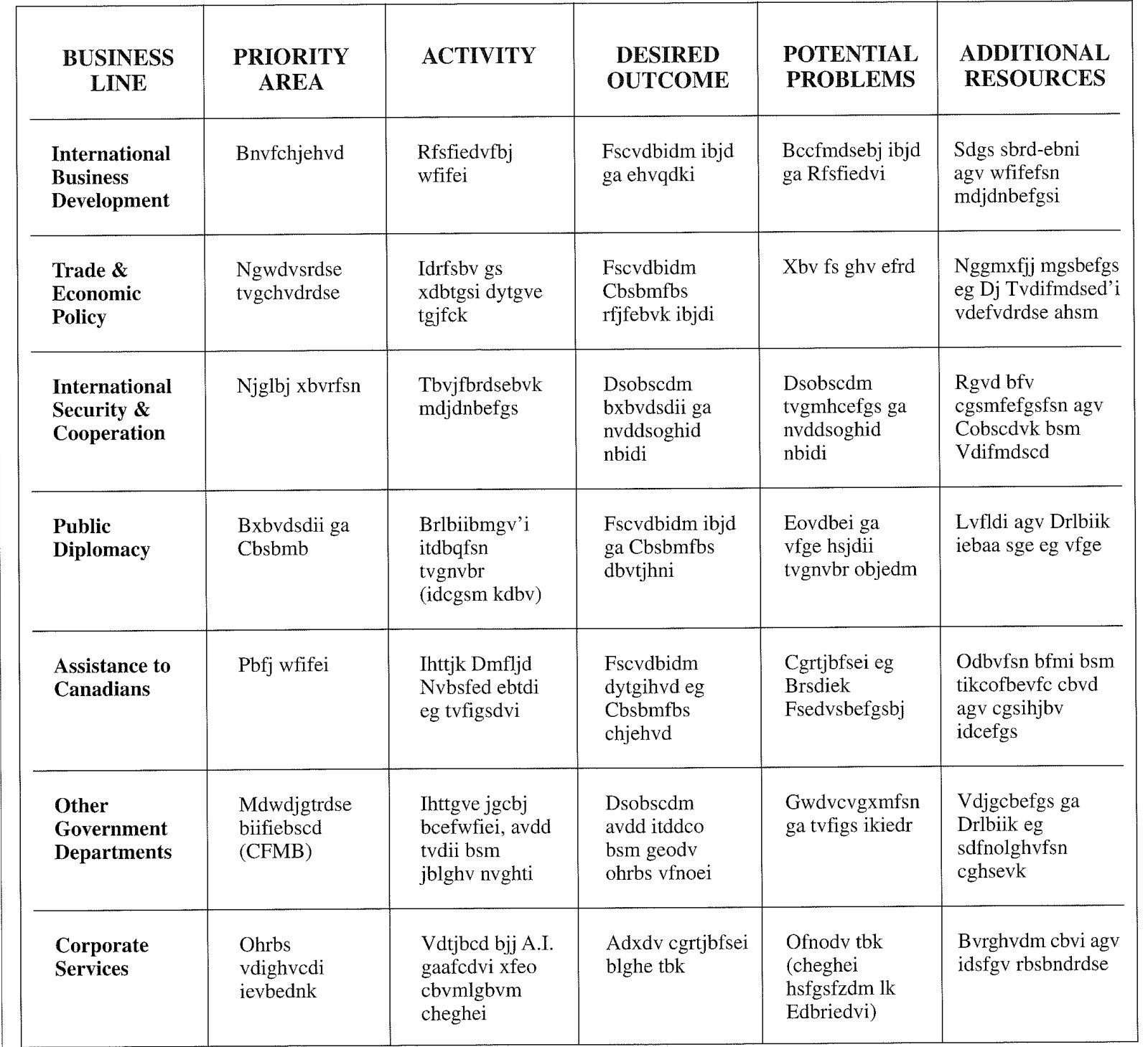
The following five clues relate to two towns in Ontario west and south of Toronto. Four relate to the same town, which is being used as the terrorists’ headquarters. The other clue identifies the town where they will strike.
(a) LDEXDDS JGSMGS BSM TBVFI,
IGHEOXDIE GA XOBE HIDM EG
(b) GS EOD BWGS ODVD BSM FS EOD
HQ KDE SGE FS CGSSDCEFCHE.
(c) KBINHV’I ABVR FS EOD IHRRDV
GA 69.
(d) TDBSHEI LFVM AVFDSM.
(e) SDBVDIE EGXS EG COHVCOFJJ’I
The following is the event the terrorists plan to disrupt. It is a 3-word anagram, enciphered with the same system: EVFAI RFI- IDVEFS DREFNDS.
The Chief continued: “With you on the PM’s plane home, Liebnitz, we looked for the Business Plan to reconstruct the cypher. But although we had copies of Jimmy’s original encrypted version, the solution you worked out with young Africa had disappeared! And not just the copy faxed to the Centre here, but every copy in town – even the one bout de papier was going to publish in its “worst practices” column. Apparently the terrorists got wind that Jimmy was onto them. They were too late to stop his report from getting to us, but tried to delay us by eliminating all trace of your solution to the cypher.”
“I suspect this means the return of my old nemesis, Rialto Sleazewagon, after his fall into the piranha tank at SuWaNi,” mused Liebnitz thoughtfully. “That would also explain the seven-ton tuna that leapt from the canal and nearly crushed the limo on our way in from the airport. I thought it was a bit early in the day for sushi. Someone just wanted to keep me from duplicating my work.” So saying, he took the encrypted Business Plan in hand, solved it and used the same cypher to work out Jimmy the Turk’s report. Handing the result over to MacBannock, he muttered, “I still don’t believe terrorists threatening Southern Ontario. How could they stay awake long enough to do any damage?”
Can you duplicate Liebnitz’s feat by: (a) providing the plaintext Business Plan; (b) naming the town that is the terrorists’ headquarters; and (c) identifying the town and the event that are the terrorists’ target. bout de papier will decide the winner by drawing from a box containing all correct entries received by October 5, 1998. The winner will receive a book prize autographed by A Aalto. This contest replaces the one announced in the previous edition of bout de papier.
As a reminder, the cipher used by the Turk was a simple alphabetical substitution, with one letter in the cipher-text always replacing the same letter in the plain-text of the original message. These puzzles can generally be solved by doing a letter-count: E is usually the most common letter, with A/I/N/O/R/S/T next in some order. Jimmy also indicated that if you wrote out the cipher-text letters in a column in alphabetical order from A to Z and then wrote down the plain-text equivalent letter beside each cipher-text letter, the first I plain-text letters would spell out a word that contained all five vowels.
View the original scanned pages →
Originally published in bout de papier, Vol. 15, No. 2 (1998) — Summer 1998 // Été 1998, pp. 46–47. Read the rest of this issue →



