
bout de papier, Vol. 15, No. 2 (1998) — Summer 1998 // Été 1998, pp. 34–38
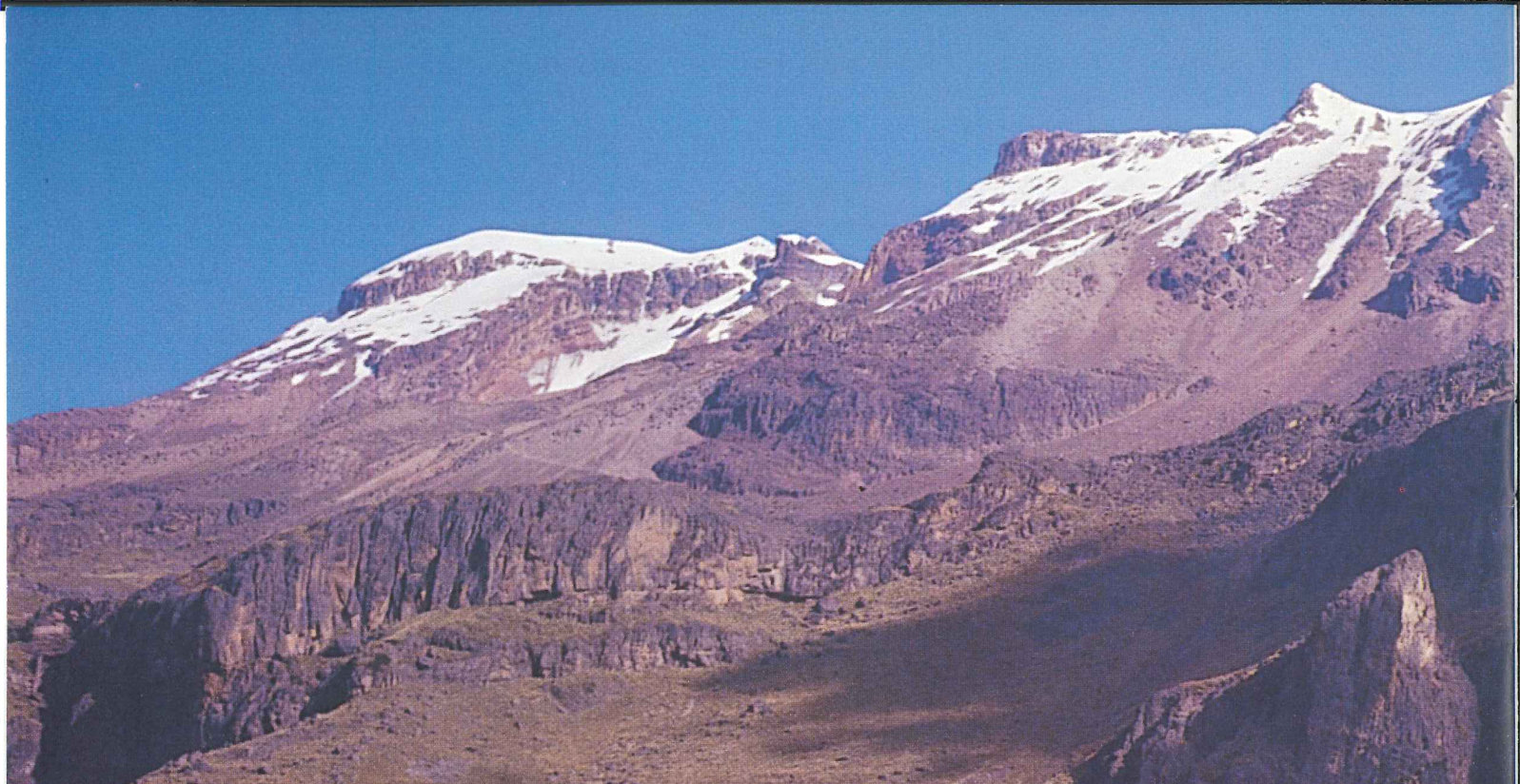
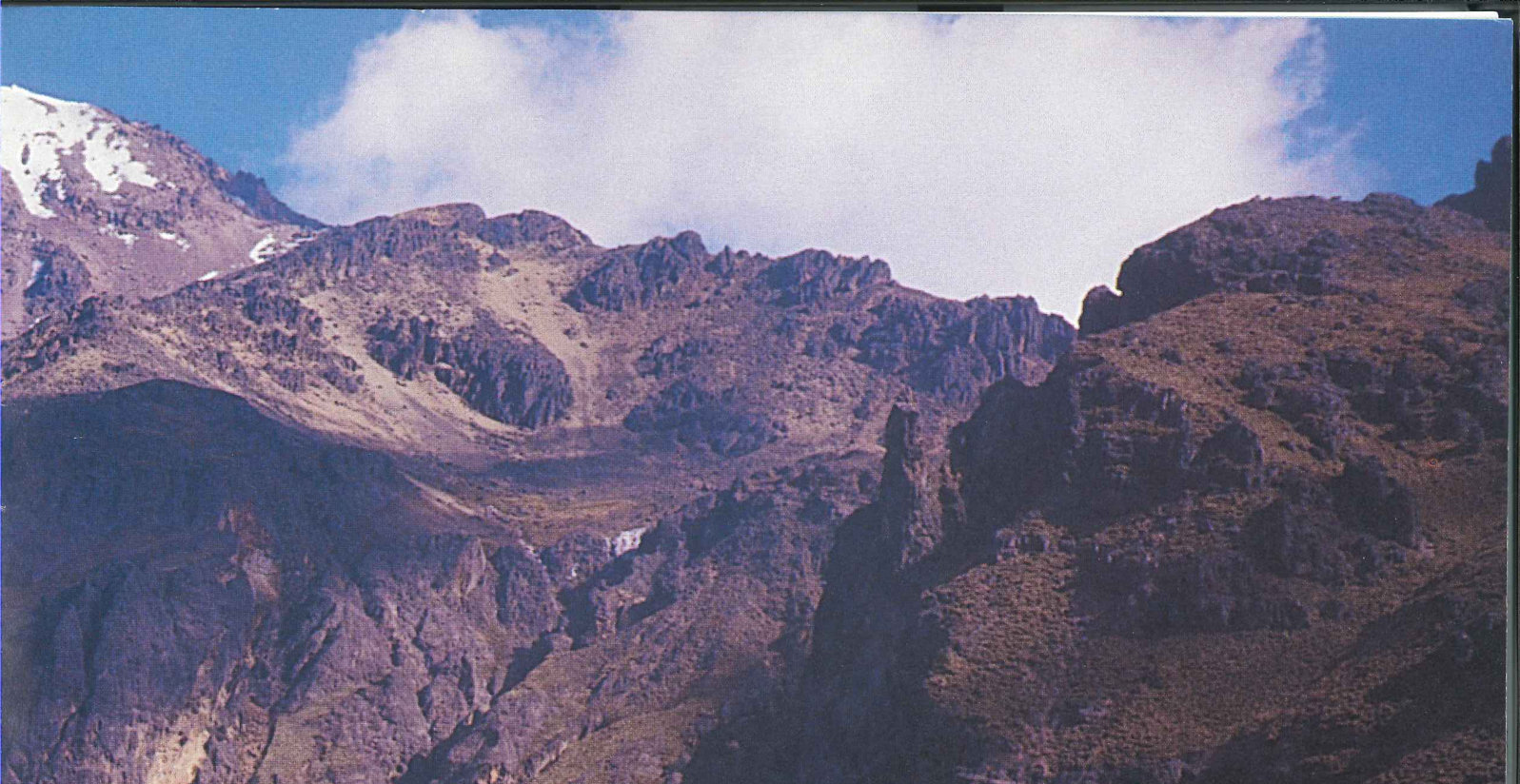
Diplomatic life in Mexico has produced at least one literary masterpiece. It is hardly flattering to the profession: Malcolm Lowry’s dishevelled hero in “Under the Volcano”, the British Honorary Consul in a thinly-disguised Cuernavaca, spends the entire book staggering around in a mescal-induced haze. He is only dimly aware of a menacing world of shadows and dark spirits around him, of which a great and powerful mountain – the volcano of the title
– forms part. The volcano really exists. It is Popocatépetl (Popo for short), 5452 metres in altitude and a mere 70 km from the centre of Mexico City, a little less from Cuernavaca. You can rarely see it these days from Mexico City on account of the smog, but if you happen to fly in by day and from the Southeast, you may be startled to find that the pilot takes you below and within a mile of the snow-capped conical summit; sometimes you can even catch a glimpse into the crater. During my two-year posting, I set out to climb not only Popo but all the principal peaks of central Mexico. The experience was exhilarating, exhausting, occasionally hallucinatory and involved a great deal of staggering around — all in all, a bottle of mescal would have been a cheaper and quicker way of achieving the same effect.
The Nevado de Toluca — the drive-in Volcano
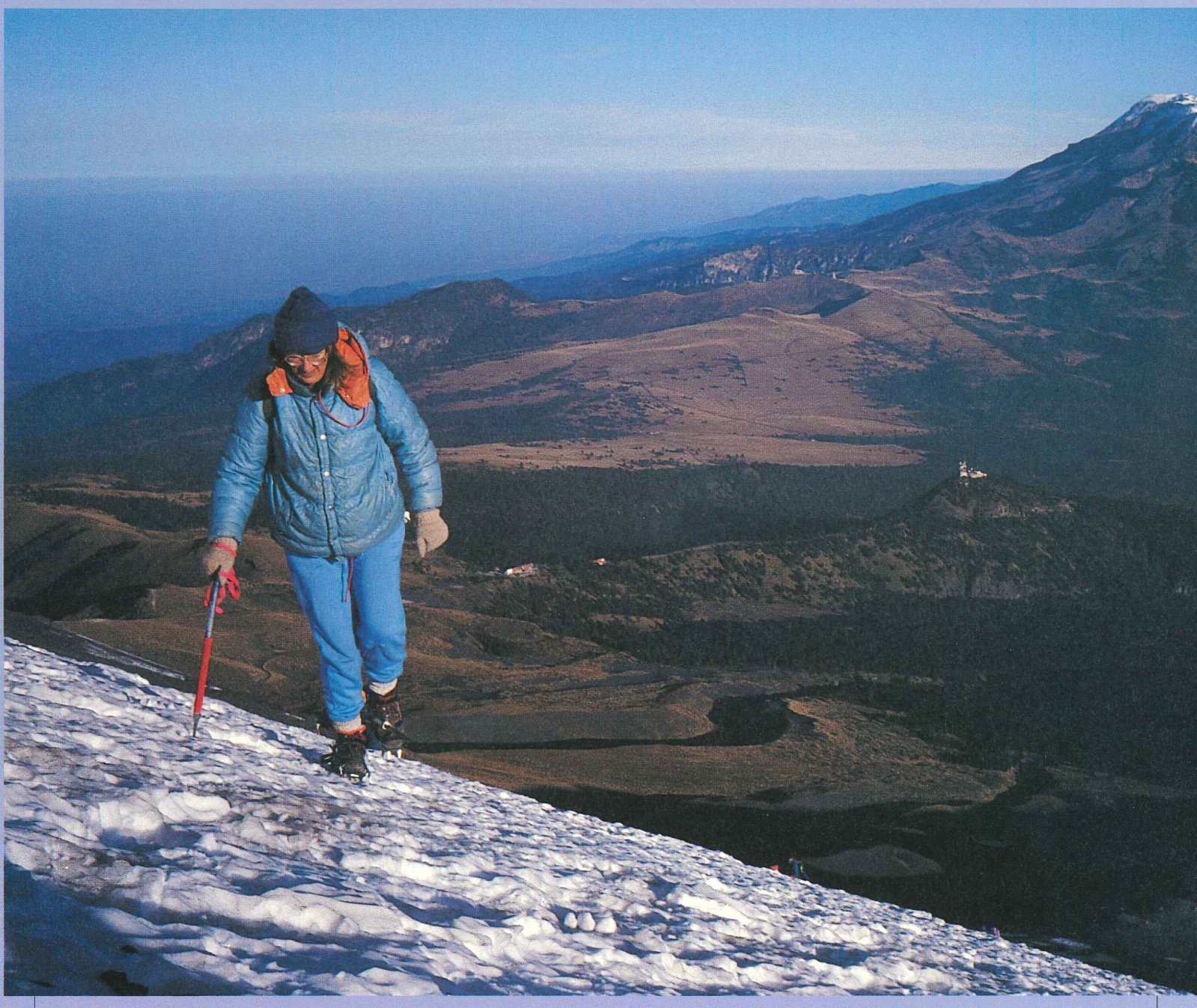
The Nevado is a great hulk of a mountain that bursts up out of densely-cultivated agricultural land in the populous State of Mexico, some three hours’ drive from Mexico City. A two-lane metalled road gradually disintegrates into a dusty track as it zigzags up through thinning pine forest. Around one bend, you suddenly come to a barrier across the road: a polite and timid campesino, with a rifle slung over his shoulder, comes out from behind a tree and collects a small toll. It is unclear whether this toll is officially sanctioned; you suspect not.
Emerging from the trees the road skirts around the flank of the mountain and disappears through a nick in its side. It is rather disconcerting to find yourself then coasting gently down to the shores of a small, black and cold-looking lake and to realise that you are in the crater itself.
From the crater, it’s two or three hours scrambling to virtually any point on the rim. It’s cold at any time of the year, there are usually snowfields to negotiate and, once you are past 4500 metres, most hikers find the tell-tale queasiness of altitude sickness begins to kick in. However, none of this puts off determined “Chilango” (Mexico City-dwellers) weekenders. They flock to the Nevado in their dozens: plump, stocky women in neon-orange tights and high heels, clutching the family pooch to them as they negotiate scree slopes and requiring pushes up the steep parts; sullen teenagers in American-college sweatshirts lurking in crevasses and trying to get some noise out of their boom boxes; the population of an entire Mexico City barrio using your car as a goal post for an impromptu soccer game on the crater floor. Definitely not your average volcano.
Volcán Orizaba — a mountain with serious altitude
Orizaba is not to be knocked off as lightly as Toluca. At 5780 metres, it is the third highest mountain in North America, after McKinley (Alaska) and Waddington (British Columbia); at this altitude nothing is easy.
The Embassy team was a motley but capable one: André Charbonneau (at that time posted at our High Commission in London, here on vacation); Nathalie Mathiasen from our Immigration Section in Mexico, along with her husband Dave, a US Marine; Elizabeth Gammell, Trade Commissioner at the Embassy; myself; my wife Jenny (Systems Administrator at the Embassy) and our guide, Ricardo. Ricardo, at least, knew what he was doing: he is one of only two Mexicans ever to have climbed Everest and is widely regarded as the country’s foremost climber.
Ricardo has everything organised. It takes us the best part of a day to drive to Tlachichuca, a small village some 1 150 km inland from Veracruz. Here we transfer to the back of a truck; those who have a presentiment of what is coming squeeze into the front cabin, while the rest blithely enjoy the sunshine and fresh air on the flatbed. It’s four hours of lurching up a deeply rutted dirt road that simply disappears for long periods in the forest. We are thankful it hasn’t been raining recently, but we are all soon coated with a centimetre of gritty brown dust that makes breathing and keeping our eyes open unpleasant.
The “refuge” is a great cavernous stone building in scree at the foot of Orizaba’s cone. There is no glass in any of the windows, and by the time it’s ten below, just after dark, we wonder what is the point of actually sleeping indoors. Nobody really feels like eating, but Ricardo forces pasta down us until we are feeling sick.
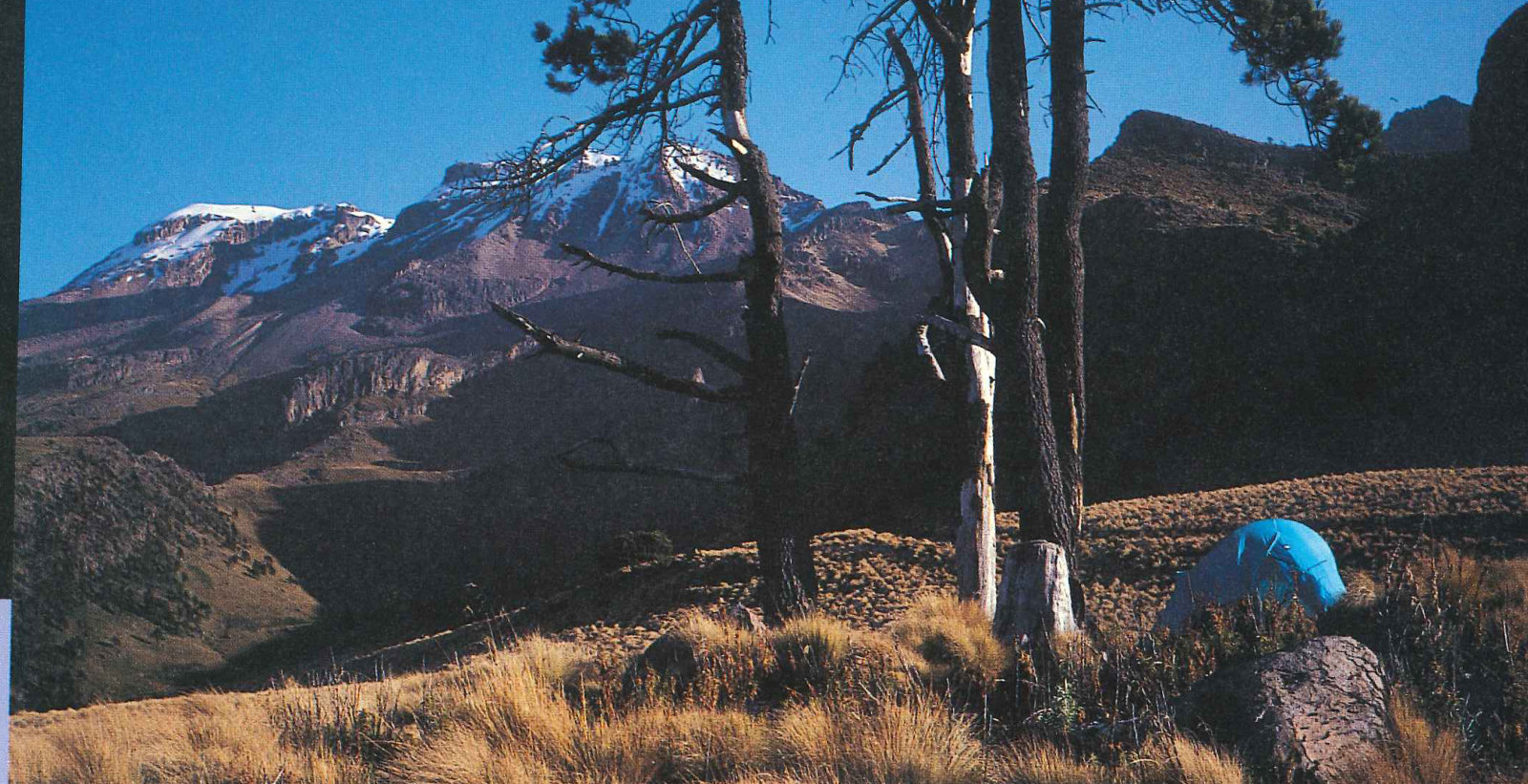
We’re up at midnight, off at I a.m. Two feet apart, eyes on the boots in front, we begin zigzagging our way up, at a snail’s pace, first on scree, then on hard-packed snow. Nobody speaks. I can’t decide if I feel sick or want to go to the bathroom; I soon find I am doing both, repeatedly. At the snowline, just after dawn, the view is breathtaking. At least, I suppose it must be: I take some pictures and wonder if I have ever felt worse. Two of our team decide to drop out. I envy them, but I know that Jenny will go on — if I drop out here, the embarrassment will be too much. What seems like many hours later but is actu ally only I a.m., we are all strung out in a vertical line, ten feet apart, with the leader only feet from the rim of the volcano. We are roped up and crampons allow us to stand with some degree of security on the hard-packed snow slope; we’ve just carefully negotiated our way around the final crevasse. There is no sense of anticipation, no excitement: those at the top of the line wait dully while the stragglers inch their way up. Five steps. Rest. Three steps. Rest. The rests get longer and longer, the steps shorter.
Ricardo finally rallies us. We all hold hands and lurch crazily forward: this way, everyone reaches the top at the same time. We’ve made it! To great applause and admiration – this is the most energy anyone has displayed all day — Dave pulls out a bottle of champagne from his backpack! He sprays it everywhere but is understandably crestfallen when, one by one, everybody politely passes on drinking from the bottle – we all find the prospect of champagne physically repellent at this moment.
Disappointingly, the summit is crowned by a heap of old scrap-iron and the remains of several car batteries. Who can possibly have carted this up here, and why?
Ixta — the sleeping princess
Ixtaccíhuatl, according to Aztec legend, is a sleeping princess, jealously guarded by her prince (Popocatépetl) fifteen kilometres to the South. The mountain is elongated in shape, not conical, and it does indeed resemble a reclining woman, with her knees pulled up. The several snow-capped summits are known as the Knees, the Breasts and the Nose, with the left breast (from the Princess’s point of view) reaching the highest point (5286m).
Although Ixta is not as high as either Popo or Orizaba, it’s a more complicated and technically challenging climb, and weather conditions on top can change with treacherous speed. Most years, two or three climbers are killed in snow and wind storms: Ixta deserves a good measure of respect.
The obligatory axle-scraping dirt track leads from the saddle between Popo and Ixta — the Pass of Cortés, for it was from here that the Spanish conquistador first sighted the fabulous Mexico-Tenochtitlan in 1517 — to a litter-strewn parking area. From here, it’s a varied walk/climb, for some six or seven hours, to the tiny geodesic-dome refuge that, when the sun glints, can just be made out on the skyline.
Here, at 4900 metres, with the great metropolis of Mexico City spread out far below us like a glittering jewel-box and the stars above as brilliant as you will ever see, I spent one of the most unpleasant nights of my life: one after the other, I seemed to be hit by waves of nausea, diarrhoea, intense thirst and shivering fits, these in spite of the piles of down garments that I had heaped upon myself. My trudge to Ixta’s left nipple, on a morning of brilliant sunshine and icy deep blue skies, was a re-run of the nightmare on Orizaba, although when I look at the pictures today I try to convince myself I enjoyed it…
Popo — into the abyss
At the Paso de Cortés there used to be a statue of the Spanish conquistador. He is not greatly admired in Mexico, to put it mildly, but even his worst enemies should admire his daring and fortitude. His arrival at this windswept place is one of the defining moments of modern history, on a par with Balboa’s sighting of the Pacific from “a peak in Darien”. The spectacle the Spaniards beheld is described by a common footsoldier, Bernal Díaz del Castillo, writing fifty years after the event:
…when we saw all those cities and villages built in the water, and other great towns on dry land, and that straight and level causeway leading to Mexico, we were astounded. These great towns and temples and buildings rising from the water, all made of stone, seemed like an enchanted vision from the tale of Amadis of Gaul. Indeed, some of our soldiers asked whether it was not all a dream. It was all so wonderful that I do not know how to describe this first glimpse of things never heard of, seen or dreamed of before”
Months later, as he lay siege to Mexico City, Cortés would regularly send his soldiers back to the pass and up Popo itself. Their mission was to descend deep into the crater to gather sulphur for the making of gunpowder. This they did so often that it became a routine (a sobering thought for would-be climbers of today.
Some vandal – or was it the government in some fit of supreme nationalist zeal? — has long since removed the statue of Cortés, and all that remains today is a crumbling plinth.
As is the case for Orizaba, the ascent of Popo is best begun before dawn – leave much later and you will find yourself approaching the summit when the snow is at its mushiest and forward progress becomes impossible. This time, I had a new strategy: coca. Coca, in the form of teabags and made from raw, green coca leaves, is entirely legal in Mexico, and is supposed to be a particularly good remedy for those who suffer from altitude sickness. I don’t know about this, but I can now vouch for its emetic qualities.
The approach to the cone of Popo, from the usual campsites or the refuge at Tlamacas, is a long and skirting one through shale and fields of black volcanic dust: hard going in that, for every two steps up, you slide back one. It’s about two and a half hours to a rocky platform (“Las Cruces”) just below the usual snowline. From here you can see straight up to the rim: as the guidebook says, “proceed to the summit”
It’s a deceptively long trudge to the top: an unremitting 40 degree slope on hard snow with a dirty crust of volcanic dust. But as you rise further and further above the morning mist and clouds that still fill the valleys far below, as the air thins and the morning stars fade in the deep blue sky, the awareness of just where you are begins to sink in. The immediate horizon is the same right and left: the perfectly straight, 40 degree angle. Looking beyond it to the right, 110 km away, you can clearly see the Nevado de Toluca, the first rays of the sun just catching patches of snow on its black flanks. To the left, at 140 km, is the cone of Orizaba: behind, the clouds merge faintly into the pale blue of the Gulf of Mexico. At your back, and already on the same level, the summit of Ixtaccíhuatl. At this moment, barring aeroplane passengers and expeditions to the relatively unfrequented Orizaba, you’re the highest person in North America.
The crater is everything a volcanic crater should be: clouds of foul-smelling steam waft up as you peer in, wary of coming too close to the sheer edge. Somewhere on the floor, 400m below, you can make out patches of bright yellow and orange: it’s too windy to hear anything this morning but you’re sure that, if the wind died, you’d hear Popo bubbling and spurting. It’s sinister, menacing, and you start to feel a little uneasy. The rim of Popo isn’t the kind of place where you want to hang around.
Next time you’re sitting on the starboard side of the early morning flight to Oaxaca, and the plane banks around the mountain, you can’t help feeling just a little smug, even possessive: you have stood just down there, and you looked scornfully over your shoulder as this very same flight laboured past, below you.
View the original scanned pages →
Originally published in bout de papier, Vol. 15, No. 2 (1998) — Summer 1998 // Été 1998, pp. 34–38. Read the rest of this issue →



