
bout de papier, Vol. 15, No. 3 (1998) — Fall 1998 // Automne 1998, pp. 40–41
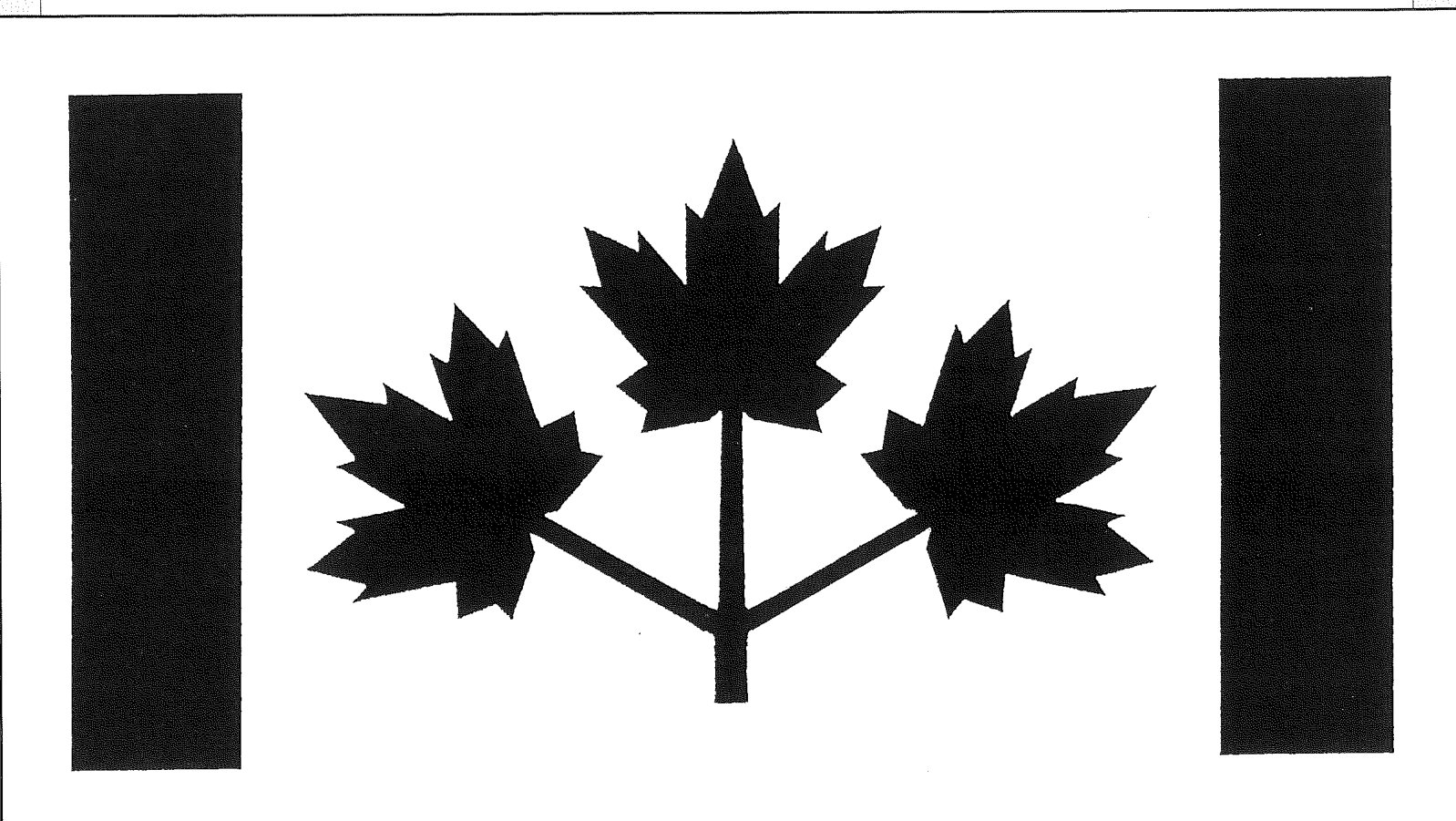
As recalled in the Summer issue Vol. 15 No. 2 of bout de papier, John Halstead was a remarkable man of diverse talents and interests. Many associates of his on the editorial board of bout, as well as other readers, know that Halstead was actively involved in the search for a distinctive national flag for Canada. Christopher Cook, a freelance historian in Ottawa currently employed as an editorial assistant in DFAIT’s Historical Section, found early evidence of Halstead’s involvement in the Lester B. Pearson Papers at the National Archives of Canada
Along with others who had served in the armed forces during the Second World War, Halstead believed that the use of the Red Ensign or the Union Jack to symbolize Canada internationally detracted from the country’s independence in international affairs and implied an inappropriate subordination to the United Kingdom. When Halstead prepared the memorandum reprinted below, which was seen by Pearson, the question of a Canadian flag was once again before the House of Commons. Though Halstead’s specific recommendation was not interjected by Pearson into that debate, it did resurface a decade later when Pearson, by then Prime Minister, proposed what was unfortunately but effectively mocked by John Diefenbaker and others as the ’Pearson pennant.”’ That proposal bore a remarkable resemblance to the sketch reproduced below, which accompanied the memorandum. But, as Halstead had anticipated this was “a delicate and uncertain field charged with emotion and irrational association”. Confronted by dissension and controversy over the particular design, Pearson substituted what is now our national flag for the “pennant” devised by Halstead
The sentence which appears within square brackets took the form of a footnote in the original document.
Memorandum
To: Miss [Mary] Macdonald, Minister’s
Office
From: J.G.H. Halstead [Defence Liaison
Division]
Security: PERSONAL
Date: February 10, 1954
Subject: Canadian National Flag
Following your suggestion the other day, I am outlining below, for what they are worth, some thoughts on the subject of a Canadian national flag which may be of interest to the Minister in connection with the forthcoming debate in the House.
What a Flag Should Do
National symbolism is a delicate and uncertain field charged with emotion and irrational association. I therefore enter the field with considerable trepidation and with the knowledge that I may be making too neat and logical a pattern where none exists.
A national flag should, I think, serve two main purposes. It should represent Canada abroad; and it should represent to Canadians the spirit which unites the country as a whole.
Increasing Demand for a Flag
There has in recent years been an increasing demand in Canada for a distinctive national flag. It is true, however, that in the past there has been insufficient public interest or support for the proposal, or at least for any one of the many proposals put forward, to enable a generally acceptable design to be adopted. This is not a matter which can or should be artificially pushed. It has yet to be seen whether public sentiment is now strong enough to warrant definitive action. I do believe, however, that there has been in Canada since the last war a striking growth in national consciousness and national pride and an accompanying feeling that we should have a flag which will be a suitable symbol of these things.
As recently as the last war it was the experience of Canadian servicemen in Europe that they were generally regarded either as “Englishmen” or as “Americans”. It was difficult, if not impossible, for the ordinary European to grasp the fact that Canada and Canadians were something apart from – though admittedly intimately associated with — our neighbours south of the border and our cousins across the Atlantic. Since then Canada’s distinctive position in international affairs has become more widely recognized. Ambassadors and Ministers have been exchanged between Canada and an increasing number of other countries; Canadian delegations in the United Nations and at international conferences have played an active and often influential role; and there has developed a Canadian foreign policy based on an independent view of the world. Now for the first time in peacetime there are Canadians serving in many countries overseas and allies serving in Canada for the collective security of the free world. In these circumstances, the absence of an accepted symbol of Canadian nationality is a growing inconvenience.
We should perhaps ask whether the red ensign, used at present as a Canadian flag, or the Union Jack, which is also regarded by some as the only legitimate Canadian flag, is adequate. I think it is clear that neither is fully representative of the Canada of today. Even the red ensign (commonly known as the “Canadian Ensign”), although it contains the shield from the Canadian coat of arms, hardly meets this requirement. It might once have symbolized the political origins of our country and part of its evolution to nationhood, but to adopt it now would surely not agree with present-day facts. The Union Jack can hardly be regarded as the symbol of the Commonwealth since the epoch-making changes that have taken place in that association in the last few years. [The flags of the United Kingdom, Australia, New Zealand and South Africa contain the Union Jack (though in the last case it is hardly discernible) but those of India, Pakistan and Ceylon do not.] Moreover, the Commonwealth is only one of the associations to which Canada belongs today.
There are other objections to the “Canadian Ensign”. From the visual point of view it is not very satisfactory because the shield which is the “Canadian” element in the design is so placed that when the flag is flying it is often invisible or difficult to make out. Even if it were easily visible, it is doubtful whether most foreigners would recognize the shield as Canadian, since the maple leaves which it contains occupy a relatively minute space.
What Characteristics Should a Canadian Flag Have?
The national flag of Canada should be distinctively Canadian and should be readily recognizable as such at home and abroad. The only symbol which meets this requirement, as far as I know, is the maple leaf. It is also the only symbol of Canadian origin in the Canadian coat of arms. The shield contains a sprig of three green maple leaves on a white or silver background.
The design of the flag should be heraldically acceptable, since a flag is by definition a heraldic device. Many of the designs put forward recently have failed to meet this requirement.
The flag should be simple, easily learned and easily reproduced.
The flag should emphasise those things which unite us. It should therefore avoid as far as possible symbols which represent particular interests or particular associations which may be potentially divisive.
The flag should not be too closely tied to historical or geographical factors which might change. I think it would be a mistake, for example, to attempt to represent the ten provinces since changes in this number might necessitate awkward changes in design.
Finally, the flag should, by its general form and colour, suggest Canada’s political affiliations and associations. For the reasons I have already given, I do not think it would be appropriate to do this by incorporating the Union Jack in the design. The same purpose might be served, however, by using red, white and blue as the dominant colours, colours which appear not only in the Union Jack but also in the flag of such allies as the United States, France, the Netherlands and Norway.
J[ohn]. H[alstead].
View the original scanned pages →
Originally published in bout de papier, Vol. 15, No. 3 (1998) — Fall 1998 // Automne 1998, pp. 40–41. Read the rest of this issue →



