
bout de papier, Vol. 15, No. 3 (1998) — Fall 1998 // Automne 1998, pp. 28–31
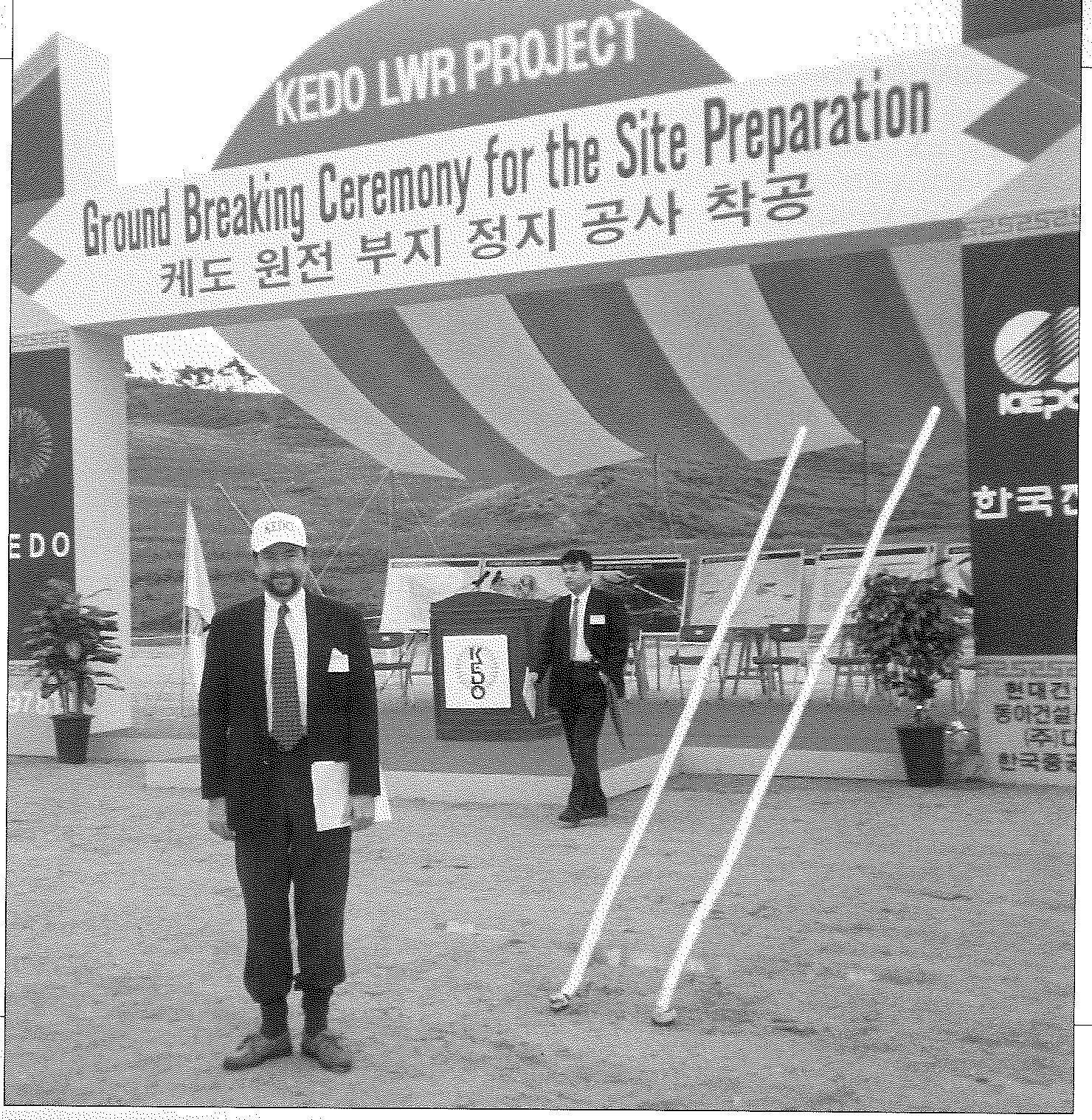
As a veteran of the Cold War and the realities of the division of the two Germanies, the parallel with the Korean situation has not gone unremarked. Unlike the German Democratic Republic, however, to which I was accredited from 1984-86, I have no similar access to the Democratic People’s Republic of North Korea (DPRK), a country with which Canada does not maintain diplomatic relations. My chance to visit came when I was asked to represent Canada at the 19 August 1997 ground-breaking ceremony of the Sinpo nuclear project in the Kumho region of northeastern North Korea. This project is the result of a 1994 USA/North Korean Agreed Framework whereby the DPRK gave up its research on nuclear weapons in return for the supply of two nuclear lightwater reactors and some 500,000 tonnes of heavy fuel oil annually until the nuclear stations come on stream. The main partners in this project, known as the Korean Peninsula Energy Development Corporation, or KEDO, are the USA, Japan and South Korea, soon to be joined by the European Union. Other member nations include Canada, Australia, New Zealand Argentina, Finland, Chile and Indonesia.
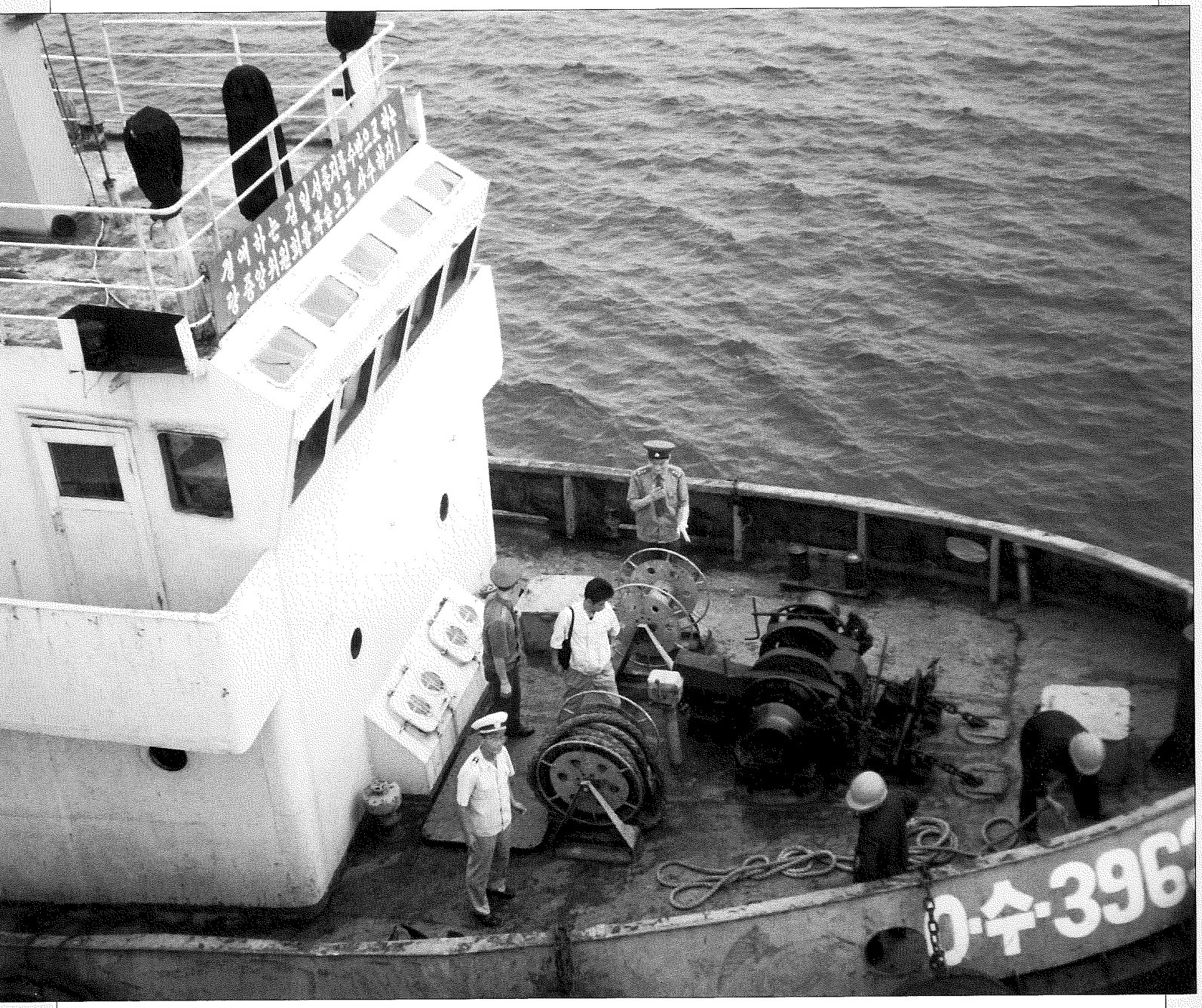
Entry to the DPRK cannot normally be made from South Korea — most visitors head to the north via the convenience of the Beijing to Pyongyang air link. For this ceremony, organized by KEDO in cooperation with the prime contractor, KEPCO, a South Korean merchant navy training ship, the HANNARA, was chartered to transport about 90 officials from KEDO, KEPCO, participating nations and journalists. Conditions aboard were what one would expect naval cadets to enjoy — communal showers and multi-bunk cabins, and cafeteria style messing. The ship’s company had made this journey once before and were seasoned hands. As we left the South Korean port of Tong-Hae for our overnight passage, the master of the ship comforted me by saying that we would not have DPRK naval surveillance on the trip north, because they were short of fuel! That said, our track still followed an agreed route, via “Point Alpha” ’, a rendez-vous off the DPRK coast from which we could be tracked easily.
After steaming at a comfortable twelve knots in calm waters we arrived off the port of Yang-Hwa early in the morning to embark the pilot who arrived in a very dilapidated harbour tug, built to do ten knots but now could manage just five! We berthed without incident after coming into a pleasant enough port surrounded by very green hills. The harbour itself was clearly unused except for a few rusted fishing vessels which never left the port during the 24 hours we were there. The port probably hummed once but the jetty crane looked as though it hadn’t moved in twenty years; the doors of the warehouses were shut tight. A lone guard box greeted us as we waited for North Korean officials to show up in two rather tired Volvo automobiles. The ghost-like aspect of the port was overseen by a benign portrait of the late “Great Leader”, Kim Il Sung, with appropriate revolutionary sayings to inspire, in fading red paint. A lone ox-cart ambled through the port seemingly coming from nowhere, and going nowhere. Rat guards were placed on the ship’s lines in the port, something we had not seen in the south. As someone joked, who could know if these were put on to prevent North Korean rats from boarding the ship, or put on by the North to ensure that no South Korean rats left the ship?
Arrival formalities went smoothly enough. While we were still on board the ship, two DPRK doctors came on board from the quarantine service to check the pulse of everyone disembarking and, in a few cases, to place a thermometer under arm-pits as an additional safeguard. Obviously reassured that none of us would collapse while we were in the country, we were allowed to disembark. KEDO had provided all participants with identification certificates, pseudo passports in fact, and it was with this document that genial immigration officials stamped our way into the country. No port facility worth its salt would be without a “duty-free” shop and Yang- Hwa was no exception. Visitors were able to buy various North Korean products including bottles of “Adder Liquor”, a particularly noxious spirit with a dead snake in the bottle. Real aficionados, I am told, eat the snake after they have consumed the alcohol!
KEDO-supplied vehicles moved us from the port through town and on to the site, about nine kilometres away. The road infrastructure was primitive. A hard dirt road with vestiges of ancient hard-top led out of town. We connected with a side road into the Sinpo area, another dirt road but newly enlarged and very muddy and slippery on the rainy day we visited. Generally, one was struck at how little transportation there was in Kumho. We saw neither buses nor cars. One of the reasons people are as trim as they are is probably because they have to walk everywhere. The port facility itself is used by various people to transit the waterfront. We never really got close to them and most averted their gaze away from the ship, almost as though they thought they would be ideologically violated by looking at such South Korean influence. Indeed, while we only went from the port to the site and back, and were not specifically accompanied or escorted, it seemed that people were kept at a distance while we were in town. This was borne out by workers at the site who said that their contact with the locals is minimal.
Passing through the harbour town itself, on largely dirt roads, there was a long building which reminded me of a Victorian tenement; one could not help but observe that there is not much money spent in a town like this. As we rose above the town over the hills, the whole scene could have been a port anywhere, on the Channel or the Black Sea perhaps, but circa 1890.
Access to the site location itself, about three kilometres off the “main road”, was controlled which suggests that the locals are not encouraged to come too close either. That said, there is a village very close to the site with tile-covered houses with gardens filled with every vegetable imaginable. We were told that people can keep what they grow on their own patches. Indeed, as we passed by luscious rice paddies, corn fields that were healthy enough with slightly stunted crops, and a pear orchard with ripening fruit, it was hard to believe that we were in a country where drought and famine are reportedly rife. We also saw a small herd of rather plump cattle which could have been planted for our visit, but this seemed unlikely, given that the general fertility of the area was established. Even three or four gambolling goats we saw seemed quite content with their lot!
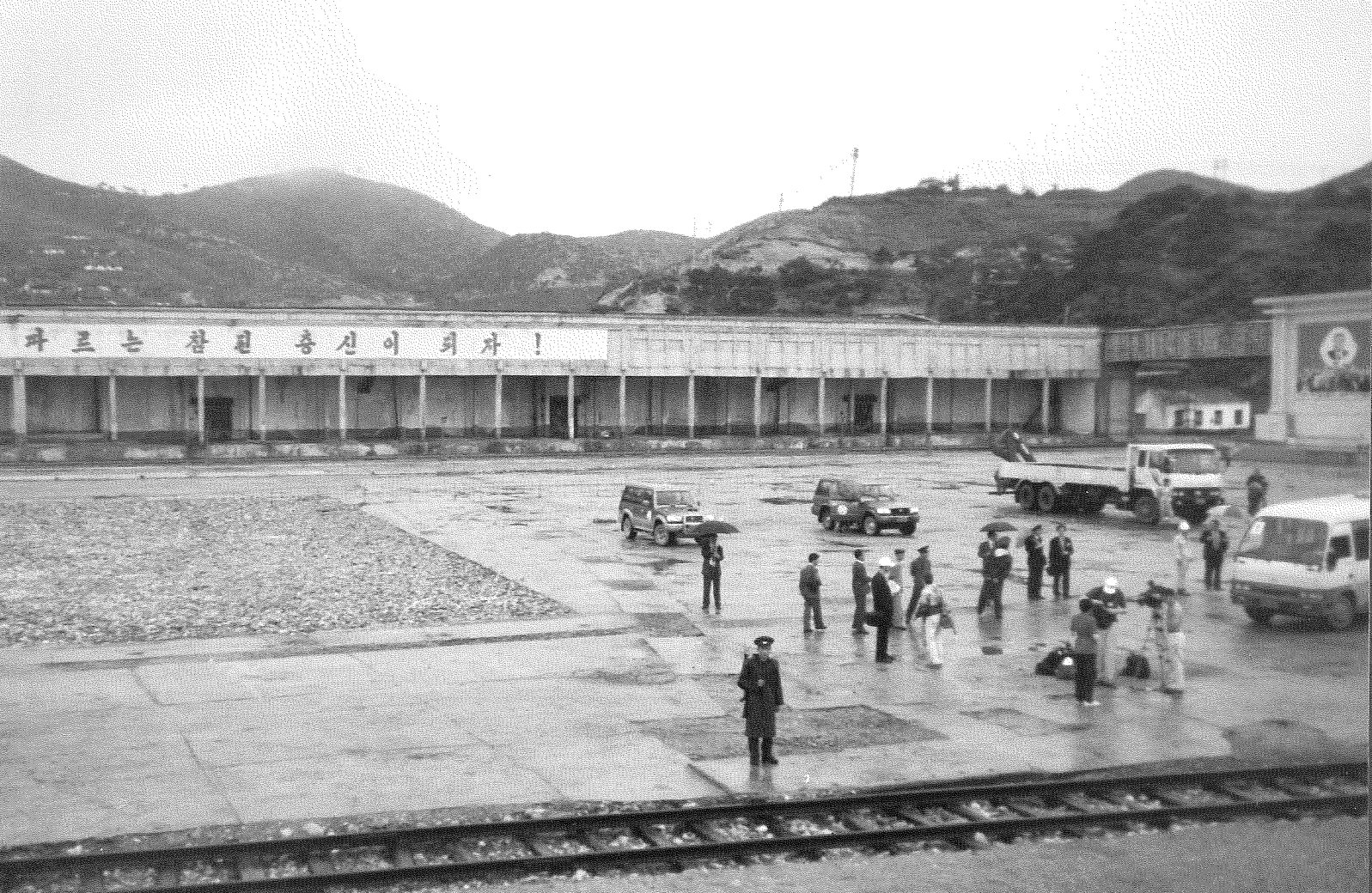
Indeed, while our actual exposure to the local scene was rather carefully scripted, I never saw anyone who looked particularly deprived. North Korean faces are darker and more angular than those of the average South Korean, but much work is done in the fields in this region of North Korea and without public transportation, or even many bicycles, it is easy to keep trim by the extensive walking one has to do.
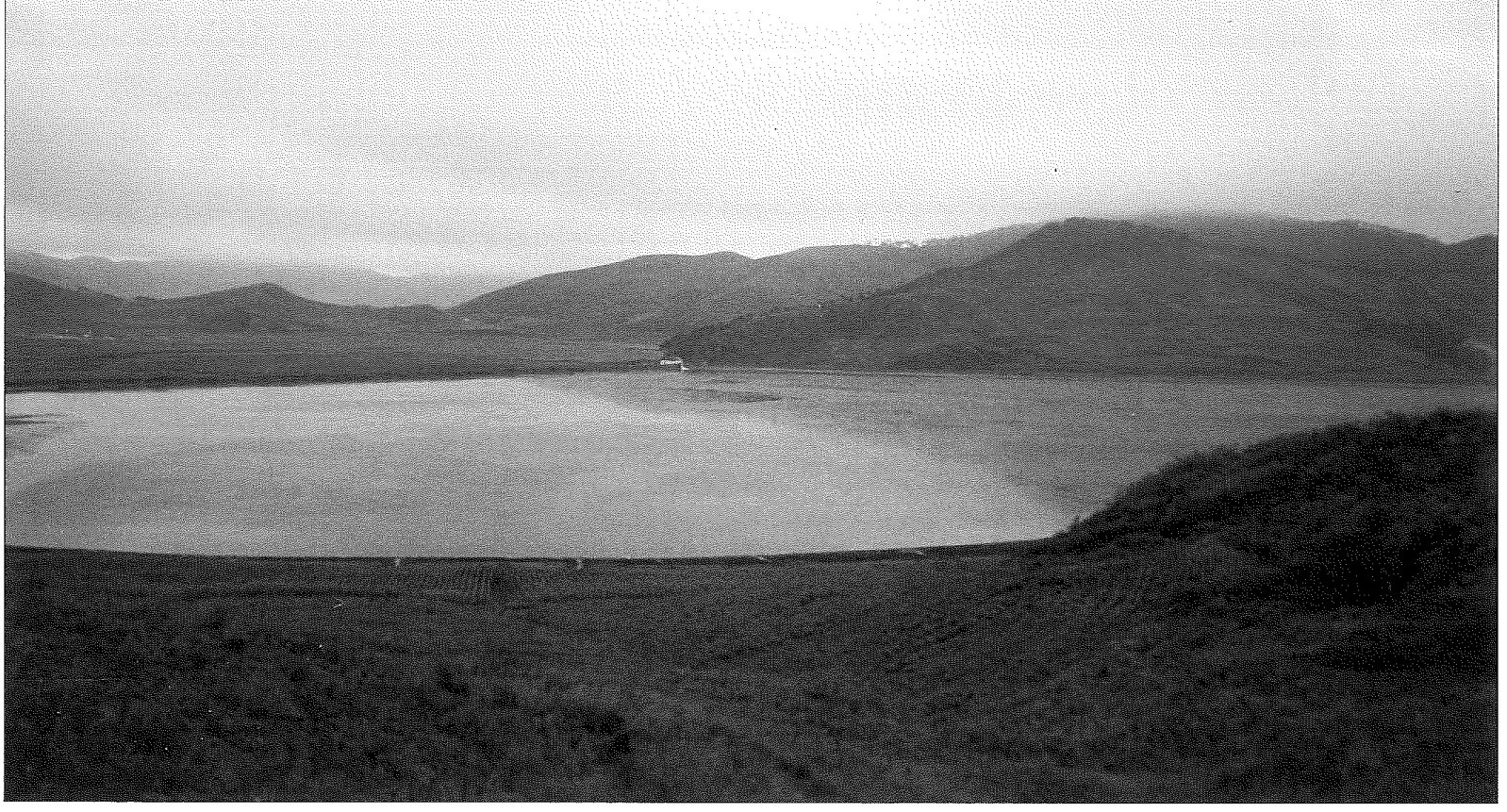
A steady drizzle continued through our eight-hour time ashore. The site itself is certainly green-field, and set amidst some very pleasant coastal scenery. The beaches were very sandy but KEDO workers have only limited access to them, and under supervision. There is certainly a barrier between the site and the sea which serves as a potential defence against sea-borne invasion. The whole state of infrastructure in this region is very undeveloped, with minimal roads and a rudimentary rural electricity service. In fact the new roads that have been put in for the project are very muddy in wet weather and our bus almost slithered into the ditch several times, as indeed did a bus carrying some journalists later the same day! One lake close to the site looked a little depleted and an adjacent pumping station was now above the water line. can conclude that there had been a lack of water, but the pastures and the crops seemed only marginally affected.
The ceremony itself passed virtually flawlessly with about fifty North Korean officials in the audience who applauded politely, if uncertainly, after the speeches. Their representative was a little more pointed in a later press conference when he denounced those responsible for delays in the project to date! KEDO hosted a reception in the guest house provided for KEDO workers where we mingled and chatted among ourselves or with some of the DPRK officials. It was interesting watching the South Korean participants meeting with their kinsman in the North. As one said simply to me later: “It is easy to communicate Lake close to the site because we are the same people.” The guest house itself, run by the North Koreans, was well stocked with beers from Japan, Britain and Belgium among others! Rooms went for a very cosmopolitan rate of over US$100 a night.
Later that evening as dusk fell, we returned through the fields of corn in a setting that to me was very reminiscent of rural Eastern Europe 15 years ago. The “Pyongyang Express” passed by, a train with six very dilapidated cars, one of three or four daily trains that service Kumho district, we were told. We received waves from passengers who crowded open platforms on the train. As we descended to the port of Yang-Hwa we were struck by the dimness of the lights in dwellings, as though each house was allowed to use only 20 watt bulbs. We saw televisions in several houses as we passed, where they would have seen a brief report of the ceremony we had just attended on the one DPRK station available to them. Many of the local women going home at night by foot carried baskets on their heads, something one sees rarely in South Korea now.
As we repeated the same formalities to depart the DPRK as we had to enter earlier that day, we were strangely thrilled by what we had done and seen. I am not the only Canadian diplomat to have visited North Korea, but I am now part of a very select group that has. Those of us who participated cannot claim to have received a huge insight into either the country or the people of North Korea but we had the satisfaction of having been in one of the last frontiers in the world, where normal folk simply do not go. Nothing we saw jarred us unduly, but we were struck by the essential poverty and undeveloped rural nature of the area. Apart from a couple of armed sentries on the jetty in Yang-Hwa we saw no military personnel or installations during our short stay in the country, although as we left harbour we saw a small navy landing craft heading in to port. In an odd way, the pastoral nature of the area was serene and calming and one was reminded of what all the Korean peninsula must have been like sixty years ago. The hustle and bustle of the South today bears no resemblance to the rural, agrarian part of the North we saw. It was evident too that for many South Koreans visiting the North for the first time, where they were born or from where their parents had come, it was an emotional “homecoming” that leads one to believe that when unification does occur, it may not do so with the hard “bump”, at least at the personal level, that many anticipate.
View the original scanned pages →
Originally published in bout de papier, Vol. 15, No. 3 (1998) — Fall 1998 // Automne 1998, pp. 28–31. Read the rest of this issue →



