
bout de papier, Vol. 16, No. 3 (1999) — Fall 1999 // Automne 1999, p. 37
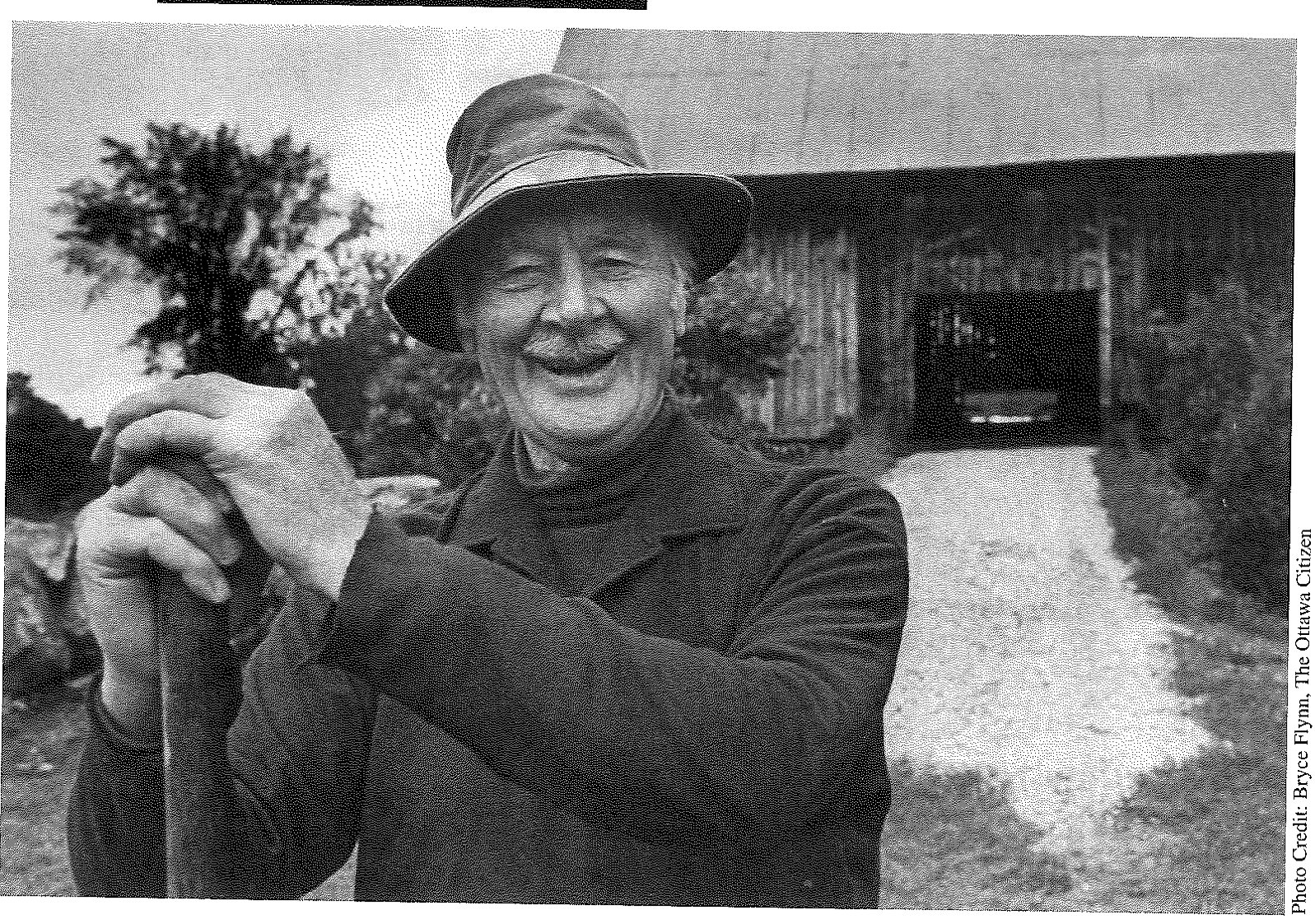
Escott Reid was a man whose life was of much value to his country and the world community. His high intelligence and courage were great assets in his work. His humour and consideration for others were shared by his charming wife Ruth, lovely daughter Morna and his two talented sons, Patrick and Timothy.
Escott’s career was of great length, quality and variety. He had a brilliant academic record in Canada and at Oxford, where he was a Rhodes scholar and had the good fortune to meet Ruth. After gaining a Rockefeller Foundation Fellowship, he spent two years studying Canadian political parties. He had a fruitful period as National Secretary of the Canadian Institute for International Affairs. He then worked for the Embassy in Washington and External Affairs in Ottawa from 1939 to 1952 with conference periods elsewhere. He has been given credit for important roles in the birth of the United Nations, the International Civil Aviation Organization and the North Atlantic Treaty Organization, tasks obviously of great value. He made the first public suggestion for an international collective security organization. At a relatively youthful age and after limited experience he was appointed to the senior position of assistant under-secretary in External Affairs in 1947 and deputy undersecretary in 1949, a result and reelection of his ability and achievements.
Escott’s concern for humanity was fully engaged in his vigorous opposition in 1942 to the federal government’s security policy of moving immigrants and Canadian born Japanese inland from British Columbia coastal areas. At the same he opposed Canadian policy of refusing immigration to Jewish people planning to move on to the United States. Six trees have been planted in the Toronto Community Forest at Yahir, Israel in Escott’s memory by the Jewish National Fund of Canada.
In 1952 he began five years as High Commissioner to India after turning down two other senior diplomatic appointments. He spent much time there working successfully to increase and improve our aid program. He established very happy relations with the outstanding Prime Minister of India, Pandit Nehru, and became a warm friend of the Indian foreign ministry. These relations were of great effectiveness during the concurrent Suez war and Soviet suppression of Hungary in 1956. It seems clear that Escott’s efforts helped considerably to stimulate Indian statements critical of the Russians despite the Delhi government’s strong dislike of the British and French invasion of Suez which meant that those governments had no effective influence on India concerning Hungary. Escott’s work in this field was largely but not fully supported by Ottawa.
Delhi was my first post and a fortunate one. Escott and Ruth treated me and other young members of the mission as junior family members whose health and welfare were important to the Reids. Escott gave me a rotating series of jobs in the High Commission plus a number of assignments requiring trips to different parts of India. I couldn’t help learning much about India but also about useful diplomacy on my lucky first posting.
After Delhi Escott spent four years as Ambassador in Germany, 1958-62. It was a politically turbulent time concerning East Germany and Berlin and the Soviet Union. Escott spurred Canada’s work to preserve and increase peace in Europe. My family and I spent only five months on posting in Bonn at that time since I sought successfully a transfer to London, England where my mother was dying of cancer. Escott played a helpful role in this compassionate posting.
Escott then spent three years, 1962-65, working as a senior official in the World Bank where he encouraged the efforts of the Bank and International Development Agency to increase aid to developing countries. Escott’s next and equally productive role was back in Canada. He became Principal of Glendon College, a new institution which was part of York University in Toronto. One aim and feature of the college, which Escott vigorously promoted, was bilingualism which made some progress in his time. His flexible views and liberal outlook were great assets during his four-year term of office ending in 1969. Students in Glendon at that time have described his inspiring and creative role.
Escott did not, of course, settle down then to retirement. He has written several books of great variety and competence about his experiences in Canada and overseas and the international institutions whose work he furthered. His contributions to foreign affairs have rightly been recognized. He was made a Companion of the Order of Canada in 1971 and he received the Pearson Peace Medal in 1993. Geoffrey Pearson, who was on the committee which chose Escott for that prize, noted that he “had idealism wedded to intellect. And he had the courage to say the things he thought. Some government would fire you for that.”
For several years Escott and Ruth were warm hosts for friends in their country home, a converted barn in 80 acres of attractive countryside in the Gatineau north of Ottawa. Characteristically Escott had my wife and me there for lunch on the day of my retirement after 38 years in the Foreign Service. Many others have spent happy and interesting times there with a friend who was an outstanding Canadian and his wife a delightful hostess.
David C. Reece
View the original scanned pages →
Originally published in bout de papier, Vol. 16, No. 3 (1999) — Fall 1999 // Automne 1999, p. 37. Read the rest of this issue →



