
bout de papier, Vol. 16, No. 1 (1999) — Spring 1999 // Printemps 1999, pp. 30–32
Head of Government (HOG) visits are a cornerstone of today’s international relations; if nothing else, they serve to concentrate officials’ minds on finding “deliverables”. However, like permanent embassies, they are a feature of modern era diplomacy, their popularity reflecting, to a great extent, the growing ease and speed of travel, and the ability to remain in real time contact with home base. Today most HOGs can go off on an official visit confident that while they are away, they will not be overthrown, or their country overrun.
It was not always thus. Roman emperors expected foreign rulers to visit them, not vice versa. If they visited a foreign capital, it was at the head of their army, and the deliverable was the city’s capture and sack. This fate befell the Persian capital, Ctesiphon no less than five times between the second and the seventh centuries. “Summit Meetings”, such as they were, took place along the border or on the battlefield. There was always the risk of treachery; several emperors barely escaped with their lives when a parley turned out to be an ambush. One, Valerian, was less lucky, being captured by the Persians in 259, and ending his days as a living footstool to the Shananshah.
By the mid-14th century, the Roman (Byzantine) Empire could no longer maintain this fiction of primacy. Its dominions, which had once extended from the Tyne to the Tigris, were reduced to Constantinople, a chunk of the Morea (Peleponessus), and a clutch of islands and seaports on the Aegean and Black Sea coasts. In less than a century, civil war and Serbian and Ottoman Turkish incursions had reduced it from a still respectable middle power to an impoverished client of Venice and vassal of the Turks. The crown jewels had been pawned to Venice, whose traders and their Genoese rivals maintained sovereign enclaves in Constantinople and fought private wars on Imperial territory.
By the 1360s Emperor John V, one of the longest reigning and least effective incumbents ever to sit on the Imperial throne, was forced to face the fact that the only way out of the Empire’s death spiral was to enlist massive western support, even a crusade, to drive back the Turks. John persuaded himself that the King of Hungary, the most powerful monarch in the Balkans, could be induced to organize such a crusade. In 1366, without any prior preparation to test this hypothesis, John took the unprecedented step of setting out to visit the Hungarian court, despite the fact he had to traverse a hostile Bulgaria. The mission was a fiasco. The Hungarian king had little interest in crusading, and on his way home John was stranded for several months at the Bulgarian/ Hungarian frontier. He had to be rescued by his cousin Amadeo of Savoy, who arrived with a small fleet and persuaded the Bulgars to release John.
Amadeo persuaded John not to give up his attempts at summit diplomacy, and convinced him that he could gain the Pope’s support and blessing for a crusade, by arranging a reunion of the Greek Orthodox and Roman Churches. From 1366-69 teams of ecclesiastical “sherpas” attempted to thrash out the modalities of such a union, the goal being an ecumenical council to bless its terms. The process was very slow, as the Papal side demanded, in effect, the unilateral submission of the Greek Church. This would be a very hard sell in Constantinople, where popular sentiment was “better the Turk’s turban, than a cardinal’s hat.”
A madeo, impatient at theological wrangling, finally browbeat John into going directly to Rome to make a personal submission. John arrived in October 1369, the first “Roman” emperor to set foot there in over 700 years. While John did make his submission to the Pope, he could not do so on behalf of his subjects. Nonetheless the Pope wrote to various Catholic monarchs asking them to provide material and financial assistance to the beleaguered Empire. After 5 months in Rome, John moved on to Naples, where he received a cordial reception but no concrete assistance, and then to Venice, where he found himself stranded for lack of funds. The Venetians threatened to sell off the Imperial crown jewels, but, after fraught negotiations, allowed themselves to be persuaded to forgive the Empire’s debt, promise to return the jewels, pay John’s onward passage to Constantinople and even to provide additional funding and some warships. All this in exchange for the island of Tenedos, which lay strategically athwart the mouth of the Hellespont. To John this seemed a small price for bringing some tangible results home, after two years abroad. It was not to be; his son Andronicus, whom he had left as regent, belonged to the anti-Venetian faction, and besides had a grudge against his father, who had partly blinded him after an abortive coup d’etat. Andronicus not only refused to hand Tenedos over to Venice, worse he gave it (gratis) to Venice’s bitter foe, Genoa. So at the end of the day John’s mission to Rome yielded no crusade, no crown jewels, no galleys, no money. He had surrendered his faith and, worse still, had lost Tenedos. This was not Byzantine diplomacy’s finest hour!
Succeeding him in 1391, John’s son Manual II was a far more impressive figure; a soldier, statesman, and theological scholar of no small repute. For several years before it was finally lost to the Turks, he had energetically defended the Empire’s second city Thessalonika. As crown prince and then as emperor he had to tolerate the excesses of his Turkish liege Bayazid II, who had forced Manual to join Turkish military expeditions (including one in 1390 to reduce Philadelphia, the Empire’s last Asiatic stronghold). Bayazid also had the disconcerting habit of mutilating Manual’s senior officials during his forced visits to the Ottoman court. In 1394, fearing the next such visit would be his last, Manual refused to answer Bayazid’s summons. In retaliation, Bayazid laid siege to Constantinople and failing to take it by storm, closely blockaded it for the next eight years, causing great distress and hardship.
The West, however, had finally woken to the Turkish threat. In the 1360s, the Ottomans were a distant menace in the eastern Balkans. Thirty years on, Bulgaria and Serbia had both fallen (bringing Kosovo to the world’s attention for the first time), and the French and Italian principalities in Greece were threatened. In 1396 the long awaited crusade was launched. Led by a somewhat reluctant king of Hungary, various other Balkan princes, and the (undisciplined) flower of French nobility, it got as far as Nicopolis in Bulgaria, before it was finally destroyed. The crusade did momentarily lead to an easing of the Turkish blockade of Constantinople, and some survivors drifted in to shore up its defences. One of these, the French Marshal Boucicaut, was to return with a few hundred more reinforcements and a small fleet which successfully harassed the Turks, but Boucicaut could see the cause was hopeless without massive outside help. He persuaded Manual that another appeal to the West was needed.
This time there was no talk of church reunion; Manual was a staunch defender of his faith, and besides the papacy was now split with rival popes in Rome and Avignon. The kings of Europe were likewise split in their allegiances and an appeal to one pope and his adherents would only alienate the supporters of the other. Manual and Boucicaut therefore undertook a far more ambitious scheme by which Manual would visit, in turn, the leading Italian city states and the two most powerful monarchs in the West: Charles VI of France and Henry IV in England. Envoys were sent out to canvass these monarchs and other princes; the results were encouraging. Manual described his objectives as follows:
It seemed good to both me and to my advisors, and to the most prudent of my allies to betake myself to Italy and then even to transalpine Gaul and to Britannia …to persuade in person those who have the power to defend us, to be willing to use their strength and not give way to further delay and neglect, as was the accustomed thing for them to do.
Leaving his nephew John as regent — a courageous move, as John had been plotting with the Turks and had even vainly offered to sell his claim to the Byzantine crown to the King of France — Manual set out on December 10, 1399, with a delegation of some 60 officials and clergy. They would not return for over three years. Manual did not entrust his wife and children to John’s care, but left them with his brother Theodore, who, as Despot of the Morea, controlled the Empire’s last substantial territorial block.
Manual’s reception in Venice was much warmer than his father’s had been. He got the usual tour of the pawned crown jewels, the Venetians promised to evacuate the Emperor’s family should the Turks threaten the Morea, and talks about military aid were described as promising. That said, Venetian contingency plans for preserving their trading interests with the Turks, should Constantinople fall, were well advanced. Manual then proceeded to Milan, whose Duke also promised aid and made generous provision to see the Emperor and his entourage safely to France.
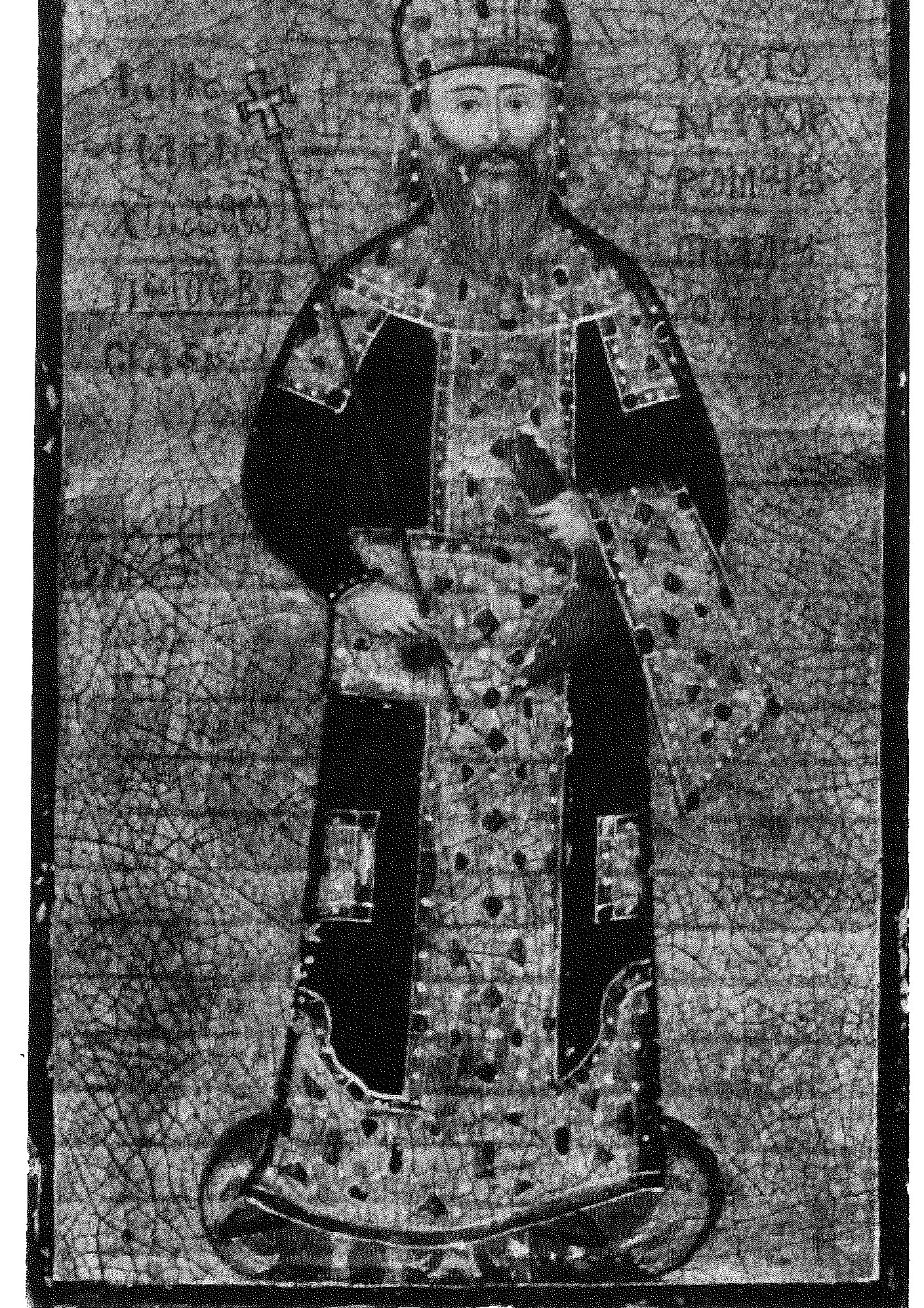
The Imperial party reached Paris in June 1400. They received an exceedingly warm reception, again all costs were borne by the host country, and Manual was lodged in the Louvre (then a palace). He impressed the French very much; the Renaissance was taking hold and the culture of ancient Greece and Rome, manifest in Manual’s presence, along with his charm and dignity, gave him a great allure. His image, recorded in French miniatures, on gold medallions and even a tapestry, shows a tall, long-bearded figure in long fur-trimmed robes, astride a warhorse. The French King promised to fund another 1200 soldiers for Constantinople’s defence, and Manual was encouraged to believe that even more aid would be forthcoming. In the meantime he despatched envoys, armed with gifts of holy relics (of which the Byzantines still had a considerable store), to the kings of the Iberian peninsula. Promising sounds soon came back from these lands. Manual now began to negotiate his passage to England, somewhat complicated by the poor state of Anglo-Gallic relations and the newly enthroned Henry IV’s preoccupations with Scotland and Wales.
In December, Manual arrived in London, which, like Paris, became the scene of another royal love-in. Manual, the first Roman Emperor to visit the island in 1,000 years, made a tremendous impression, and was likewise impressed by England’s wealth and prosperity. Henry IV entertained his guest with tournaments, and the lord Mayor of London held a banquet in his honour. Henry really did want to go on a crusade, a real one, his only previous experience, one of the Teutonic Knights’ package-tour expeditions to smite the “heathen” Lithuanians was soured by the fact that the Lithuanians had recently, and inconveniently, converted to Catholic Christianity. He gave Manual £4,000 and also promised to trace another £2,000 sent by Richard II, which had been embezzled by the Genoese. Full of hope, Manual returned to Paris in February 1401 where he was to remain for another 18 months, keeping up a voluminous correspondence with Europe’s princes and prelates, and waiting for their aid pledges to materialize. He saw himself returning home leading a large and well-funded crusading army, but as 1401 slid into 1402, the tone of Manual’s letters started changing from optimism to disillusion.
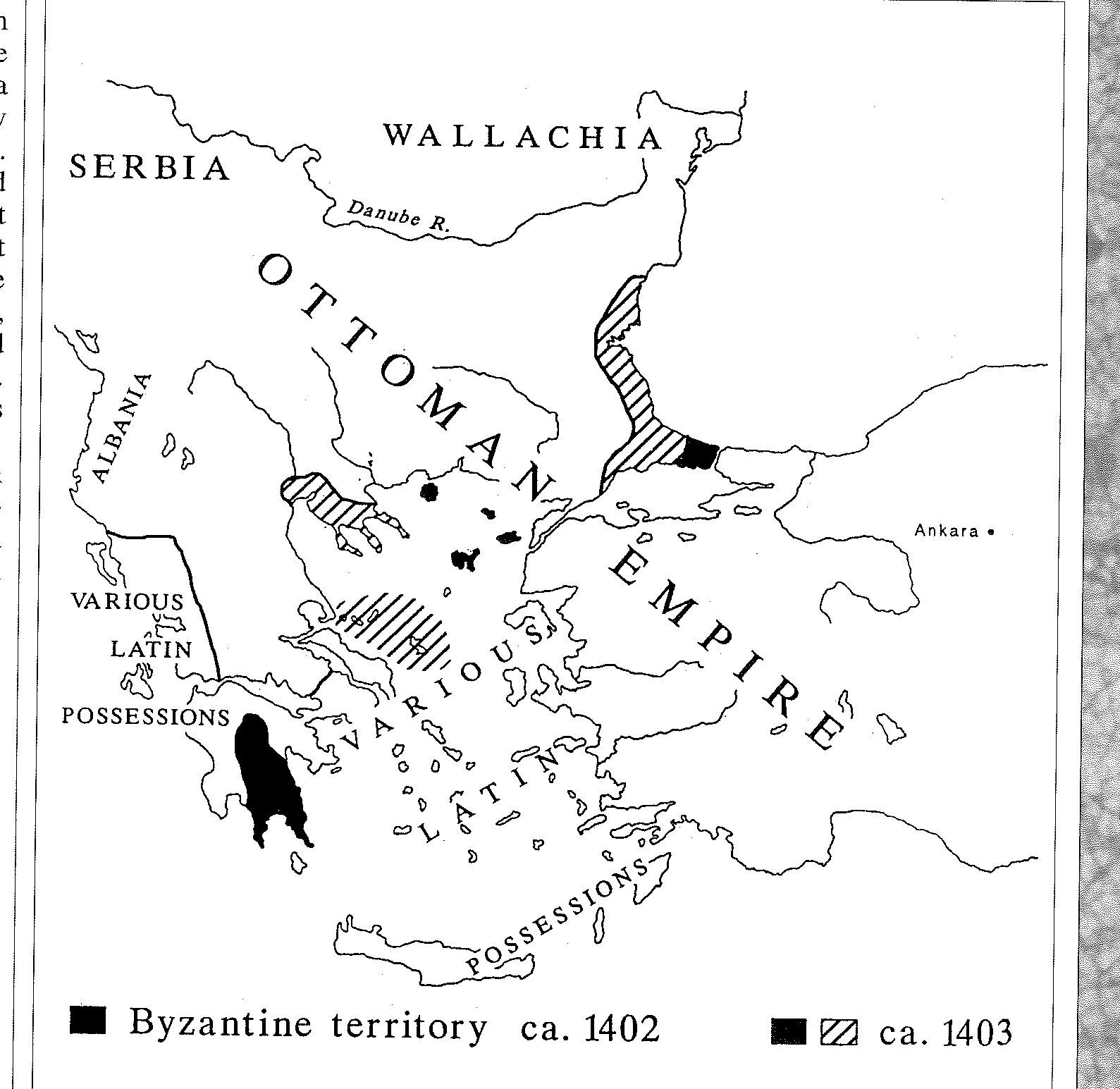
What finally set him on a homeward course was the advent of Timurlane with a Mongol horde, from the depths of Central Asia. In July 1402 he massacred the Ottoman army near Ankara. Bayazid ended his days in an iron cage, and his sons fell to fighting over the succession to his shattered empire. News of this reached Manual in Paris in October, with urgent appeals from the Venetian Senate that he get back to Constantinople as quickly as possible. Manual was slow to respond and did not get home until the summer of 1403. In the meantime his untrustworthy nephew, John, had done a deal with one of the Ottoman pretenders, Suleiman. Given the Empire’s weakness, Suleiman’s concessions were astounding, he returned the city of Thessalonika and its environs, several cities along the Black Sea coast, portions of Thrace, and some islands. John had won the Empire a 50-year life extension, while Manual came home with nothing but unfulfilled promises, although he was quick to consolidate the gains that his nephew had won.
There was to be one last “Team Byzantium” mission. By the time Manual died in 1425 a new, unfriendly sultan, Murad, ruled in Edirne. Manual’s son and successor, John VIII, was persuaded to pursue again the chimera of church unity, in hope of securing Western aid. After years of ecclesiastical negotiations, the Papacy finally agreed to a general church council, to be held in Italy, but meeting the expenses of the Byzantine delegation. In February 1438 John landed in Venice accompanied by the Patriarch of Constantinople, and some 700 other Byzantine notables and clergy, including 30 bishops. John made almost as fine an impression on his hosts as Manual had, his theological team was likewise well received, and their presence in Italy gave even greater impetus to the revival of interest in classical antiquity. The next two years were spent arguing the terms of union, agreement finally being achieved in Florence early in 1440. In the end however, John and his prelates could not deliver the people of Constantinople, who rejected the union. Despite that, one last Crusade was mounted in 1444. It got as far as Varna on the Black Sea, before being crushed by the Turks.
The Roman Empire lasted nine more years, and at the end was not wholly abandoned by the West. On 29 May, 1453, Constantinople became Istanbul, bringing to a close the twenty-two hundred year history of the Roman state. Both Genoese and Venetians stood and died with the last Emperor, Constantine XIII, defending the breach that Mehmet the Conqueror had blasted in the City’s thousand year old walls.
View the original scanned pages →
Originally published in bout de papier, Vol. 16, No. 1 (1999) — Spring 1999 // Printemps 1999, pp. 30–32. Read the rest of this issue →



