
bout de papier, Vol. 16, No. 4 (1999-2000) — Winter 1999-2000 // Hiver 1999-2000, pp. 23–26
The Department of Foreign Affairs and International Trade has initiated an educational Web site aimed principally at teachers and students at the secondary school level in Canada, though much of the content will also be of interest to a wider audience. Canadians in the World / Les Canadiens dans le monde includes a diverse menu of topics, with original content developed for the Internet and Web versions of print and audiovisual materials. As part of this project, journalist and author Clyde Sanger was asked to update his 1988 book Canadians and the United Nations / Les Canadiens et les Nations Unies. Sanger not only revised the editorial apparatus but also interviewed additional individuals for profiles of their lives and work for the Web version (which will eventually include audio and video clips as well as other enhancements of the text). In light of the time required for translation, preparation and posting of the material, and with the co-operation of Clyde Sanger, bout de papier has been given an exceptional opportunity to scoop a Web site. The profile of Neill McKee will be posted at Canadians in the World (http://www.canschool.org) and Les Canadiens dans le monde (http://www.canecole.org).
Hector Mackenzie
After the UN World Summit for Children in 1990 James Grant, then the executive director of UNICEF, set down some 40 “Goals for the 1990s” which the summit had fostered. The goals included everything from promoting universal primary education to curing iodine deficiency in children. But they did not include any mention of HIV/AIDS. Soon after Neill McKee arrived in Nairobi in January 1994 with the title of UNICEF’s ’senior programme communication officer for Eastern and Southern Africa, he was worried by this omission. He read the World Bank statistics for AIDS in various countries of his region, which were published in 1995, and thought them “pretty devastating”. But these statistics at first “didn’t seem to make a difference … because UNICEF and the whole UN system was in a state of denial that [AIDS] would have a huge effect on everything they were doing for child survival and their development in future.”
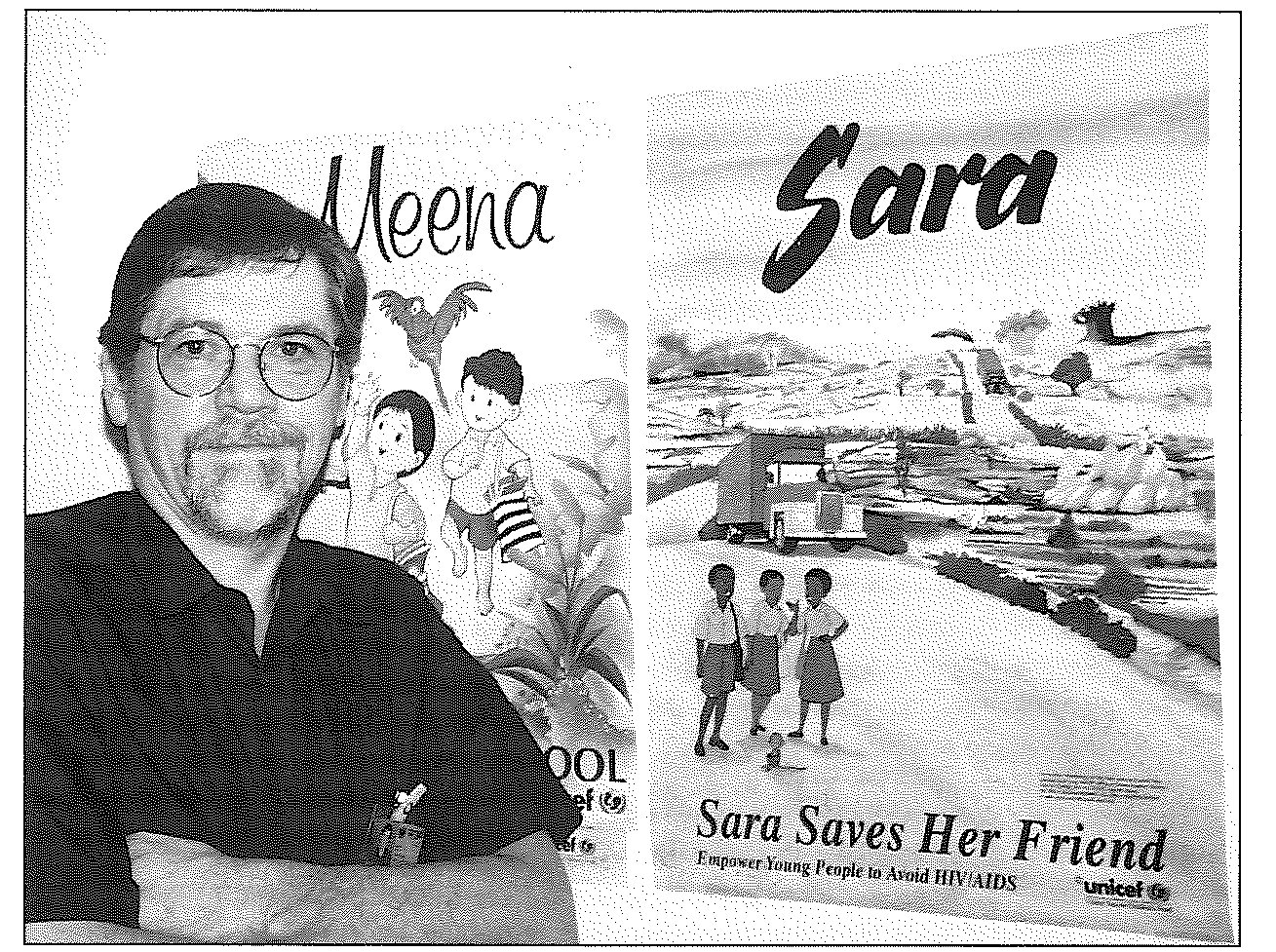
This situation is now turned around, says McKee; and AIDS, along with malaria, are recognized as “the two main killers of children, as well as the fact that AIDS caused the orphaning of millions of children” sub-Saharan Africa. McKee used his position as communications specialist and some 25 years’ experience as a film-maker with Canadian development agencies to help bring about this change of official attitudes. He also tackled the job of presenting the AIDS issue to African families in an imaginative way that would not run up against a wall of cultural behaviour. His thesis has been (and still is) that “AIDS is a gender inequality crisis in Africa.” This is the message behind what he calls “the Sara communication initiative,” the invention of an attractive group of self-reliant young characters that are becoming famous throughout much of sub-Saharan Africa in comic-books, videos and radio soaps.
Fittingly, Neill had wanted to become a clinical psychologist when he was in his first year of university and, when he moved on to the University of Calgary after a year at Western Ontario, his B.A. was in psychology with philosophy as minor subject. This was a break from the family line. His grandfather had died in a farm accident, leaving nine young children; and his father had to quit school at 13 to look after the farm and with his twin brother eventually set up a farm equipment business, based in Elmira, Ontario. Neill was born in Kitchener in November 1945.
Influenced by this pair of entrepreneurs, he first thought of heading towards engineering and spent what he calls “a rebellious youth, fixing cars, chasing girls and not being academic at all.” By Grade 13, though, he wanted to do social oriented work He says:
“In my last year in high school, I was sent to a United Nations schools conference in Waterloo. I had thought of doing political science but, in my first year of university, the political science professor I had was so boring that I didn’t pursue it.” However, he was drawn toward international affairs. “At Western in 1965, I became friends with Nathan Mwanda, son of an Ndebele chief, who was doing a Master’s in Business, and we talked a lot about the Rhodesian UDI (unilateral declaration of independence) and the future Zimbabwe. Then at Calgary I chose as my roommate Wasfi Yusef, an Egyptian Ph.D. engineering student. After Calgary, influenced by my grandfather Neill’s background as a minister, I applied to go with the United Church of Canada to Japan — but I was rejected as unsuitable to go overseas — apparently they didn’t like my universal terms of religion for their church.”
Instead, CUSO accepted him and sent him as a teacher to Sabah, in Borneo, Malaysia. “There I met a Peace Corps guy making a film. I had done some theatre and some scriptwriting at Calgary and a little filmmaking; so I borrowed his 16 mm camera, which he’d bought from a Chinese tailor, and made a film I called ’Manaulu?’ or ’Where is the jungle?’ The camera ran too fast, so the movie was a bit slower than reality — which is what life is like in Borneo! In any case, CUSO saw it as too controversial to use — it talked about cheap volunteer labour and it questioned some basic development policies which discriminated against the non-Malays. But CUSO’s information section saw strong camera work and wanted more, and I made five or six films for CUSO.” These were essentially recruiting films, like “Tanga man” showing what the life of a CUSO volunteer was like in Tanzania.
In turn, he was recruited in 1974 from his field staff post in Malaysia to become the head of the audio-visual unit at the Ottawa-based International Development Research Centre. In truth, he was the unit. In making 35 films for IRC he did everything: operated a basic camera, worked the sound equipment and a still camera – and did his own troubleshooting. “Today one could do it all on video, but not in the 1970s.” From his family background, he was interested in agricultural machinery, so making “An End to Pounding” about a village-level dehuller came easily. He made films on health, education, agriculture, fisheries and aquaculture, forestry and the environment, and received many international awards for such films as “Trees of Hope” and “Prescription for Health.”
In 1990 he joined UNICEF in Bangladesh as chief of programme communication and information. He developed comprehensive communication strategies, working on such subjects as sanitation, basic education, immunization and others of James Grant’s “goals.” Just as importantly, he was the co-creator (with Hermann Tillmann from Germany and Maruja Salas from Peru) of the VIPP method of working with partners in government departments and in civil society. Here is how he explains VIPP, or Visualization in Participatory Programmes, which is now widely used in UNICEF and other organizations for program planning:
“The idea was to get a participatory method going, for planning or to put ideas across that would have widespread ownership at the middle level – some at senior government level, and below — so that the participants would carry out the plan thereafter, implemented by a wide group of partners, instead of its being owned by a single ministry.” He came to this idea because “when I first went to Bangladesh, I sat through so many seminars, so many symposiums, so many meetings all virtually similar, with people lecturing on the same things with so much overlap. Such a waste of time. I had to do a lot of public speaking when I first went there, and I got so frustrated sitting there. At one meeting a guy speaking in Bangla ended up speaking faster and faster because the chairperson was timing him with a wristwatch and everyone in the audience was laughing!”
There were, he says, a lot of participatory programs at village level, but not above. On a trip to Germany he found they had evolved a method, after the 1968 riots, of getting people in industry and in government to plan together, work together and train together. “But it became too engineered, too regimented — you always had to follow the same planning framework. With VIPP there is no particular framework. There are a set of tools, and basic rules for using them — and you can use it for what you want. One rule is that individuals don’t take notes. Ideas are synthesized on different coloured cards — one idea per card — and stuck on pinboards or walls. People don’t privatize the proceedings, saying ’This idea is mine.’ They may work in buzz groups, but everything is visualized. Ideas go up and down, many cards are clustered and titled as ideas are put in a patterned way. It takes less time in many ways than an ordinary workshop where people go in circles, get fixed ideas early and are repetitive. Success with VIPP depends on having a good facilitator, who can bring out everybody’s ideas without putting anyone down, without ridiculing anybody.
“It was my idea to call it VIPP and apply it in this particular way, but I invited Tillmann and Salas to Dhaka and we wrote the manual together.” As for its success, McKee says modestly: “I think it was instrumental in devising the major plans for implementing many programs in Bangladesh, including universal primary education. After the Jomtien conference of ’Education for All, nothing had happened in a year and a half. Ministries and academics differed on how to do it. We had an event to put everything together – and it worked. Then VIPP was applied to water and sanitation, nutrition and health programs, as well as an overall framework for child rights — and we tied in NGOs and many ministries.
“In a number of African countries, too, it has been quite successful in breaking down communication barriers. Often discussions there are formalized and top-down, with the chief or leader deciding. VIPP breaks down this hierarchy. It is sometimes difficult for leaders to see the importance of this method for leadership. But if the process empowers people to make decisions and offer recommendations to the leader, then it puts them behind it and makes the leader stronger. It is often better for the leader to sit back as an ordinary participant, not try to be the facilitator.” One can see the psychology graduate coming out in McKee’s words.
His work in Bangladesh began to focus on the difficulties of the girl-child. Political leaders in South Asia had named the 1990s as the ’Decade of the Girl-Child,’ and Neill dreamed up the notion of some animated films in which a smart girl of about nine years old made her way in the world around traditional obstacles. The psychologist in him led to his team’s portraying Meena as admirably resourceful, rather than do things that would be disapproved of in a young girl. Together, they manage to ensure that Meena gets a place in primary school (“Count your Chickens”), is given a fair share of family food (“Dividing the Mango”) alongside her brother Raju — and saves her father from the village moneylender.
His team included Nuzhat Shahzadi, who had a background in public health in Bangladesh, and Dr Mira Aghi of India with experience on ’Sesame Street,’ as well as his first scriptwriter and manager, Rachel Carnegie, who had worked in Bhutan as a VSO teacher from Britain. The stories were illustrated by Ram Mohan of Bombay, but he had to go outside the region for writers. “We tried South Asian writers for the Meena stories and they failed. We got Bombay scriptwriters involved, and they couldn’t write anything that would suit all the cultures. They would write more of a Bombay generic melodrama, and they couldn’t take account of all the possibilities of Bangladesh, Nepal, Pakistan. Rachel is an excellent facilitator, always trying to involve more people. The main thing with her, and in our approach in Africa, has been listening to the voices of young people themselves in an extensive research process; and in the process of evolving the story the writer has to be open to criticism in a very broad way”. When Neill moved on to East Africa, another Canadian in UNICEF — Christian Clark from Montreal – took over as executive producer for the series. He has called Meena “an historic breakthrough for using media and popular culture for children’s rights.”
Soon after reaching Nairobi, he had a meeting with the Ministers of Gender from Tanzania, Ethiopia and Uganda. “I was pushed by them — especially Uganda’s Dr Specioza Kazibwe (now the Vice- President who is also a surgeon who had had her own childhood struggles, as the only girl in a family of eight brothers) to do something about the girl-child. The ministers were not specifically talking about AIDS. I knew that, in general, women in Eastern and Southern Africa are less empowered than, say, West African market women; and I asked whether this lack of empowerment wasn’t underlying the spread of the AIDS pandemic in the region, compared with West Africa. My thesis was — and it still stands – that AIDS is a gender inequality crisis in Africa. The ministers agreed, but they didn’t have the statistics to support this view until later.”
McKee did research to check his thesis, and found several factors to explain the high incidence of AIDS in East Africa and Uganda in particular. “There is wife inheritance among the Luo people — that is, if a man dies, you take the wife. Younger people don’t do that, now. But there are customs, not documented too well, to do with purifying the widow, sometimes with a professional purifier (who may be HIV-positive himself to cleanse her with sex before she marries the brother. Another interesting fact which I learnt from the 1995 World Bank report was that the AIDS belt overlapped with areas where there was no male circumcision — in other words, uncircumcised boys have a greater risk of STDs. Then there are the trucking routes up from Mombasa through Uganda to Rwanda and the Congo. The truckers had the habit of sleeping at Kampala or thereabouts. Another factor for prevention was the early recognition of the problem by the government of Uganda, and its openness on the subject.”
But the main factors had to do with unsafe sexual practices — coercive sex, older men tempting young girls through gifts (sugar daddies), recreational sex by adolescents, early marriage, polygamy and multiple sexual partners. The family planning organizations, he found, were targeting the married couples and the 17 to 19 age-bracket. “But that’s too late, as sexual behaviour is fixed by then, especially for a girl who may be exposed to AIDS at 13. The churches’ influence in sex education in the region has been behind the concept that adolescents should not be exposed to the idea of using condoms. Yet 13 to 15 is easily the average for a first sexual experience. People are afraid to talk about the use of condoms as men find it unmanly, not the ’real experience. This makes difficulties in husband-wife relationships, because if a wife suggests it she’ll be screamed at for being like a prostitute and possibly unfaithful — whereas the reality is that he’s likely to have several relationships. Being a wife in East and Southern Africa today is a very high-risk job!”
Statistics published in mid-1998 for HIV/AIDS put a figure of 25 percent among the sexually active adult population in Zimbabwe and Botswana, 20 percent in Zambia, 17 percent in South Africa, 12 percent in Kenya and about 10 percent in Ethiopia and Uganda. Figures for the Congo and Angola, says McKee, “have been low until now, partly due to bad roads preventing movement. But the war in the Congo will have had an effect.?”
McKee’s main concern is children and, in this case, young girls. “The incidence of AIDS among girls is six times higher than among boys at age 16. By that time they will probably have a relationship with an older boy or man, and maybe with a sugar-daddy who can provide cosmetics or pay for university fees. In the University of Zambia up to 50 percent of the girls are HIV-positive. In this region, a girl is brought up to be a quiet observer and a workhorse in the household, to obey and not to express herself. I figured there were lots of problems for girls. It’s somewhat surprising, because you see a lot of empowered women around — the Decade for Women ended with the Nairobi conference — but they are an anomaly, and many of them are unhelpful at bringing up their sisters. I had a feeling from the outset that this lack of empowerment would be a major issue for HIV/AIDS. I wanted to see if we could empower the girl-child quickly through developing psycho-social skills: negotiation, communication, problem solving, creative thinking, coping with stress, developing a self-concept. These are the issues underlying the Sara initiative. It is a long-term way of dealing with HIV.”
So Sara, a spirited girl of about 13 or 14, was created. She is surrounded by school friends like Amina and an array of relatives including a wicked uncle who pockets her school fees and a grandmother with traditional views. She also has a pet girl-monkey called Zingo who several times saves the situation, as when truck drivers abduct Amina and she lets the air out of their tires, which allows Sara and other pursuers to catch up. Some researchers and writers were first opposed to introducing a pet animal as a main actor but research with children changed their minds. As a UNICEF leaflet about Sara carefully explains, “Zingo’s antics are humorous expressions of Sara’s inner feelings; feelings she could not express and remain respectful and acceptable to her elders.”
The general theme of the comic books and videos is resourcefulness and self-reliance of young people in dealing with the discrimination that persists against girls. In the first episode Sara proves she is worth her school fees by building with her friends a fuel-saving smokeless stove (shades of IDRC projects!). In a later book (’The Trap”) she turns the tables on an elderly and lecherous businessman, Mbuta, who has blackmailed her into meeting him after dusk in the woods. Of course, the tale about the truck drivers in “Sara Saves her Friend” carries a clear, if indirect, message about AIDS, while the third episode “Daughter of a Lioness” tackles the hot subject of female circumcision — and a girl’s right to choose — and the fifth is about teenage pregnancy.
McKee elaborates: ’The third episode, on female genital mutilation (FGM), is related to the pandemic in that the custom does increase the risk of HIV/AIDS, but it also about the whole issue of rights of the girl. I don’t think any of these episodes mention AIDS directly, the idea being that we don’t need to hit people over the head with the AIDS message. That will come in the introduction or use of the comic book and videos in various groups, and it will inevitably come out in discussion. FGM is a big issue in the Horn of Africa, Kenya, bits of Tanzania and Uganda, and right across Central and West Africa, and the episode is starting to be used in Cameroon, and to some extent Nigeria.
“It is controversial, because in reacting to this film it can polarize issues in many people’s minds, and communities can be polarized around it, for or against. We had meetings to consult with a group of African women from West Africa, Kenya and elsewhere, and some based in Europe who saw the film and the resource book, and we were pleased they said it was very valuable and, put in the proper context and used properly, it can be a very powerful tool. The resource book gives all the background to FGM, describing experiences where positive solutions are occurring in a sensitive way. That’s the hope, that Sara will be used in a way that’s sensitive and less confrontational. Senegal recently outlawed FGM — that’s fine, but my question is: Does that drive the practice underground? Senegal was admired internationally for doing it, but my question is: What’s going on at the village level? It is better to get them to be saying ’Let’s talk it over, and decide what parts of our ceremonies we should keep that are important to our culture’?”
A great deal of consultation with focus groups — from villages and schools and health departments — and with researchers over every Sara episode has gone on (using the VIPP method, of course!) and artists and writers have been recruited from half a dozen countries, and bolstered by some of the Meena veterans. Neill McKee had led a remarkable team that has worked together for five years. The Sara initiative, now going commercial throughout sub-Saharan Africa, may do as much as any other development project to encourage attitudinal changes in Africa towards the adolescent girl — and have a lasting impact on those appalling statistics of AIDS.
View the original scanned pages →
Originally published in bout de papier, Vol. 16, No. 4 (1999-2000) — Winter 1999-2000 // Hiver 1999-2000, pp. 23–26. Read the rest of this issue →



