
bout de papier, Vol. 17, No. 1 (2000) — Spring 2000 // Printemps 2000, pp. 54–56
The royal launch swooped down on the docks at Bhyll, past the river steps fronting the Hindu temples where hundreds of the devout were bathing in the sacred Su Wa Ni. Jungle-clad mountains rose on either side of the fertile plain behind the town. Dryan Tweedie, current Rajah and permanent archivist, was expounding the history of the area conquered by (and named after) one of his predecessors, a Shia ruler named Rikon. “You know, Bugbyte,” muttered Attila McGee to the statuesque black woman beside him, “what with you being a computer genius and all, there’s room here for a line about Bhyll Ghats and Shah Rikon Valley, but I think I’ll pass.” To which she replied, “You know, McGee, what with you being utterly clueless and all, there’s room here for a swift thwack upside your head, but I’ll pass if you will.”
Ranee Mabel Stanley was briefing LDC Liebnitz on her reason for asking the Centre’s help. “My old band, Edible Granite, has been rehearsing for a comeback. “ Noting the sudden rictus on the ace logician’s face at mention of the heavy-metal disaster, she assured him, “It’s all right, they’re in Indonesia now, recreating the Krakatoa explosion. But while they were here, we had to isolate them miles up the valley past human habitation. It was the only way to keep Amnesty International out of our hair. As it was, every orchid in the vicinity broke out in Kiss colours, the local orangutans all took up body-piercing, we have the largest flock of cross-dressing cockatoos in Asia, and an extended family of Komodo Dragons got deeply into rap. But we kept the secret from the wildlife groups until after the band split. The Dragons are actually doing rather well in Manhattan.
“One day, while the boys were pumping out their latest number, Deathwatch Marmalade, an enormous feedback squeal flattened every tree for miles and set off a major landslide in the nearby mountains. When Dryan and I arrived a few days later, we decided to check the site of the landslide, and found that it had re-opened a cave blocked by an earlier slide — our archaeologists estimate five to seven thousand years ago. Just inside the cave we found a stone tablet bearing unknown runes. The runes were freshly cut, but ours were the only footprints in the heavy dust. Further inside, we found — well, Ludwig, I’d better let you see for yourself.”
Three days later just before noon, five dusty travellers in the latest Indiana Jones safari gear smoothly dismounted (well, four smoothly dismounted and Attila fell off his horse) beside a stark cliff. There, still partly camouflaged in shredded vines, shattered rock and a pile of stunned monkeys still holding their ears, was a narrow crevice in the rock face. Hitching their horses to a nearby sloth, they entered the crevice.
Creeping down a long tunnel past the undisturbed stone tablet, they entered a cavern the size of a cathedral, its vaulted ceiling lost in flickering shadows. The tunnel had been natural, but the cavern had clearly been worked by hands of great cunning and artistry. A maze in clear crystal covered all the walls and half the floor in glittering silence. Obsidian cogs and gear-wheels meshed on diamond bearings, frozen in mid-turn. Glistening arcs closely inset with emeralds and sapphires bridged the cavern with light. As the visitors played their torches over the vast assemblage, it cast back such a fierce refracted fire.
Bugbyte O’Nanotek recovered first. “Holy Father Turing,” she exclaimed. “I know what this has to be — but I’m not sure I believe it!” Turning to the others, she explained. “Late at night, huddled around a blazing CPU, SysAdmins tell stories about the Coming of the First Computer. Many millennia ago, they say, a spacecraft crash-landed somewhere on earth. Unable to repair its ship, the alien on board made contact with our ancestors and gained their help to take the first step in recreating the technology of space-faring: a computer with artificial intelligence. Given Earth’s technology level, the computer was built entirely of stone, but based on light and crystals — an optical computer! The small amounts of necessary electricity were generated by piezo-electric pressure on quartz crystals. SysAdmins call the result the Grand Electro-Optical Difference Engine. Most of us are too cool to admit they believe the story, but we all seem to spend a lot of time on the Web looking. And this has just got to be it.”
Probing the machinery, she mused, “Given the all-stone construction and the sheltered conditions, there’s no reason why it shouldn’t still work. In fact, I bet the tablet in the tunnel is a recent print-out.” She pointed to three stone plaques mounted on the assemblage: one the image of a mightily-horned sheep on a gigantic crystal bearing, the second the image of a spider on a complex prismatic assembly and the third a flat plate supported at waist height bearing the image of a large high-sided shoe. “Great, the system works the same way as ours — those are clearly the RAM cache, the Web browser and the boot disk. But how do we turn it on?”
Still hoping to impress, Attila dashed over to help. Mabel, who knew impending catastrophe when she saw it, tried to stop him, but only succeeded in knocking him off balance. Stumbling forward, arms windmilling wildly, he tripped on a tiny stalagmite and fell heavily onto the boot disk, which descended smoothly into the floor. Being Canadian, he apologized to the stalagmite. Nothing happened for a moment. No-one dared move.
Then, up by the roof, a small stone portal flashed onto a long ruby rod just below. A opened and a ray of tropical noonday sun piercing hum built up, then a solid bar of light burst from one end of the rod to strike a prism on the back wall. The light stream split, re-split and re-combined, changing colours and patterns as it jumped from one crystal to another, lighting up the cavern like the inside of a diamond. Meanwhile, a heavy stone flywheel activated the obsidian cogs and camshafts, setting sparks flying from large quartz crystals. Finally, a large stone near the floor by the tunnel mouth hinged up, revealing a deep opening. Jumping back, the travellers could see a long row of diamond-tipped hammers rising and falling on a stone slab. Soon the hammers stilled and the slab shot with great force out of the opening, across the floor (just missing Attila’s head as he bent to dust a combat loafer) and down the tunnel, coming to rest beside the first tablet.

As it did so, the crystal assemblage came smoothly to a halt, the ceiling portal closing, the lights dying and the cogs falling still. The last energy of the flywheel, however, was enough to activate a vast stone door that slid inexorably down to block the mouth of the tunnel. The travellers scrambled to avoid being trapped. Bugbyte hurried back to find Attila, who was looking for his lost Rolex in the gathering dark, and haul him to safety just as the door thudded down. Soon, they were all standing in the sunshine at the bottom of the cliff face, huddled over the two stone tablets.
Liebnitz took charge. “ Well, my guess is that the first tablet is a message from the artificial intelligence in the GEODE, probably a reaction to the Edible Granite blast that unsealed the tunnel. As you said, Mabel, it is written in an unknown script.”
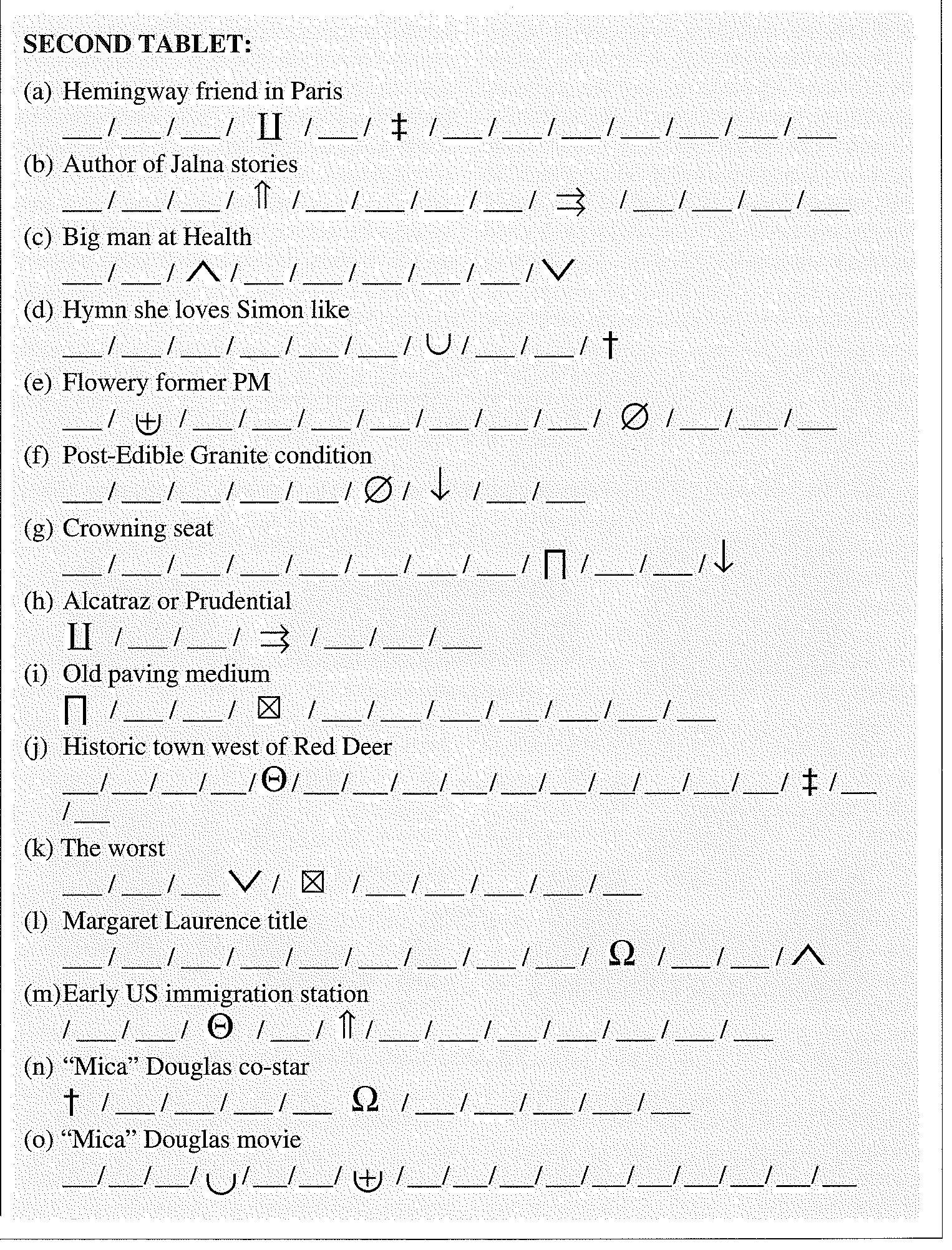
“The second tablet, however, seems to be a Rosetta Stone of some sort, since it uses both English and the unknown script. My assumption is that the GEODE can in fact understand English and modern references, having spent time on the Internet – which would also explain the rumours of its existence. My second assumption is that the original message was in English, but that GEODE chose a random font. When we couldn’t read that font, it provided help. Now it wants to be alone again, but I’m sure it will get back in touch later.”
After studying the second tablet for a few minutes, Liebnitz grunted and grinned. “I see that the GEODE has a sense of humour: all the references are to people or things with the words ROCK or STONE or some foreign variant in them. The runes in the first tablet are used to replace some of the same letters in the answers to the 15 clues in the second tablet — so if we get those answers, we can work back to the original message. Of course, GEODE could simply have printed out the first message in plain English, but I suspect that it’s been a long time since he’s had anyone to play with….
On that basis, Liebnitz made short work of the second tablet and deciphered the message from the first, which turned out to be a song title. Can you duplicate his feat, by providing (a) the answers to the 15 clues on the second tablet; (b) the song title on the first tablet; and (c) the name of the group who sang it? bout de papier will decide the winner by drawing from a box containing all correct entries received by July 31, 2000. The winner will receive a book prize autographed by A Aalto.
View the original scanned pages →
Originally published in bout de papier, Vol. 17, No. 1 (2000) — Spring 2000 // Printemps 2000, pp. 54–56. Read the rest of this issue →



