
bout de papier, Vol. 17, No. 4 (2000-2001) — Winter 2000/2001 // Hiver 2000/2001, pp. 16–17
Editor’s Note: John Hadwen is a retired foreign service officer and a member of the editorial board of bout de papier. The circumstances of his first appointment as head of post — as High Commissioner to Malaysia and Singapore as well as Ambassador to Burma (now Myanmar) — are described below in an extract from an unpublished manuscript entitled “Foreign Policy on the Frontiers: Canada-Burma Relations 1967-71. “ Hadwen’s long and distinguished career also included service as Ambassador to Afghanistan and Pakistan and as High Commissioner to India and Ambassador to Nepal. However, this extract features Hadwen’s work with the Secretary of State for External Affairs, Paul Martin, Sr., and the curious process whereby the latter eventually agreed to send the former abroad.
Hector Mackenzie s a career foreign service officer I A judged it was time for me to be
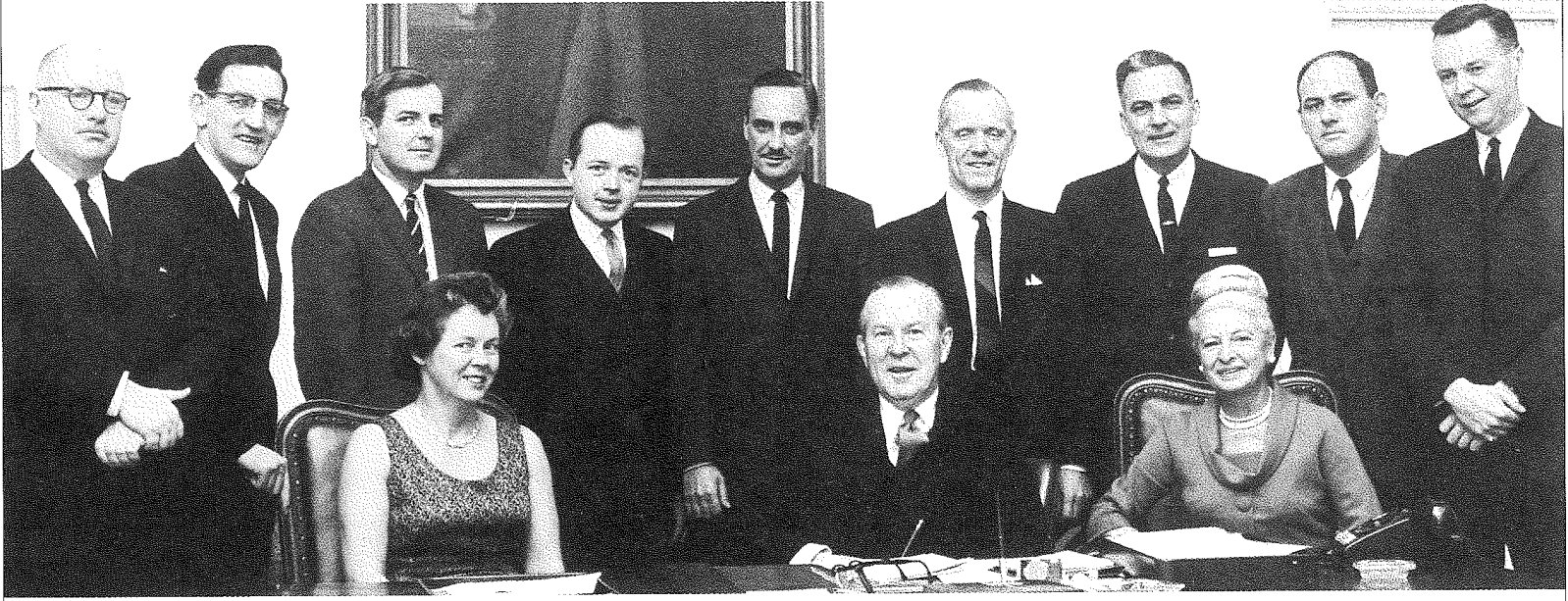
I posted abroad in 1967; however, it was not at all clear that I would be able to go anywhere. I had been working since 1964 in the office of the Secretary of State for External Affairs, the Honourable Paul Martin, with an additional responsibility for the management of material going to and from Prime Minister Lester B. Pearson. But could I leave my work for the foreign minister, Paul Martin?
We had began our direct association when was I suddenly summoned early in 1964 from Norway to be interviewed in Paris. My wife and I flew there and were installed in the Plaza Athené. I was told to report to Mr. Martin at breakfast in a still more exclusive and expensive hotel. I knew there was some kind of new assignment in the air, amongst other reasons, because I had written a memorandum to Ottawa, unrelated to the work I was doing as chargé d’affaires in Oslo, Norway, to the effect that as a department we were neglecting the function of speech writing for the minister. Its central thesis was that when all was said and done it was what the minister said publicly that established our foreign policy. No matter how significant our foreign political analysis might be it didn’t matter very much if it was not reflected in what the foreign minister said. I can’t recall why I wrote the memo, but it apparently arrived in Ottawa at a moment when there was an urgent requirement for some improvement in the way material was prepared for the minister. Mr. Martin wanted to speak often and on many subjects.
At breakfast Mr. Martin and I had a pleasant chat of no particular direction at the end of which he asked me “Do you want to become a bishop?” This was one of his tactics to use expressions with many meanings to provoke those he was with. My reply was that I was ready for a new challenge although I didn’t want or expect to be a cleric. Martin said nothing else and I returned to my wife saying that something, I did not know what, was certainly afoot. A negotiation followed and within two weeks I was back in Ottawa assigned to work on speeches for the minister.
I was not given any specific title or clearly defined responsibility but I was put into an office near the minister and became part of his team. I then embarked on a most complicated process of inserting myself into the speech writing process. After a confused and indeed agonizing period in which I produced many unused texts I became an established member of Mr. Martin’s office. It would be possible to write a whole essay on that process alone.
By 1967 I had become something of a friend of Mr. Martin’s. He and I got along well together even though he was by any standard a most difficult and demanding person. I traveled with him on almost all his visits to the UN, to NATO and to Commonwealth and other meetings abroad and I managed his office through a long series of crises from 1964 to 1967. However, by 1967 I realized it was time for me to return to the more normal structure of the foreign ministry and in particular to take an assignment abroad. I mentioned this to Mr. Martin and his immediate response was that there was no possibility of my being released. In fact, he went on to ask me whether I would take charge of his campaign for the leadership of the Liberal party. Throughout my time in his office I had been able to maintain the principle that I was responsible for foreign policy affairs and that others had a domestic political role to play in support of Mr. Martin’s objectives. So, I was surprised that he would have begun to look ahead to a different role altogether for me. I resisted Mr. Martin’s overtures. When I made my point to the department, their general response was that I would have to work things out with Mr. Martin. This produced an uneasy situation and I found myself very much in a state of flux. Of course, the workload in the Minister’s office rolled on with pressure each day to service the Minister’s role in the House of Commons and to organize his participation in functions inside and outside Canada.
Then, a strange circumstance began to occupy the Minister. At the post in Kuala Lumpur, Malaysia, a dispute developed over the need to purchase an official residence. For a number of years we had made do with a relatively small house for our head of mission, which was rented and had a number of disadvantages. The effort had been started to find an alternative when the existing head of mission settled on a site in the centre of town. The property was so large and the house so big that Treasury Board and the other authorities in Ottawa refused to consider it. The head of post eventually then advised that if the department was unable to purchase this property he would offer his resignation. This kind of issue seldom came before Mr. Martin, but there was no alternative when both sides to the dispute stuck to their positions. In fact, the head of post did indeed resign. I was involved in the handling of the communications on the matter but, took no part in the discussions. When the decision was finally taken that the post would become vacant I applied for it. I did so by informing the department that I thought this was a suitable assignment for me and by telling Mr. Martin. He continued to press me to stay with him more or less indefinitely but I held out. Eventually a memorandum came up to Mr. Martin that listed my name opposite Kuala Lumpur, a listing with about 15 other proposed appointments.
The procedure was that once the department had made its recommendations, it was up to Mr. Martin to take the list up to the Prime Minister and obtain his approval. was expected to do this personally which involved going with this document 20 yards down the hall between the Foreign Minister’s office and the Prime Minister’s office in the Centre Block of the House of Commons. Mr. Pearson was, although this is again another story, very careful to respect Mr. Martin’s position. He seldom made unilateral changes to Mr. Martin’s recommendations and, although there were tensions between the two men, in fact, they got along very well.
In this case Mr. Martin seemed to refuse to approach Mr. Pearson. He used to say that he wasn’t going to recommend any of us if it meant that I would leave his office. I doubt he meant that, but that is what he said. The result was that this memorandum rose to the top of his in basket for discussion with Mr. Pearson and then fell to the bottom. I would bring it forward and, in response to the undersecretary’s request, urge him to take it to the Prime Minister, but he refused to do so. The situation was beginning to have adverse effects on the plans for the department to service its relations for a number of governments and was also beginning to create some personal problems for the individuals on the list who had been told they were recommended for an assignment abroad but could not, of course, make any plans until the government’s decision was taken. I suggested to the undersecretary, one of the great public servants of my time, Marcel Cadieux, that my name be taken off the list and my position be left to be negotiated later in the hope that this would make it possible for the list as a whole to go forward. I don’t know what the undersecretary may have said to Mr. Martin but in the final analysis Mr. Martin summoned me one day and, again, in a typical style said to me: “John, does Malaysia have a common border with Vietnam?” I was taken aback because I had not presumed to do any preparations for the possible posting and frankly I did not really know whether Malaysia had a common border with Vietnam. Vietnam, of course, was one of the major preoccupations of Mr. Martin and of the Canadian Government in this period. We would spend a good part of each day considering what positions Mr. Martin and Mr. Pearson would take on events connected with the war in Vietnam. So, I responded: “No Mr. Martin, Malaysia does not have a common border with Vietnam”, and then when I had a quiet moment later I checked the Atlas and found that I was correct. It must have been soon after that Mr. Martin got approval for our list and it became established that I would be leaving his office and going to Kuala Lumpur.
View the original scanned pages →
Originally published in bout de papier, Vol. 17, No. 4 (2000-2001) — Winter 2000/2001 // Hiver 2000/2001, pp. 16–17. Read the rest of this issue →



