
bout de papier, Vol. 17, No. 4 (2000-2001) — Winter 2000/2001 // Hiver 2000/2001, pp. 9–12
She would not be the first one to admit it, but, perhaps what drew Louise Buhler to the Hanoi Opera House was the unique space it created, which was at once both architecturally charming, yet ghostly and timeless. Like the opera house in Manaus, Brazil, the raising of which was so dramatically described in the Werner Herzog film ‘Fitzcarraldo’, this structure was meant to be a beacon of civilization in an uncultured, end-of-empire outpost. Originally built in 1911, under French colonial administration, and having undergone little maintenance and suffered much history in the intervening years, the Hanoi Opera House has just been restored to sparkling good health.
the intervening years, the Hanoi Opera H
Louise, a Canadian aid worker, first came to Hanoi in 1982, and visited regularly on working trips until she took up residence in the city in 1996. Whenever she had the opportunity, she always stopped by the Opera House, just in case a performance was on. Prior to the pre-perestroika/renovation Communist political liberalization of 1989, Vietnam was, and had been for years, a very closed society. During the mid-80s, the only foreign artists permitted to enter the country and offer public performances were fifth-rate Russian dance and classical music ensembles, who were usually as poorly off as the members of the Vietnamese audience.
Hanoi’s Art Market
Vietnam’s growing art industry, which has been the subject of much foreign and domestic interest over the past several years, especially in Southeast Asia, has been suffering somewhat of a decline. The art market is very much tied to the tourist trade, and the decreasing inflow of the past couple of years has been reflected in slow sales among the city’s numerous galleries. Several have claimed that the appearance of fakes of the works of well-known artists have damaged the trade, particularly when it became known, as was reported in the Vietnam News, that copies of two paintings by Nguyen Sang and Bui Xuan Phai were sold at Sotheby’s and Christie’s auctions in Singapore. The fact that the Vietnamese currency, the Dong, has not devalued, and that prices, usually quoted in US$, have not come down from the peak reached in 1997, has also not helped. However, everything is relative, and there are still bargains to be had.
As was previously mentioned, Trang Tien Street is one of two main focal points for shopping and admiring the fruits of the city’s many artists. Countless galleries, large and small, are tucked away along the main avenue, and up along narrow side streets. Upscale art, and prices, may be found in the gallery in the Metropole Hotel. The venerable and sprawling Capital Gallery (45Trang Tien St, Tel: 844-257-040) offers a wide selection of artists’ work, spread over several floors.
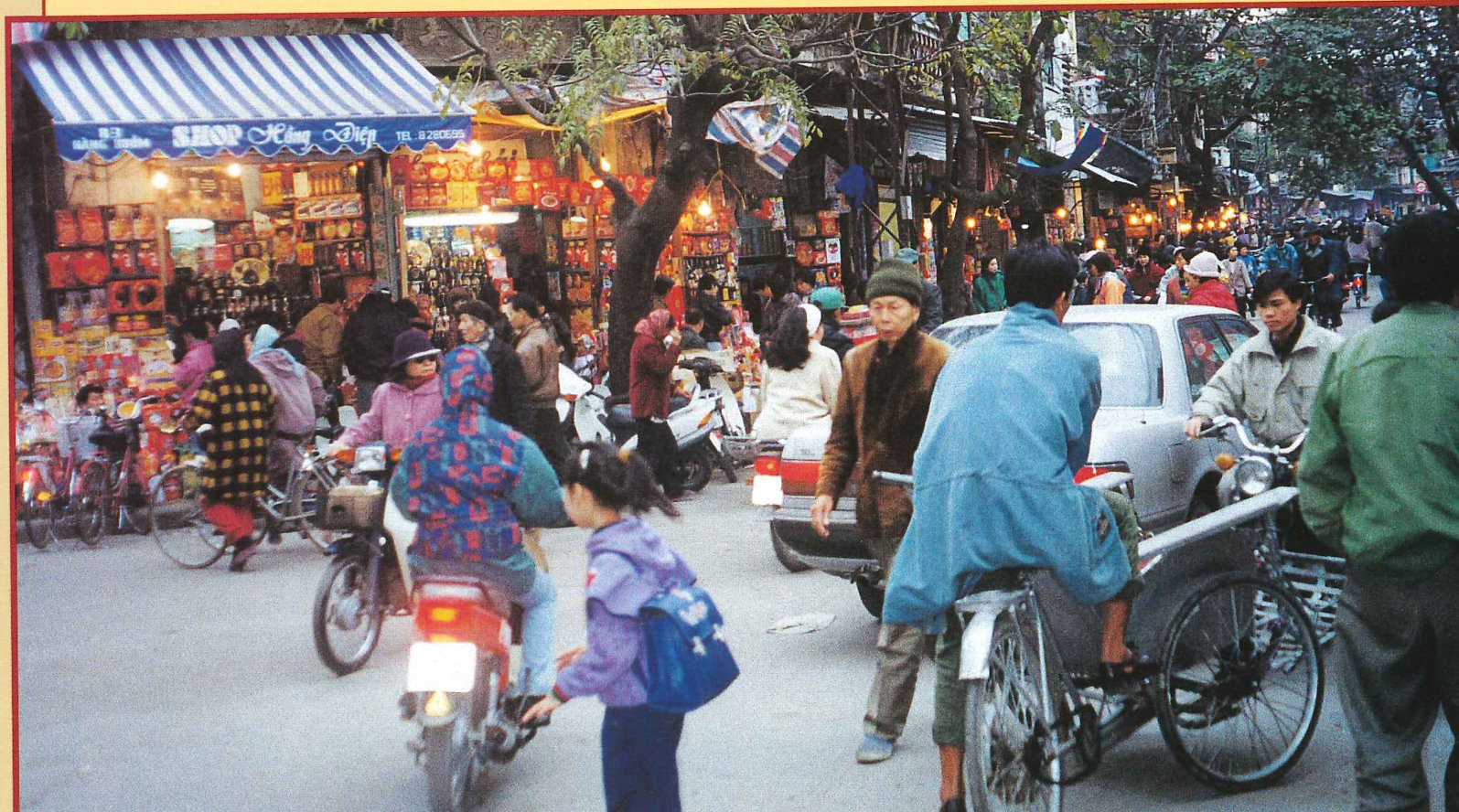
The largest stretch of galleries runs along the connecting Hang Gai and Hang Bong Streets, in the city’s wonderful Old Quarter. Sharing space with dusty antique stalls, traditional embroidery shops, and every other conceivable trade, this long line of galleries is an art lover’s paradise. Finest of the lot is the lovely Apricot Gallery (40B Hang Bong St, Tel: 844-288-965), which includes two floors of muted lighting, and highly priced but exquisite products, whereas Thanh Mai Art Gallery (64 Hang Gai St, Tel: 844-251-618) offers an extensive variety of high quality work, but in a more humble setting.
Most galleries exhibit five to ten works of a handful of the more famous younger artists, such as Nguyen Tan Cuong, Dao Hai Phong, and Nguyen Thanh Binh, as well as a selection by lesser-knowns. Gallery managers generally sell their paintings on commission, and negotiations typically reach a stage where the artists, or their families, need to be reached by telephone to agree to a final price. Prices for these younger stars currently range from US$250-600, but other pieces can be had for much less. But, given the recent state of the art market, and the slump in the currencies of the region, surely a reckoning is close at hand. in 1954.
Tickets were freely given, and Hanoians readily occupied the hard wooden seats. Hot in summer, cold in winter, the Opera House gave back as good as it got. Dust rose in clouds as people filled the stalls, mumble and clatter echoing off the peeling paint and dingy finery. But this did not detract, as a certain magic happened which captured Louise’s heart. Taking their cue from the grandeur of the setting, however deeply buried beneath its layered grime, the citizens of Hanoi dug out from their trunks and closets, from beneath ancestral beds, the garments deemed appropriate for occasions such as this. Some in top hats, others in dresses with bustles, most in frock coats, the audience invariably entered the venue in a haphazard and patched pageant of mismatched and proudly worn elegance from various bygone eras.
However, the ghosts have been banished, as the Vietnamese government has given the Opera House a thorough, top-to-bottom scrubbing. The place now sparkles “like a rare diamond in this very poor country”, as described by Mr. Ho Thieu Tri, the overseas Vietnamese-French architect who directed the $14 million restoration.
The timing of the project was planned in order to showcase the building during the summit of the Francophonie in November, 1997. But, while the government imported the appropriate and necessary Italian and French artisans and materials, national pride demanded that it refuse financial assistance from the French. This obstinacy did not go unnoticed, particularly at a time when the pounding received in the southern delta by Hurricane Diane had led to tremendous hardship, homelessness, and loss of life. In fact, the midnight oil had been burning fiercely, and the restoration was only partially complete when a summit-related state function took place therein. A recent tour demonstrated that it is still a work-in-progress, but what a job they’ve done.
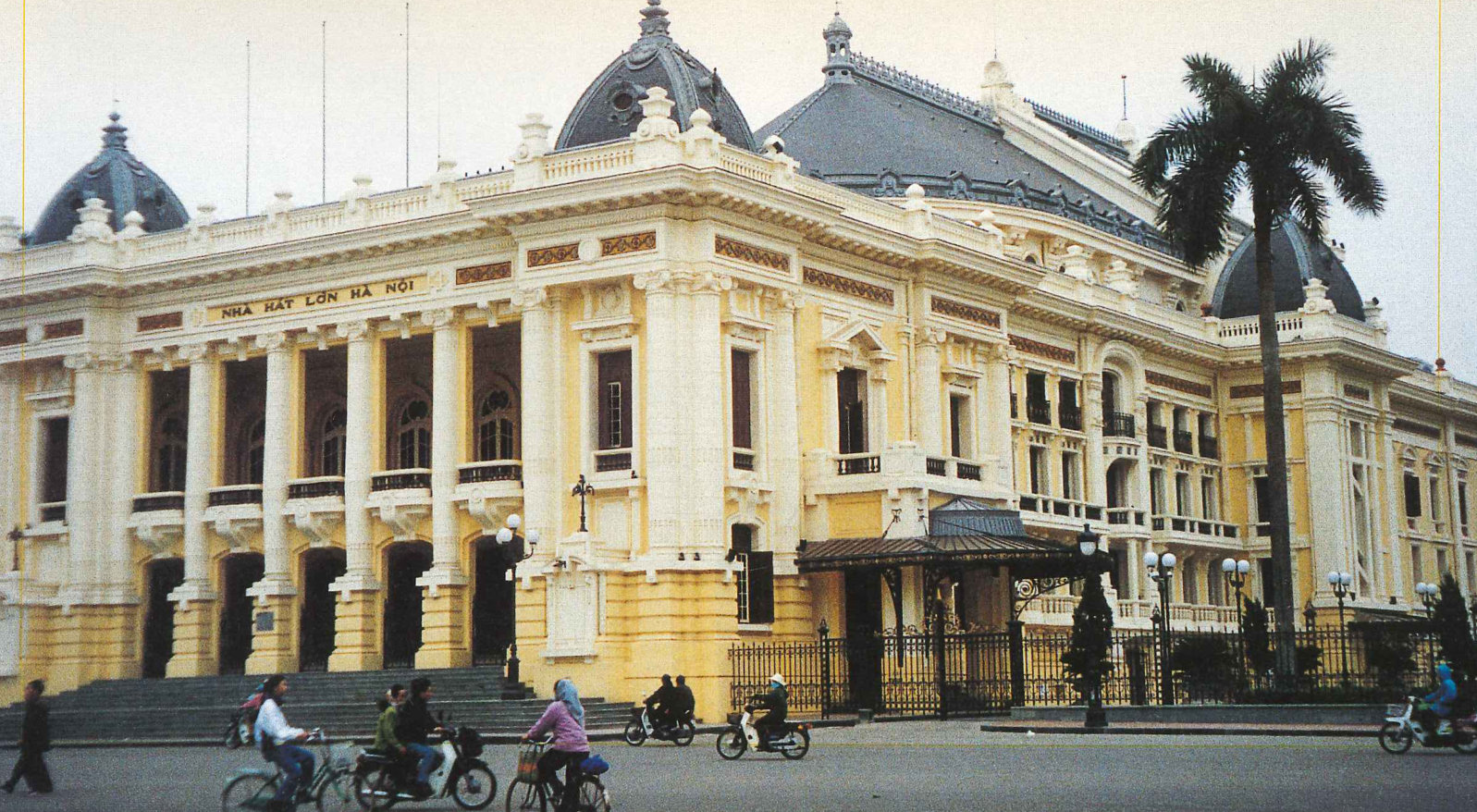
Modelled on L’Odeon de Paris, the Opera House sits amidst a swirl of traffic, with six busy roads radiating away in all directions. Trang Tien Street, the main avenue drawing away from the front steps, is a stately, treelined processional road, and leads a few blocks down past the lovely oval of Hoan Kiem Lake (Lake of the Restored Sword is a wonderful legend involving the mid-fifteenth century Emperor Le Loi and a giant golden tortoise with divine powers). Surrounding the Opera House are several upscale restaurants, the charming colonial Metropole Hotel, and a curious variety of chic art galleries, small appliance repair shops, rundown book shops, and other assorted clutter. A huge Hilton Hotel has sprouted up immediately beside the Opera House, but otherwise, the area remains resolutely, and captivatingly, Vietnamese in its democratic mix of rich and poor land usage.
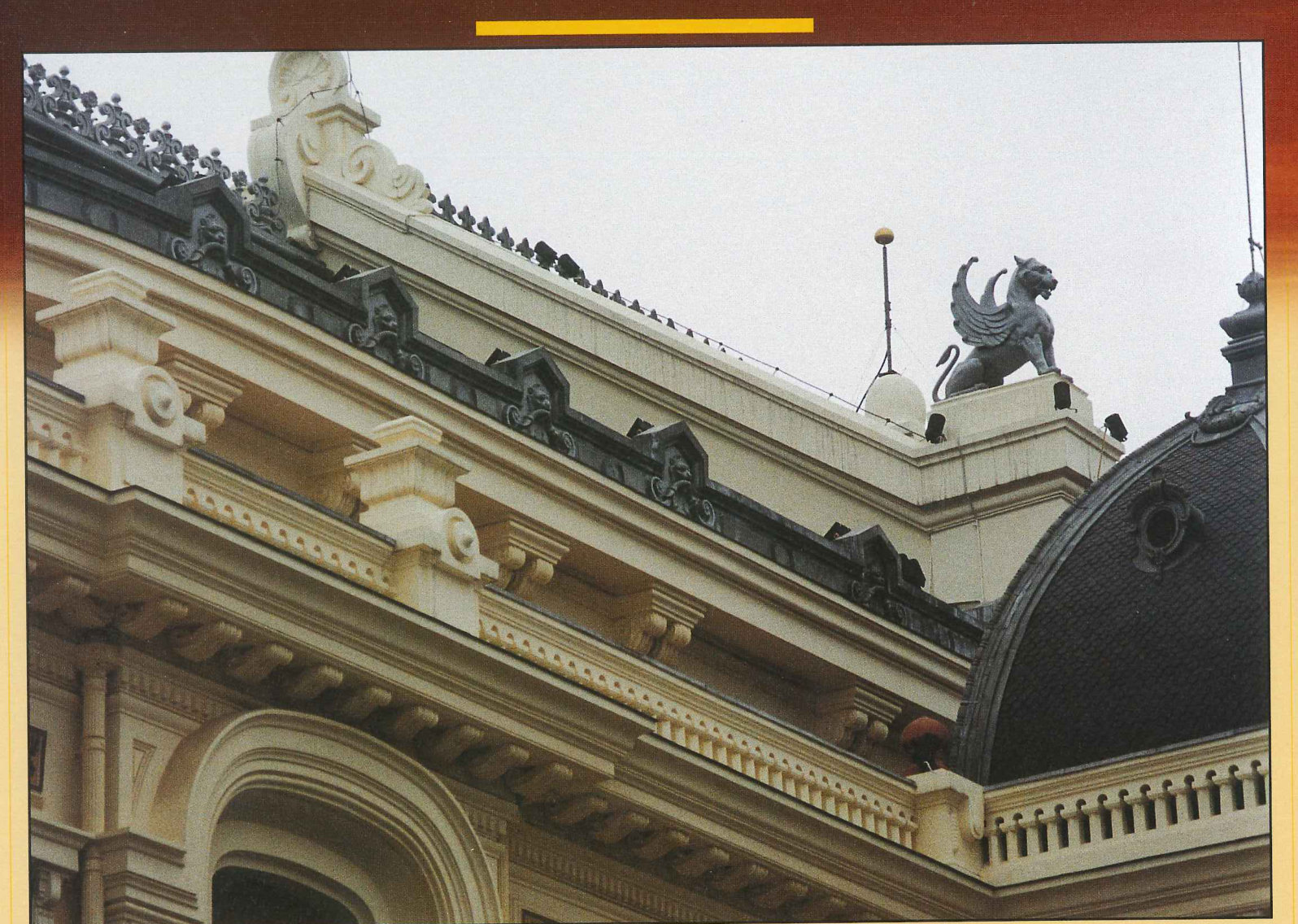
Most of the administrative and cultural with that combination of dusty yellow with buildings erected by the French were painted white trim that one finds throughout Indochina, and the Opera House sports a fresh exterior coat. Topped by a gray slate roof, the edifice is almost imposing in its square and sturdy, forthright bulk. The columns running up the front speak of imperial strength, but the details and the finishing have a sensuous side which soften and enhance the overall impact, without becoming frivolous. This is not a wedding cake, but viewed in the evening, in the rich cast of professional lighting, one feels a certain lightness in being at the foot of a city’s special place.
And what a place it’s been. Up until the end of World War II, operas and classical music were performed within for the colonial crowd and the Vietnamese elite. Nationalist forces took over parts of the north in 1947, and President Ho Chi Minh gathered together his first parliament of the newly created Democratic Republic of Vietnam in the hall. The French counterattacked in December of that year, right up the front steps of the building. They flushed out the rebels from their position on the second floor when they ran out of ammunition, and later executed them. In fact, restoration architect Mr. Tri was at pains to maintain and highlight a couple of French bullet holes in the mirrors of one grand room, in order to tangibly remind visitors of recent stark history.
Classical evenings returned with the French in 1947; however, the Communist Party replaced the opera parties when the colonial government was finally and violently evicted in 1954. Youth meetings, political plays, and Vietnamese music filled the hall for years, along with a few corporate cocktail parties in the early 1990s, until the government closed it for the restoration in 1995.
Entering by the front stairs, one meets a grand white marble staircase which leads to the foyer, before the actual hall. To one side are a pair of stately, high-ceilinged rooms, graced with long windows, bolts of fine red drapery, and ounce upon ounce of delicately applied gold leaf-trimming. To one side is an exquisite green marble fireplace, and on the floors are stunning tile mosaics.
While many older Opera Houses were small enough to be characterized as intimate, with just over 300 seats this one is positively personal. The hard wooden seats have been cleaned up and given plush red velvet cushioning, and every one has a perfect view of the stage. The walls are ornate and a joy to behold, but the domed ceiling is a spectacle: a mildly subdued riot of gold leaf, sparkling chandelier, and rendered blue sky soaring like the music from below.
The original stage has been replaced with one more modern, and sound and lighting systems befitting the 1990s have been installed. The orchestra pit has been sufficiently enlarged such that full orchestras might perform, and the Royal Swedish Orchestra graced the stage shortly after the Francophonie summit. Orchestras from Australia, Italy, and the US are booked to perform over the next few months.
Mr. Tran Trong Hung, Director of the Opera House, and a composer in his own right, has ambitious plans for his charge. He has high hopes for collaboration with Vietnam’s Southeast Asian neighbours, and hopes to be in a position to invite the Singapore Symphony Orchestra to perform in the near future. No “house band” exists as yet, but Mr. Hung also plans to establish a resident orchestra.
As well as Western classical music, the Opera House also serves as a venue for traditional classical Vietnamese groups, pop, and even karaoke nights. To date, most Western classical events have been sponsored by and arranged in conjunction with foreign embassies, where tickets are distributed by invitation only. However, plans are afoot to open up and offer tickets for musical events with a two-tier price breakdown: less for locals, lots for tourists. During the early years of the economic liberalization in the early 1990s, the product launches and cocktail parties occasionally led to what were considered excesses, such as the huge Coke bottle balloons found floating from the front steps during one memorable product launch. While willing to entertain corporate sponsorship for certain events, as arts venues do the world over, Mr. Hungsays: “No more Coke parties”
As with Singapore’s Raffles Hotel, the restoration has stirred some controversy, and some are not entirely happy with losing part of the glory that seems to have been entwined with the grime. Choosing not to tamper with her ghostly memories of the Opera House’s former dusty self, Louise Buhler has chosen not to visit during its current incarnation. However, she has made a start on a collection of the work of some of the city’s finer artists, and so continues to engage with the deeply felt heart of the place.
View the original scanned pages →
Originally published in bout de papier, Vol. 17, No. 4 (2000-2001) — Winter 2000/2001 // Hiver 2000/2001, pp. 9–12. Read the rest of this issue →



