
bout de papier, Vol. 18, No. 4 (2001-2002) — Winter 2001/2002, pp. 27–28
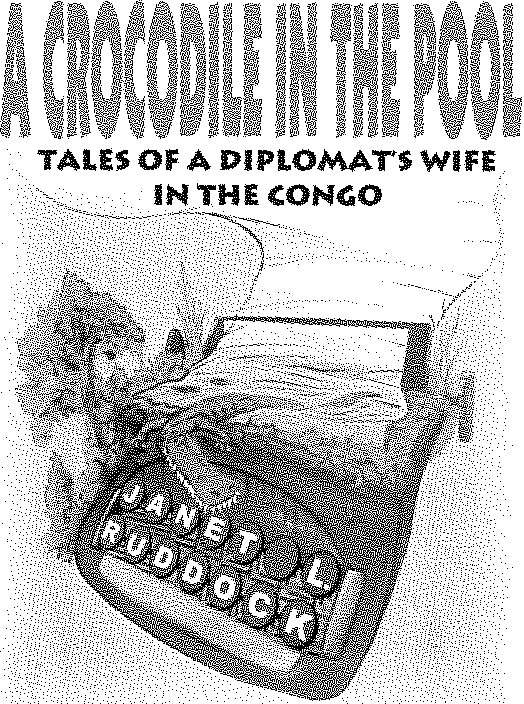
A CROCODILE IN THE POOL: TALES
OF A DIPLOMAT’S WIFE IN THE
CONGO, by Janet L. Ruddock. Published
by General Store Publishing (Burnstown)
2001, $24.95
Janet Ruddock’s odyssey from diplomatic spouse to author began one day in May of 1998 in a dusty North Toronto basement.
Imagine the scene: a childhood friend comes upon a brown manila envelope labeled “Janet’s letters from Africa”. She pulls out a series of crusty, yellowing typewritten pages from two decades before and begins to read. She cannot stop and continues for two hours. She sends the letters off to her childhood friend Janet, with one additional comment: “These should be published”. In late summer 2001, they were.
And that is how A Crocodile in the Pool, a delightful collection of anecdotes about life in then-Zaire, now the Democratic Republic of the Congo, came to be. If it all sounds improbable, that’s because it is: if ever there was a poster girl for serendipity, it is Janet Ruddock. The tale of how the book was published is almost as interesting as the book itself.
Janet, the wite of Foreign Service officer Frank Ruddock, did not see herself as a budding author when she and her new husband were sent off to Congo in the summer of 1978. Both Toronto natives, they had studied at the same high school, renewed acquaintances years later at University of Toronto and married there in the spring of 1978, just before Frank received a job offer from the then- Department of External Affairs.
The hardship posting
As luck would have it, the choice for a first “hardship” posting was Zaire, which had been wracked by ongoing civil war. Just as they were preparing to leave, Zaire was the site of the Kolwezi massacre in May of 1978, where 100 foreign nationals and many more Zairois were killed.
“Our friends and family were calling us and saying ’Well, they certainly won’t be sending you there now!’ ’ Worried at the prospect of the newlyweds heading off to the jungle to face certain disaster, Janet promised them that “I would regularly send newsletters home to tell them that we were all right”.
Once installed in Zaire, she taught at the local American school in the morning and then, in the hot afternoon, would pull out her battered old Brother portable typewriter and “peck away” on the events of the month. She offered snippets of daily life or tidbits of Frank’s travels, turning them into an enthralling account of life in Africa. Then Frank would photocopy five copies of the letter (the limit for the diplomatic pouch) and send them off. Once in Canada, they were distributed though an elaborate “pyramid-like” scheme, which saw the five letters spread among all of their friends, in multiples of three.
The letters were a huge success. “I was getting such amazing feedback, that I took it on as a personal challenge. As time went on, the letters became better, longer, more popular and more widely-read. A professor at the University of Calgary even used them as one his readings”
Two years and seven thick letters later, Janet and Frank returned to Ottawa, Janet pregnant with the future Patrick. When people suggested she turn the letters into a book, she had two reasons for not undertaking the project: “First, I was getting on with my life; second, I did not have the letters because I had sent them off. End of story”.
Twenty years later…
That is until 1998, when Karen Barker Crotin contacted her friend Janet Rainey Ruddock, to say that she had been cleaning up the family home in anticipation of moving her mother, Jean Barker, into chronic care and had found a cache of the letters. She sat down and read the letters, laughing and thinking back to when she had first read them. She then wrapped them up and sent them to Janet in Ottawa, noting that “My mom kept these letters and I just can’t throw them away” ’ adding that “they really should be published”
Her son, Patrick, then 18, a fan of British zoologist and author Gerald Durrell, saw a similarity between the Durrell books and his mother’s story. He encouraged his mother to turn them into a more modern form, in preparation for a book. Janet retyped them onto a computer file, not knowing how to go about offering them to a publisher.
Then fate intervened again: a publisher appeared out of nowhere on a trip to Calabogie with a friend, when the friend’s granddaughter had to use a washroom at a pitstop in Burnstown. The washroom was located in the office of General Store Publishing. Janet chatted with the publisher, Tim Gordon, for a while about the letters, and she sent them off to his senior editor. The editor and Gordon were both impressed, and the project began. One problem: there was not enough material in the seven letters for a book
Re-enter Karen Barker Crotin. When Janet phoned her to say the letters were a hit with the publisher but there were not enough of them, Karen revealed that she, like her mother, had kept all the personal letters Janet had sent to her. With that stock to augment the original letters, present-day footnotes to provide a more detailed sense of the events, peppered with illustrations by Janet’s second son Robin, and assistance from Frank on the historical details, the book was published earlier this year.
The book rings true
The book is delightful. For anyone who has lived in Africa, it conjures up the travails and perils of getting “from here to there” ’, as well as having the feel of the continent in the late 1970s, when Mobutu Sese Seko was ransacking Zaire as well as its treasury.
For those of us with a foreign affairs background, the life of fascinating travel and day-to-day activities rings true. If one is neither of the foreign service community nor travelled abroad, it still has an appeal. Frank’s trip to a far-off Rwandan mission to provide a Canadian priest with a passport and his subsequent rescue by a band of children when his car gets stuck on the road, has a wonderful texture. The tales of large-scale dinner parties in the midst of growing uncertainty have an air of “The Year of Living Dangerously”.
And then there is the account of the day a crocodile was discovered in the school swimming pool: “No one knew exactly what to do with a crocodile in the pool. One crocodile normally means other crocodiles. Therefore it seemed unwise to have hundreds of small children wandering about as tasty appetizers for roving crocodiles”.. The letters were written in a lowkey style and it seems that the lower the key, the more hilarious the moment. As they say, there is many a good yarn to be found in the book.
Janet is now hitting the trail to promote the book in the Ottawa area, where three bookstores (and one in Toronto) are carrying it. She says she “is not in it for the money” but admits it “feels wonderful to hold the book in her hand” and loves writing. As for the serendipity of the letters found in the basement, the book is dedicated to “good friends everywhere … especially to the late Jean Barker, who carefully saved my letters for a distant day. And to my dear friend Karen, for finding them”.
Available at Shirley Leishman’s (Westgate), Nicholas Hoare, Books on Beechwood (all in Ottawa) or by email from the publisher at: [email protected].
View the original scanned pages →
Originally published in bout de papier, Vol. 18, No. 4 (2001-2002) — Winter 2001/2002, pp. 27–28. Read the rest of this issue →



