
bout de papier, Vol. 19, No. 1 (2002) — Spring/Summer 2002 // Printemps/Été 2002, pp. 28–31
_n earlier issues of bout de papier, we reprinted two papers from the early 1950s which were parts of a comprehensive “Re-Examination of Canadian Foreign Policy” that was guided by the Deputy Under-secretary of State for External Affairs, Escott Reid, at the request of the minister, Lester B. Pearson. Some of the proposed studies were never completed before the project was abandoned. Others were relatively straightforward reviews of past and current policy in specific domains that were circulated within headquarters and to posts for comment. Yet another category of memorandum prompted more debate and consequently underwent multiple revisions. By the time some of these latter papers were shelved, the original authors had assumed other duties, as had Reid.
Arguably the most Sisyphean task was that assigned to George Glazebrook of Defence Liaison (2) Division. Glazebrook, a wartime recruit from academe to the Department of External Affairs, who had recently directed the Joint Intelligence Bureau at the Department of National Defence, was asked to evaluate not only the current balance of power but also to predict changes in that equilibrium. Glazebrook’s first draft looked 25 years into the future. By the second draft, the projection had been limited to 15 years. A third draft — completed within two months of the first
– reduced the forward gaze to five years and doubled the length of the text. Yet another version, which went to the minister, restored the time line to 15 years, taking it up to Canada’s centenary (by which time Pearson would be Prime Minister), but it was promptly overtaken by the death of Joseph Stalin. Before the project was formally abandoned, Reid had moved on to the post of High Commissioner to India, from whence his reports went to the Commonwealth Division, headed by Glazebrook. In addition to those duties, Glazebrook was also head of DEA’s Historical Division, whose archival holdings soon included the various studies. As with other records of the Department of External Affairs, these papers can now be found in Record Group 25 at the National Archives of Canada.
G[eorge]. [Parkin] de T[wenebrokes]. Glazebrook [Defence Liaison (2) Division], “The Balance of Power, Present and Future,” First Draft, Secret, October 25, 1951.
Introduction
The purpose of this paper is to analyse the probable balance of power in the world during the next quarter-century. It is obvious that the trend cannot be forecast with any hope of accuracy or finality. The object is simply, in the light of existing evidence in respect of the present situation and the best estimates available of the future position, to examine in general terms the most likely developments.
Certain arbitrary assumptions are made:
i. that in the period under review there will be no major war and no effective relaxation in the existing international tension;
ii. that the USSR will continue to be a Communist State, whereas the USA, the UK, and France will continue to be anti-Communist; ili. that nationalism will continue to be a significant factor, influencing, inter alia, the Middle and Far East;
iv. that Latin America will remain relatively detached toward
V. that no secret weapon will be invented, which would allow an individual in Helsinki or Capetown to blow up the world by pressing a button.
Given the above assumptions there will be two competing groups of powers, the one dominated by the USSR and the other by the USA. In all probability the States now actively supporting one side or the other will continue to do so. The balance, however, can be modified by the accession to an active group of States at present wholly or partly neutral. Of the possible ones those in Latin America have been rule out in the assumptions. Of the European neutrals Switzerland may also reasonably be expected to remain neutral. Sweden and Spain, because of their strategic positions, would add more to the Russian than the American group. In the Middle East, Egypt would be of great strategic value to either side, while Iran’s positive contribution would be to the American group. The most difficult States to assess are those of the Far East in respect of either their internal strength or their diplomatic positions. In particular, while the future of Japan and Pakistan may be forecast with some reasonable degree of assurance, China and India are bristling with question marks.
There is, therefore, an impressive array of factors which cannot be readily controlled by a strait-jacket made of even the most arbitrary assumptions. In the main an estimate of the future balance of power must concentrate on the effective strength of the core of each alliance, recognizing the likelihood of modifications created by the positions of the marginal states.
Military Power
Military power is, in effect, a complex of elements. It requires a stable political régime under which a government (regardless of its form) commands the support of the population. It needs a healthy people, which in turn presupposes a standard of living sufficient to maintain health. The economic structure must be strong enough not only to support an adequate standard of living for individuals but also be sufficiently diversified and elastic to produce the materiel of modern mechanized warfare. Scientific inventions and technical development may decide the issue in war. Finally, the fighting power of the individual, the training and organization of a country’s services, and the ability of its strategists may likewise decide the results. Some of these factors will be examined in the following paragraphs.
Population and National Income
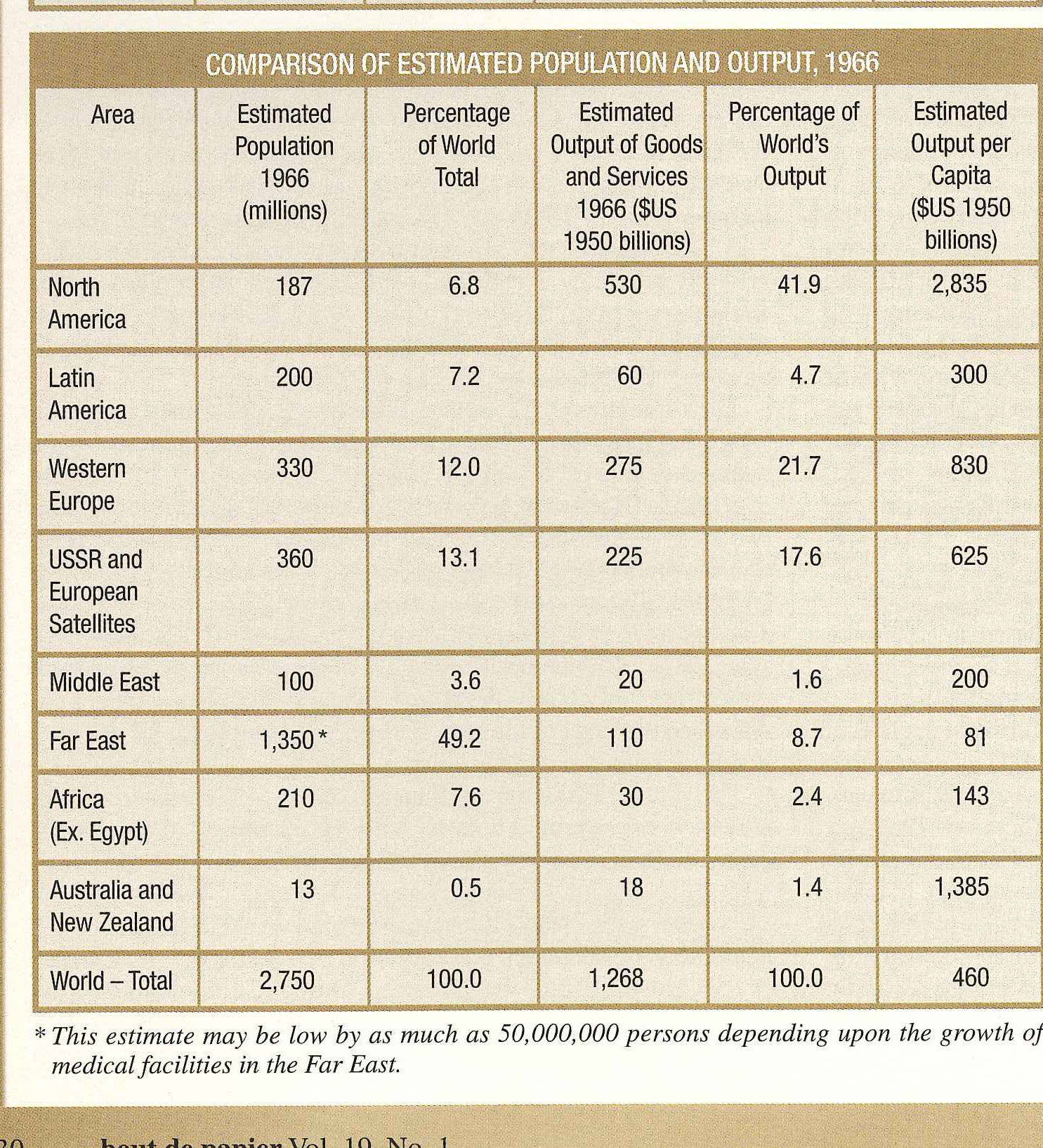
Developing the argument indicated above, the military significance of population is derived not only from its size but also from what may be described as its output. The following tables are designed to show the relationship; and, while such projections are subject to a wide margin of error, they may be taken as reasonable estimates of the comparative positions.
It will be noted that the relative position is not expected to change materially in the course of the next fifteen years. Such change as is shown indicates a relative decline of the national output of Western Europe and the Far East, and gains by North America and the USSR. As warfare becomes increasingly mechanized the capacity of the individual to produce and utilize the weapons of war (as well as to maintain the domestic economy) must correspondingly be significant. There is, of course, the consideration that, because of climate, tradition, or other reasons, one people can live on a lower standard of living than another. While this may modify the stark gap between the North Americans and the Russians, or between the inhabitants of Western Europe and the inhabitants of the Far East, it still leaves a great advantage to the country with a greater per capita output.
COMPARISON BY ECONOMIC STRENGTH
Examining again the economic strength of countries, in relation to each other and to the present and future positions, it becomes apparent that the present disparity will, in general, be maintained
The United States and Canada, together, in terms of economic strength, tower above all other areas of the world. The labour force has a high standard of living, is productive, and is capable of expansion because of a large reserve and short hours (between 1939 and 1944 the United States increased its employed labour force by 40%). In production of food the area maintains a surplus. In natural resources required by industry the area is well supplied. The high industrial capacity derives from the labour force, available materials, improved methods of production, and a large domestic market for standardized products. The transportation system is well developed.
In 1950 US industrial production was 75% higher, steel production 65% higher, petroleum production 50% higher, and electric power production 120% higher than in 1940. In consideration of this development, and published estimates, it is probable that the growth of national production will be about 20% in the next five years. If something of the same speed were maintained, the gross national production in 1966 would be 50% higher than in 1951. Western Europe (including the United Kingdom) is only partially self-sufficient in food This situation varies in degree from one area to another, as do the availability of raw materials and the productivity of the labour force. If the present tendency toward economic integration were continued this lack of balance would be modified. The traditional industrial capacity of Western Europe still exists. In the immediate post-war years Western Europe was in a very difficult position, but with the help of American aid industrial production has now risen by about 40% above the level of pre-war years. Total production has risen by about 15%.
While the area cannot be expected to return to the industrial supremacy which it once held, it may be estimated that the total output of goods and services in 1966 will be about 50% higher than in 1951.
USSR and European Satellites. In the economic, as in the political sphere, the area is largely directed from Moscow, so that some of the Russian shortages have been offset by the satellites. Within the Soviet Union the system of collective farming has kept the output of the individual still low, perhaps four times lower than in the United States. While industrial training has increased, the output per person is lower in this field also.
The grain crop of 1950, while producing a surplus, was only slightly higher than that of 1940, and the number of livestock was lower. In forest products, and in fuel and power resources, the USSR is well endowed. The same, with some exceptions, is true of non-ferrous metals and non-metallic minerals. Steel production in the area increased by one-half between 1940 and 1950, but is still below that of Western Europe. In industry the emphasis has been on basic industries such as coal, oil, electricity, iron, and steel. Transport, while weak in comparison with North America or Western Europe, is not so much so as to cause any major problem.
All the ingredients for an expanding economy exist: a rapidly-growing population, substantial undeveloped natural resources, adequate transportation, and a well-developed industrial base. It may be estimated that by 1966 the output of goods and services in the area will increase by 75% over 1950 levels.
The three areas which have been briefly examined are those which will play the major and the most clearly-defined part in the balance of power. It will have been seen, too, that all three are expected to increase materially in economic strength. There remain two areas — the Middle East and the Far East — the strategic position of which is of great importance, but which have futures which are politically not clear and economic ones which are also cloudy. The Middle East is, generally speaking, a country of peasants whose standard of living is low. While 75% of the population depends on agriculture, only 6% of the whole area is available for cultivation. Although methods of farming are backward and wasteful, the area is self-sufficient in cereals, oils, and fats.
The prerequisites for an industrial base – raw materials and power — are sparse. There is, with the exception of oil, a deficiency in basic materials. With the exception of Turkey the possibility of heavy industry does not exist. In addition to raw materials and power, skilled labour and domestic markets are absent as applied to industrial development generally. Rail transport, too, is inadequate.
It is not probable, then, that economically the Middle East will be of significance in the world balance by 1966, even if some progress is made on the bargaining power of oil. The output of goods and services by 1966 may, perhaps, amount to $20 billion US.
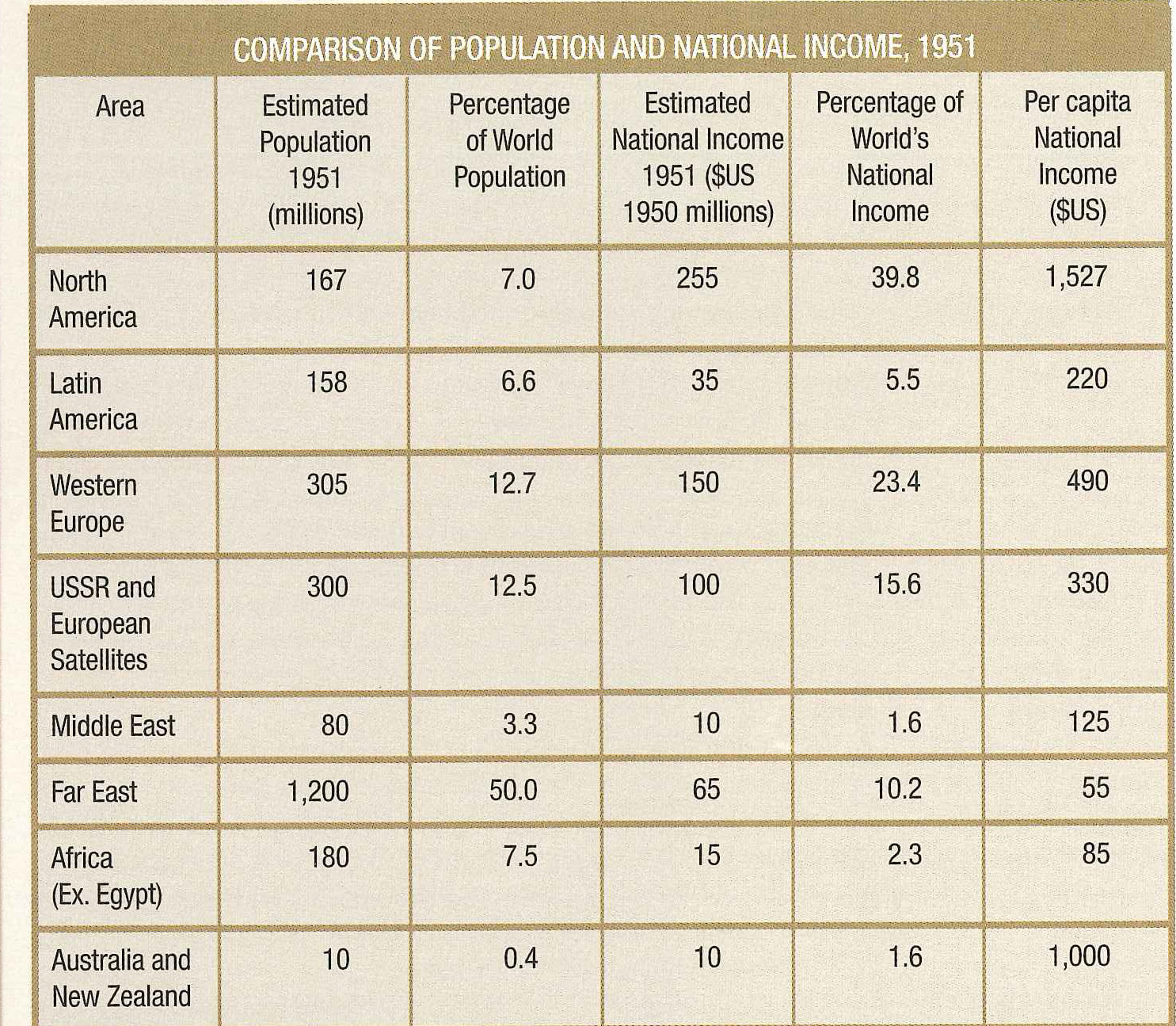
The Far East is the most incalculable area considered. A vast population (now 1¼ billion, which is more than half the population of the world) live on 6 of the land area of the world. With problems arising out of scarcity of land and industrial capital, the productivity of labour and the standard of living are low. Only Japan (with diminished resources) is likely to play any major part in industry. It is improbable that India will develop any significant economic strength in the next fifteen years. China is harder to evaluate, but is short in known resources, transportation, and trained personnel.
Even assuming a rapid development of political stability, the Far East as a whole has too many problems to overcome rapidly the long lead established by Western Europe and North America. Economic strength may be expected to expand slowly as great industrialization develops in Japan, North China, and India; but output per capita is not likely to increase materially. The general output of goods and services in the area is unlikely to exceed US $110 billion by 1966.
The Nature of Warfare
Predictions in this field are especially subject to error; but, because of the importance of this aspect of power, must be made for what they may be worth.
At the end of fifteen years A bombs are expected to be in supply sufficient for tactical as well as strategic use, and H bombs will probably have been developed. Moreover, while guided missiles will make the present heavy bomber obsolete, the long-range missile capable of carrying an atom bomb is well advanced in development. Defence against atomic attack — other than dispersion and the fear of retaliation — is likely to be sketchy.
There is a difference of opinion as to the use and effectiveness of biological warfare. It is probable that in fifteen years BW agents will be mass-produced. They might, too, be applied by destroying the food supply, e.g., by introducing foot-and-mouth disease amongst cattle. On the other hand, BW attack is affected by variables, such as wind, temperature, and humidity.
Similarly chemical warfare can readily be developed to the point of using highly lethal weapons, but is less effective in the sense that defence can be prepared in advance.
In sea warfare the main development is likely to be the decline of sea-transport. Surface craft will become more vulnerable as submarines are developed, atomic-powered and capable of long periods of immersion. Added to the threat is likely to be another from air-to-sea guided missiles.
In land warfare it may be expected that armoured fighting vehicles may lose their relative value with the increased effectiveness of anti-tank weapons. Land mines may well become more important, in view of the difficulty of detecting non-metallic cases. Perhaps the largest change would result from tactical A-bombing, which would make large concentrations of troops impracticable.
Air warfare is likely to see strategic bombing conducted by long-range rockets and various types of uninhabited aircraft. Guided missiles will similarly replace fighter aircraft. Before long it is expected that a surface-to-air missile, effective against present aircraft up to 60,000 feet will be available.
In such ways — and in others that are even more speculative — it is apparent that warfare will go through radical changes. For the purposes of the present paper, the significance of the factor is the extent to which it can aid one group or another and so affect the balance of power.
In all probability it may be assumed that scientific developments will, in the main, be centred in the United States and United Kingdom on the one hand and in the Soviet Union on the other. The difficulty in assessing the relative progress of the two arises out of the small amount known about the latter. The USSR is undoubtedly encouraging scientists by every possible means. They are given high salaries and many privileges, including comparative immunity from the sanctions against minor political heterodoxy. A number of German scientists have been employed in the USSR, and thus, and by other means the Russian authorities secured a good deal of information on German inventions. Some important information in the scientific field has been gained through espionage and from defectors. It must be assumed, therefore, that the USSR is and will increasingly be well equipped for scientific invention and development.
At the present time the UK and US have a long lead and certain advantages both in development and production of new weapons. It is perhaps safe to estimate that this lead will continue, but it is not clear whether the present relative advantage will be maintained. While, therefore, there is little doubt that the nature of warfare will change — perhaps radically — it would be little more than guessing to suggest how this would affect the balance of power.
MILITARY FORCES
The present rearmament of the West is designed to produce a situation in which the present preponderance of the Soviet group in personnel and conventional weapons can be reduced by 1954 to a point at which it ceases to offer to the Soviet Union a quick and successful war. During the intervening period, of course, the relative Russian superiority is expected to be reduced by steps. The advantages derived from this process by the West, however, are not calculated on an assumed static position in the Soviet group. In terms of numbers the latter would have no difficulty in increasing greatly its present large forces, and to a degree that would not be nearly matched by the West. The Russian economy is not on a wartime basis, and could be modified not only to release large numbers of men for the armed forces but also to convert production for direct requirements of operations.
While the Soviet Union suffers at present from some handicaps for waging even conventional war, it has already very large forces having high morale and good training. The deficiencies in its surface fleet (military and civil) are expected to be reduced in fifteen years and are partly compensated by the advantages of position and comparative self-sufficiency. Its air force is developing new types of aircraft, some of which are known to be of high standard, and others about which little is yet known. The army is already very large and can be further expanded without great difficulty. It is considered to be efficient and have high morale. So far as is known, none of the Soviet forces are reduced in efficiency by political control. The satellite forces have been growing in size and effectiveness; appear to be coming increasingly under Russian control; and to be receiving modern Russian equipment.
CONCLUSIONS
An attempt should now be made to assess the probable balance of power, in spite of the many uncertain factors.
(1) The main elements in the balance will continue to be:
a. The USSR and its European satellites.
This group will, in fifteen or twenty years, remain powerful in numbers, morale, and material. It will be least effective in a war of attrition. It will have the advantage of centralized authority. It may make greater strides in scientific development.
b. The USA, UK, France, the other
NATO powers, Australia and New Zealand. This group will certainly increase in power and probably at a faster rate than that above. It will be more able to sustain a war of attrition.
The scattered nature of its component parts produces problems of transportation, but the lack of centralized authority will be largely met by NATO. Its lead in development and production may well be expected to continue.
(2) The weight of other areas in the balance cannot be estimated with any accuracy:
a. Latin America has been ruled out by original assumption.
b. Japan will, with little doubt, be an increasingly important military power; and can be expected to remain in the
Western camp.
c. China is something more than a
Russian satellite and something less than an ally. If the Communist régime continues to rule, China will probably remain in the Russian camp. d. The rest of the Far East has little significance as a major contributor to world power. Neither India nor Pakistan can, in fifteen years, sufficiently overcome domestic problems as to play an independent role of any significance nor even to tell [sic: tilt] the balance of power. Unless all the Far Eastern countries joined one side or the other this influence cannot be decisive.
e. The Middle East is a strategic area, with force found only in Turkey. But the Suez Canal, oil, and Mediterranean communications make it an area which, if denied to the West, would seriously affect the balance.
(3) Theoretically the balance of power could be controlled by ideological conquest, one way or the other, but such an event is so unlikely that it must be ruled out.
(4) Barring such unexpected and incalculable developments as unforeseen weapons or ideological revolution, there can be anticipated a period of fifteen or twenty years during which the balance of power will not be decided in favour of the Americas or the Soviet groups. In all probability the balance will become more even, by the increased strength of the former, but not be tilted to such a degree that the Soviet groups are not capable of threatening the West.
In other words, there can be anticipated a balance of power which cannot be changed quickly by the exertions of the participants, or arbitrarily by the intervention of a non-participant.
View the original scanned pages →
Originally published in bout de papier, Vol. 19, No. 1 (2002) — Spring/Summer 2002 // Printemps/Été 2002, pp. 28–31. Read the rest of this issue →



