
bout de papier, Vol. 19, No. 1 (2002) — Spring/Summer 2002 // Printemps/Été 2002, pp. 25–27
For years rumors have circulated that the early history of the Canadian official residence in Havana was scandalous. A lover, an outraged husband, the third floor studio and flagrante delicto all figured in the house’s pre-Canadian history. Certainly visitors often remarked that the official residence called Jaimanitas had a charming, but compelling atmosphere. I certainly felt this dynamic of undiscovered secrets when I first arrived under its roof. But then I had been briefed in Ottawa earlier by the Cuban ambassador to Canada on these tales of love and adultery. After all, everyone likes a good story.
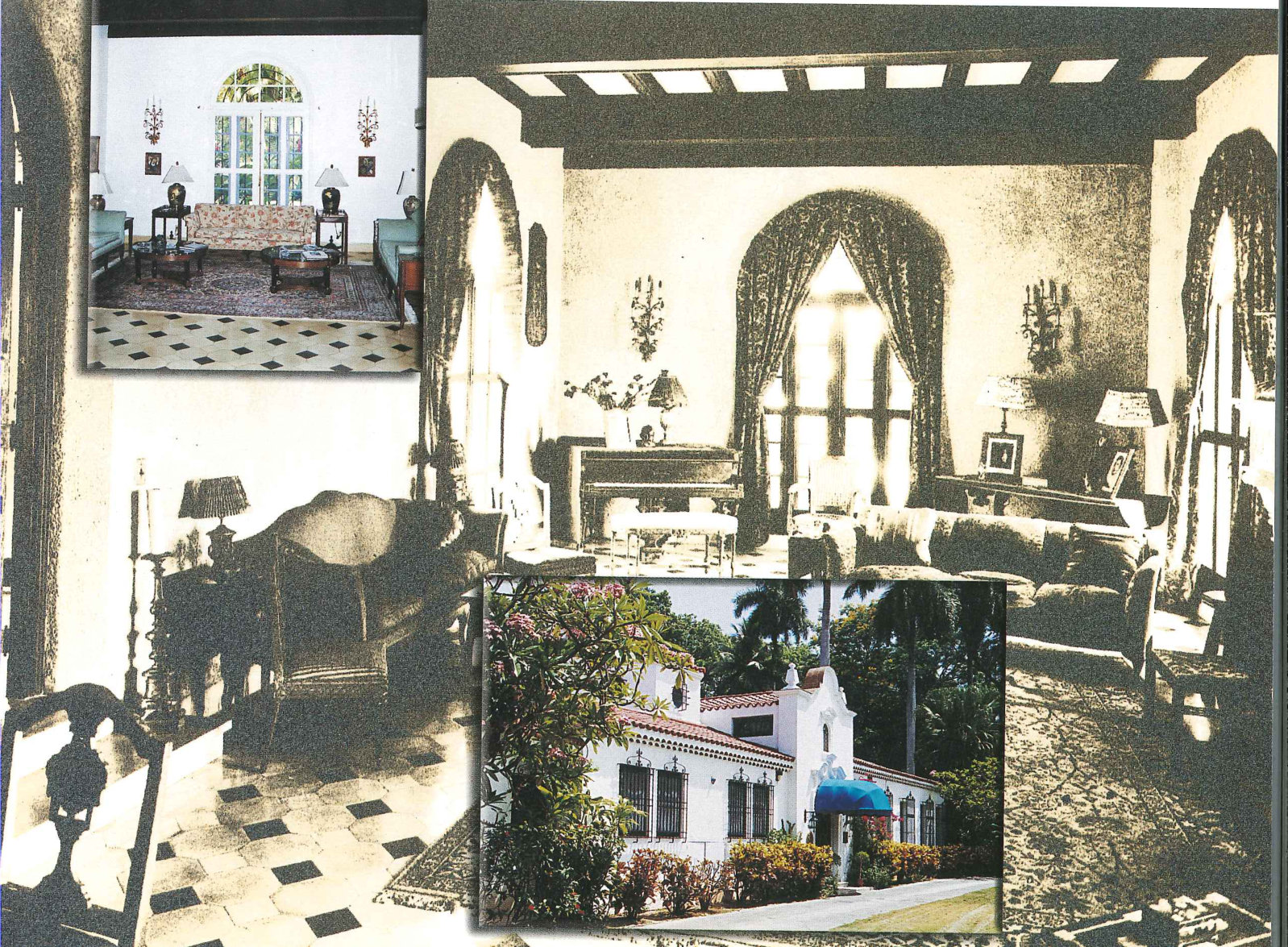
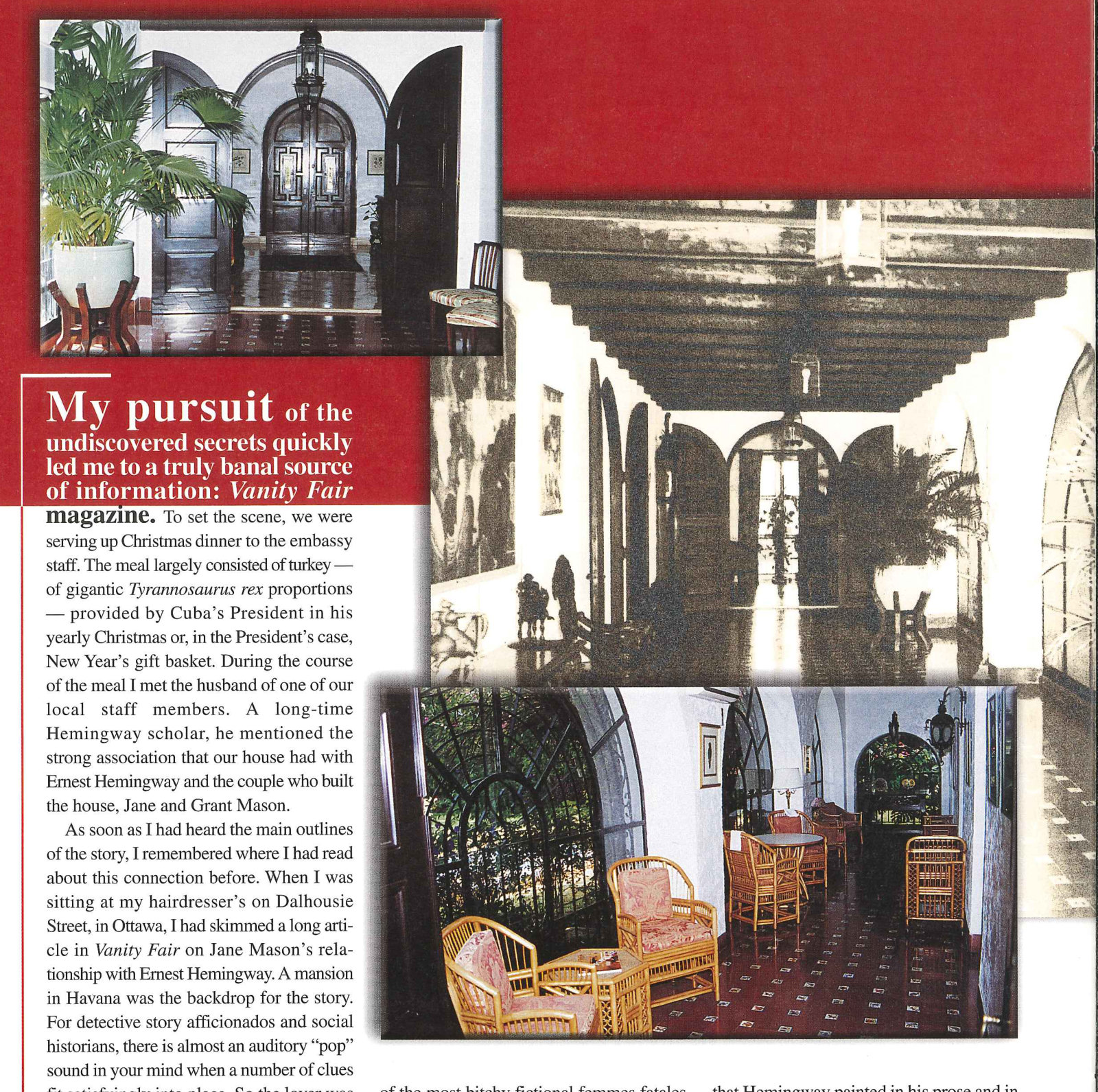
My pursuit of the undiscovered secrets quickly led me to a truly banal source of information: Vanity Fair magazine. To set the scene, we were serving up Christmas dinner to the embassy staff. The meal largely consisted of turkey — of gigantic Tyrannosaurus rex proportions — provided by Cuba’s President in his yearly Christmas or, in the President’s case, New Year’s gift basket. During the course of the meal I met the husband of one of our local staff members. A long-time Hemingway scholar, he mentioned the strong association that our house had with Ernest Hemingway and the couple who built the house, Jane and Grant Mason.
As soon as I had heard the main outlines of the story, I remembered where I had read about this connection before. When I was sitting at my hairdresser’s on Dalhousie Street, in Ottawa, I had skimmed a long article in Vanity Fair on Jane Mason’s relationship with Ernest Hemingway. A mansion in Havana was the backdrop for the story. For detective story afficionados and social historians, there is almost an auditory “pop” sound in your mind when a number of clues fit satisfyingly into place. So the lover was none other than Papa Hemingway.
By some miracle we got the sulky Cuban internet provider to work a short time later. While checking Hemingway sites and using Google, additional elements of the story started to emerge. Jane was the inspiration for one of Hemingway’s greatest stories, “The Short Happy Life of Francis Macomber.” The Margot character of this story was one of the most bitchy fictional femmes fatales of all time. At the story’s end, she shoots her husband, allegedly to save him from a charging African buffalo. It is interesting to note that on Hemingway’s Cuban farm, he chose to decorate his study with a woolly head of the same species of African buffalo as he used in the Macomber story.
Grant, Jane’s husband, was more complex than the compliant cupboard cuckold that Hemingway painted in his prose and in his letters. An heir to a railway mega-fortune, he was one of the founders of Pan American Airways. After he had been bought out by Juan Trippe in the late 1920s, he negotiated the position of Latin American General Manager, stationed in Havana. This is when he built his mansion, with access to a golf club and to the ocean, where he could dock his large cabin cruiser for marlin fishing. Later, he was named to the Civil Aeronautics Board by Roosevelt and was promoted to Lieutenant-Colonel during the war. Strangest of all, after divorcing Jane, Grant actually considered re-marrying her, when they were both between spousal entanglements.
In my detective work the real breakthrough occurred when I wrote to the author of the Vanity Fair article. Alane Salierno Mason was Jane’s granddaughter. An accomplished young editor and writer, her work is notable for its thoughtful gravitas. Even the glossy Vanity Fair article, which might have centred on the lurid lives of the rich and famous of the 1930s, is a sensitive attempt to interpret the complexities in the Ernest-Jane Grant relationship. I sent Alane a fax, care of her employer, the publishing house Nortons, explaining that I had the good fortune to live in her grandparents’ former home and was seeking photos and information. I never expected a reply. There was a return e-mail in 24 hours. Alane had already spoken to her father, who was very excited about the prospect of visiting his boyhood home. At some point in the 1950s, Antony Mason had stood outside the official residence, too intimidated by the flag and the brass plate on the door to knock and ask to see his parents’ former house.
From here, the story unfolded easily. I exchanged photos with the Mason family. I visited them in New York. Provided with an inventory of the house contents and photos from the 1930s, I have identified more than 40 items of Jaimanitas’ present furnishings as original to the house, purchased by the Government of Canada — complete with some furniture – in 1949. Currently, I am researching the possibility that one of the residence’s fountains was designed by the Japanese-American sculptor, Noguchi. The Noguchi Museum has turned up a photo of a beautiful ebony Noguchi sculpture of Jane.
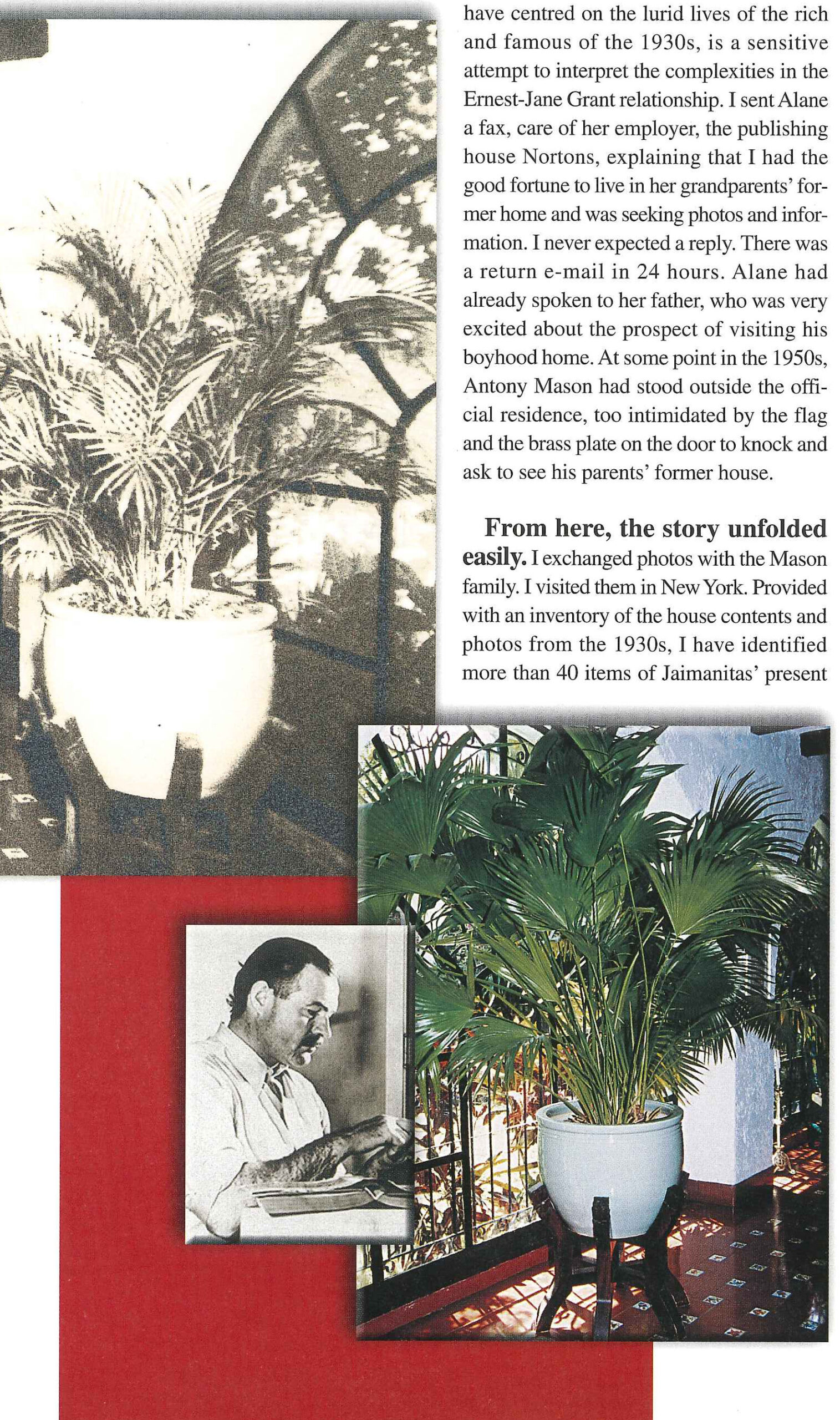
To satisty myself, I still wanted to have evidence of a link between Hemingway and Jaimanitas. Alane Mason gave me the clue. Apparently there was a description of the Mason house in the manuscript version of To Have and Have Not. Hemingway later expunged this portion when warned that the Masons might sue. Naively, I asked the Hemingway librarian at the John Fitzgerald Kennedy Library for a photocopy of these pages. I was indignantly told this was impossible, owing to copyright protection.
Fortunately, the Canadian Foreign Service provides one with a network of contacts. In a wonderful act of kindness, Graeme Clark, currently on leave in Boston, agreed to brave the fierce librarian and, armed only with a pencil, found the original four Hemingway paragraphs in the Kennedy Library. In this text, Jaimanitas is described reasonably accurately but with some hilarious detail. Hemingway depicts the centrepiece of one fountain — not the possible Noguchi fountain — as being a “peeing goose,” Luckily, in point of fact, there is no “peeing goose,” just spitting frogs.
Jane Mason is frequently on my mind. How could she not be? My dresses now hang in her cedar closet. Every night, I turn off the bedroom lamp that has illuminated the same room for 70 years. Jane, like my own eccentric mother, had a strong interest in spiritualism. Wherever Jane’s restless spirit wanders, I think she approves of my hunt for the real story. I promise we will look after the house, eradicate the termites and not put in those aluminum windows.
View the original scanned pages →
Originally published in bout de papier, Vol. 19, No. 1 (2002) — Spring/Summer 2002 // Printemps/Été 2002, pp. 25–27. Read the rest of this issue →



