bout de papier, Vol. 19, No. 2 (2002) — Summer/Fall 2002 // Été/Automne 2002, pp. 24–28
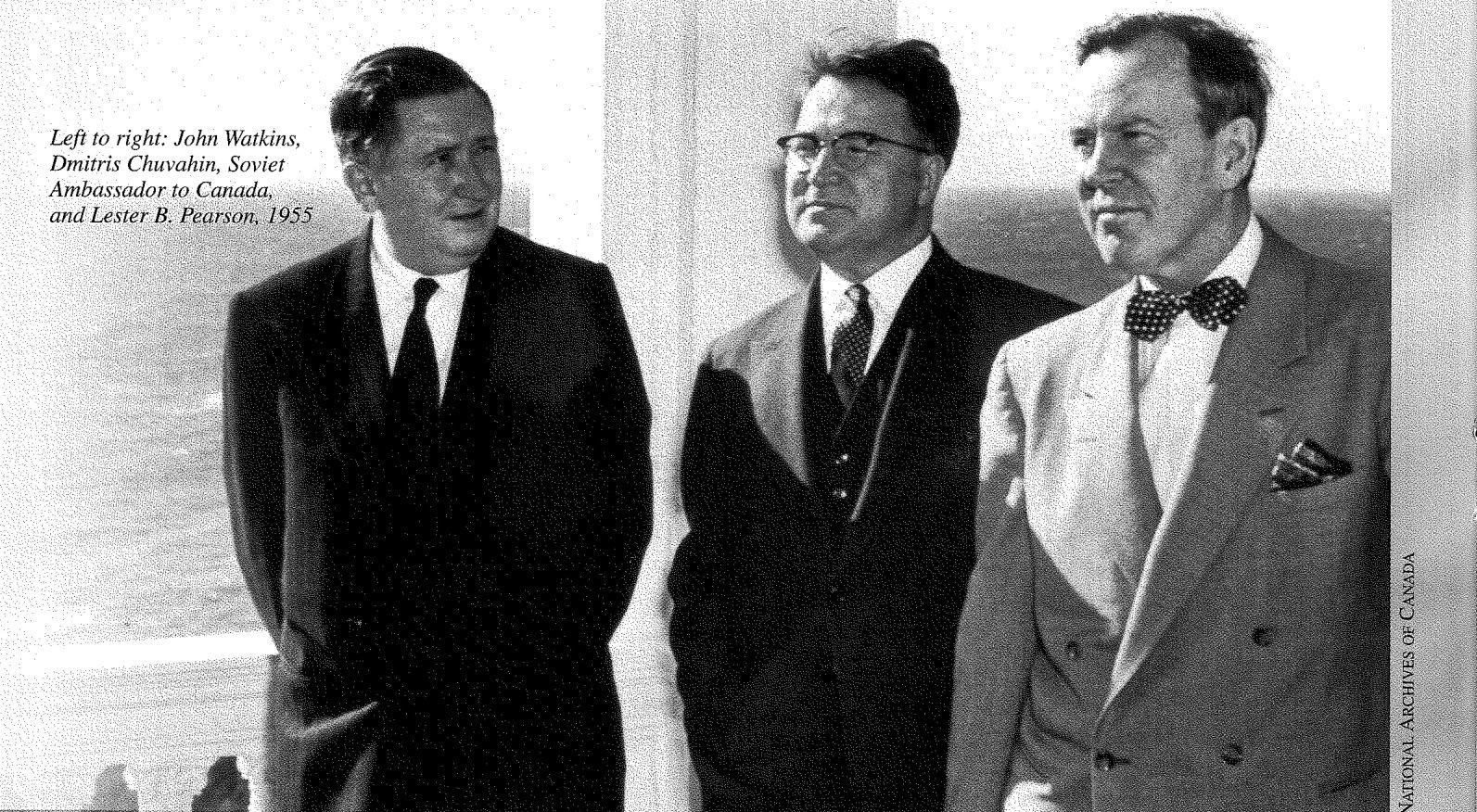
One of the more remarkable careers in Canadian diplomatic history was the one which took John Watkins (1902-1964) from the family farm near Norval Station, Ontario, to the senior ranks of the Department of External Affairs, with two postings in Moscow (including one as ambassador from 1954 to 1956) as personal and professional highlights. A gifted linguist and scholar, whose doctoral thesis at Cornell University dealt with Danish writer Gustav Wied, Watkins immersed himself in Russian society and culture within the limits imposed by the Union of Soviet Socialist Republics during the cold war.
Unfortunately, one exploration in Russia led to a homosexual entrapment that the KGB attempted unsuccessfully to exploit. Later defections by KGB agents led to the identification of Watkins as the target of this plot. After his retirement, Watkins was questioned by the RCMP’s security service, initially in London, England, and then in Montréal. Before that second interview was over – but after he had satisfied his questioners that he had not betrayed his country — Watkins suffered a fatal heart attack. This aspect of the life and death of John Watkins has been examined in newspaper accounts and books (most notably John Sawatsky’s Men in the Shadows and For Services Rendered, as well as two novels that attempt to recreate the final interrogation, and a play by Timothy Findley, The Stillborn Lover, that draws on elements of the story).
What is sometimes overlooked in this fascination with the circumstances of his death is that Watkins was an acute observer of the USSR at a time of change and uncertainty after the death of Joseph Stalin. There is an excellent edition of his diplomatic reports assembled by Dean Beeby and William Kaplan, Moscow Despatches: Inside Cold War Russia. That collection includes reports by Watkins on the decisive Twentieth Congress of the Communist Party of the USSR in February 1956, including the closed session when Nikita Khrushchev denounced the “cult of personality” under Stalin and its deleterious consequences. The memorandum reproduced below conveys his reflections and assessment after Watkins returned to Ottawa. The memorandum was declassified in 1990 by the Co-ordinator, Access to Information and Privacy (then Ted Johnston, who provided a copy of this document), prior to the transfer of departmental records to the National Archives of Canada.
J[ohn]. B[enjamin]. C[lark]. Watkins [Assistant Under-Secretary of State for External Affairs], “Some Thoughts on the recent changes in the Soviet Government,” Confidential, July 15, 1957.
“Flexibility” was one of the main watchwords of the 20th Congress of the Soviet Communist Party, and while all the members of the Praesidium apparently acquiesced in the need for more flexible policies both at home and abroad the more cautious and conservative of them, such as [Lazar Moiseyevich] Kaganovich [former Commissar of Railways and Deputy Chairman of the Council of Ministers, dismissed in 1957] and [Viacheslav Michailovich] Molotov [Minister of Foreign Affairs, USSR, 1939-49 and 1953-56; First Deputy Chairman of Council of Ministers, USSR, until February 1957], must have had serious misgivings about the extent to which the ebullient and daring [Nikita Sergeyevich] Khrushchev [First Secretary of the Communist Party of the USSR, 1953-64] might feel empowered to make changes, for they had already had a sufficiently unpalatable foretaste.
In the field of foreign affairs, Khrushchev’s visit, with [Nicolai] Bulganin [Chairman, Council of Ministers, USSR, 1955-58 (an office usually referred to in Canadian press as “Premier”)I, to Belgrade, his admission there that the Soviet Union had been wrong and the Yugoslavs right in the interpretation of Marxism-Leninism, and his abject apology to [Marshal Josip Broz] Tito [President of Yugoslavia, 1953-80] for the injury done him, had certainly seemed to Molotov, Kaganovich and others a risky course upon which to embark in view of its potential repercussions in the satellites. Khrushchev’s own simplified explanation of his conduct that, in personal relations, if you realized that you had wronged a man, you told him so and asked his pardon and that the same rule should apply between countries, cannot have carried much weight with so old and experienced a diplomat as Molotov, who, having signed some of the insulting communications sent to Tito under [Joseph Vissarionovich] Stalin’s [Secretary General of the Central Committee of the Communist Party of the USSR, 1922-53] direction, had naturally been omitted from the Belgrade party and was to be replaced as Foreign Minister just before Tito’s return visit.
While the strictures on the cult of personality and the sharp criticism of Stalin implied in [Anastas Ivanovich] Mikoyan’s [First Vice-Chairman of the Council of Ministers of the USSR, 1955-64] speech at the 20th Congress, which went considerably further in that direction than Khrushchev’s opening speech, had probably been agreed upon by the Praesidium, it seems likely that Khrushchev’s bitter, extreme and highly emotional denunciation of Stalin in the closed session at the end of the Congress came as an unpleasant surprise to some of his colleagues on the Praesidium. It was obviously undertaken with the deliberate intention of shocking the entire Soviet public into freeing itself from the dead weight of Stalinism and of releasing initiatives essential to a rapid increase of productivity in both agriculture and industry. But it must have seemed reckless to Kaganovich, who, long before the 20th Congress, had been deploring what he called the demoralization of the Soviet workers and stressing the need for discipline and a strong hand, and there were indications that Molotov, [Klimentiy Efremovich] Voroshilov [Chairman, Praesidium of Supreme Soviet (or “President”) of USSR, 1953-60] and other old Bolsheviks, with less confidence in the industry and tractableness of the Soviet population than Khrushchev seems to have, shared his worries.
Khrushchev had suffered one severe reverse in his agricultural policy in the failure of his agrogorod scheme, but this had not deterred him from embarking on the much larger and riskier new lands venture, which, if it had failed, must almost certainly have ended his political career. Fortunately for him, while by no means an unqualified success, it seems, in spite of the hazard of drought every other year or so, to be capable of adding enough in good years to the total grain harvest to justify itself and has accordingly enhanced Khrushchev’s prestige. Furthermore, the increase in production of meat, eggs and milk as a result of other innovations and rationalizations introduced by Khrushchev has been sufficiently large and rapid to impress the public strongly in his favour. Part of this success was due to increased incentives offered to the farmers, a distinctly un-Stalinist method, and Khrushchev’s determination to proceed in this direction by ending compulsory state levies from the peasants’ private plots (and currying political favour for himself by the highly unorthodox tactic of announcing it before the Praesidium had taken a decision) clearly alarmed and annoyed his more conservative colleagues.
The troubles in Poland and Hungary were doubtless cited by Khrushchev’s opponents as evidence of the dangers they had apprehended as a result of his Yugoslav policy and his de-Stalinization programme. They seem to have convinced him that he must take a tougher line with Tito at the expense of a definite halt in the progress of amicable relations; with Poland, where he threatened intervention; and with Hungary, where he intervened. But it is evident that the culmination of their worries was reached with the inauguration of Khrushchev’s vast industrial decentralization programme: A considerable measure of decentralization was adumbrated in the 20th Congress, apparently with the agreement, however unenthusiastic, of the more conservative leaders, but Khrushchev’s plan, in spite of his assurances that the necessary amount of central control would be preserved, must have seemed to them much too drastic and far-reaching for safety, (especially by reason of the additional powers which would inevitably accrue to the republican governments through the division of the country into over 100 economic regions) and persuaded them that the time had come to oust him.
However reckless and unpredictable Khrushchev may seem to the more conservative elements, there can be little doubt that his more flexible, courageous, and liberal policies appeal strongly to the younger generation, especially to the now very large group of well-educated young people whose thirst for “normalcy”, for a richer, happier, and freer life, with greater opportunities for expression, for contacts with coevals from other countries, for foreign travel, etc. is intense and articulate enough to have been a tactor in the relaxations already introduced into the Soviet scene and in the trend away from the austerity and regimentation of a revolutionary, and hence “abnormal”, society. While a Kaganovich or a Molotov might have considered impatiently that the intellectual ferment among the intelligentsia (evident in widespread and demonstrative student approbation of a recent “ideologically defective” novel and in their refusal to accept the official explanation of the situation in Hungary could be dealt with by good, old-fashioned, rigorous methods, such as expulsions from universities with forced return to manual labour, admonitory harangues by Molotov, [Dmitri Trofimovich] Shepilov [Chief Editor of Pravda, 1952-56; Minister of Foreign Affairs of USSR, 1956-67] and others, etc., the more realistic Khrushchev has probably concluded that the time has passed for such measures to be really effective and that, while the process might be retarded and rendered more gradual, it could not be stopped. He seems also to have realized that a huge literate population could not be governed indefinitely by methods which had worked with an illiterate peasantry and that the progress at which he was aiming could not be achieved without the willing cooperation of the increasingly large group of highly trained scientists, engineers and technicians, whose desires and aspirations could henceforth not be ignored with impunity.
In speaking of the attitude of the younger generation, the army cannot be excluded. With the exception of a relatively small number of senior officers, it is essentially a youth group. The refusal of some of the young Soviet soldiers in Hungary to turn their guns on the workers must have appeared as a significant portent. Army morale is a very important consideration for any commander, not least a Russian commander. It is generally conceded that, while an excellent fighter in defence of his homeland, the Russian soldier has little stomach for any other kind of fighting While it is true that there is an elaborate propaganda machine which could be applied to presenting any kind of a war as defensive, there are limits to what it can accomplish in the fore of obvious facts, as was demonstrated by its failure to put over the official line in Hungary with the students. Khrushchev could hardly have carried the day against such powerful opponents as [Giorgi Maksimilianovich] Malenkov [Chairman, Praesidium of Council of Ministers of USSR, 1953-55], Molotov and Kaganovich without the support of [Marshal Giorgi Konstantinovich] Zhukov [Minister of Defence and Candidate Member of Presidium of Supreme Soviet of USSR, 1955-57] and the army, and it is perhaps safe to assure that Zhukov gave his support to the side with which he knew that his organization was preponderantly in sympathy. In addition, it is true to say, I think, that in Russia the army has traditionally been on the liberal side in the intellectual sphere.
Zhukov is himself probably not less pacifically inclined than President [of the United States Dwight D.J Eisenhower and he is not, so far as I know, suspected of having a Napoleon complex. The report of his committee to investigate the effects of nuclear warfare is said to have had a strong impact on Kremlin thinking on the question of disarmament and to have strengthened the view that the destruction would be so great that no victor would emerge from a war fought with hydrogen bombs. Hence, perhaps, Khrushchev’s recent characterization of President Eisenhower’s remarks on the “clean” bomb as “stupidities” because any weapon capable of such enormous destruction of human life could only be an evil thing. As a reward for his support, presumably, Zhukov has now been made a full member of the Presidium, and since the drastic diminution of the power of the secret police, it may be doubted whether any leader or group of leaders which did not have his support could rule the country.
Khrushchev obviously has more confidence in the post-the post-revolutionary generation than have his opponents and if it is repaid by a serious effort on their part in support of his plans for a rapid increase in production, the 20th Congress may well stand, as it undoubtedly was intended to do, as a landmark denoting the end of the revolutionary era, the period of the building of socialism, as they like to describe it, and the beginning of a more normal, prosperous and peaceful period in Soviet history. My guess would be that, while Kaganovich and Molotov have been uneasy about the “flexes” in Soviet policy for some time, Malenkov (who, after all, had, as Prime Minister, recognized the need for improving relations with other countries, warned against the mutual destructiveness of nuclear warfare, and advocated increasing the emphasis on consumer industries at the expense of heavy industry finally balked and lined up with the old Bolsheviks in opposition to Khrushchev’s drastic decentralization programme, which he may well believe, given the character of the Russian people and the political subordination of the non-Russian republics, is so precipitate and unprecedented as to imperil the State.
: Khrushchev is a peasant, albeit an extremely shrewd and well-informed one, and as such a realist. There is a good deal of calculation behind his most colourful and apparently random remarks. His reportedly drunken indiscretion in promising foreign journalists in Belgrade visas to visit the Soviet Union, for instance, was soon seen to have been firmly based on the policy he intended to follow. I suspect that he may have concluded earlier than some of his compeers that, short of a major conflict, which hydrogen bombs in any case rendered suicidal, it would not be possible to hold down the lid so tightly either in the satellites or in the Soviet Union itself and that therefore a new course, both flexible and courageous, was called for. A more liberal treatment of the satellites had been promised in the October declaration and certain concessions, notably in respect of the joint companies had already been made. Then came the Hungarian revolt with the threat that Hungary, an important component of the Soviet security belt, would withdraw from the Warsaw Pact and adopt an anti-Soviet policy, an eventuality which Zhukov and the other army leaders can hardly have been willing to contemplate, plus the Suez episode with the fear that it might touch off a world war and perhaps, given the Russian mentality, the suspicion that it might be intended to do so. The result was a shocking, if not unexampled, exhibition of great power ruthlessness which has obviously been extremely embarrassing to such eager proponents of “peaceful coexistence” and from the effects of which Khrushchev has been and still is making strenuous and rather painful efforts to extricate himself.
Within the circumscribed limits of his philosophy and his superstitions, Khrushchev is, I think, sincere. He has an exalted, indeed almost Canadian, sense of his own moral rectitude (though naturally less well founded!) and takes pride in the frankness and bluntness of his speech and in not being, as he likes to say, a diplomat. He honestly believes, I think, that socialism is a better system than capitalism and will survive it in the context of “competitive coexistence”. This is precisely what he meant when he announced some time ago at a Kremlin reception that “we will bury you” and when he predicted recently that President Eisenhower’s grandchildren would live under socialism. At the same time he is not above borrowing capitalist techniques (in the form of increased incentives to the peasants, for instance) when it appears to him that they will help to speed production and enable the Soviet Union to catch up with the United States. Indeed, he is not even above calling on the Deity for assistance — a peasant habit in which he has indulged rather frequently of late and which must eternally astonish orthodox Communist ears.
It was notable that all the references to Molotov’s opposition to Soviet initiatives in the field of foreign policy were to such relatively remote events as the rapprochement with Yugoslavia and the Austrian Treaty (which Molotov had to negotiate whether he liked it or not). Khrushchev’s ideas have clearly been dominant in Soviet foreign policy for some time and there is therefore not much reason to think that its general direction will be radically altered. But the 20th Congress’s emphasis on flexibility will not be forgotten and the policy of peaceful coexistence is likely to be assiduously and imaginatively pursued. The Leninist thesis of different roads to Communism in different countries is unlikely to be abandoned but it would be rash to predict when Khrushchev will be ready to let a hundred flowers bloom either in the Soviet Union itself or in, say, Hungary. Nevertheless, the publication of Mao Tse-tung’s [Chairman, Communist Party of the People’s Republic of China] speech in the Soviet and satellite press is certain to have an impact on all thoughtful readers and will inevitably reinforce the liberal trend.
It would be a mistake to imagine that with the obstructionism of Molotov and Kaganovich removed Khrushchev will not still remain an extremely tough bargainer. Concessions will doubtless be offered but always in return for what the Russians can regard as a quid pro quo. Khrushchev has a pretty shrewd estimate of the Soviet Union’s bargaining power and like all Russians, and especially Russian peasants, he will always be wary of being fleeced. On the other hand he will probably be readier to match wits with Westerners than any of his colleagues, past or present, except Mikoyan.
. Although the elimination of Molotov, Kaganovich and Malenkov from the Praesidium inevitably strengthens Khrushchev’s position, it should not be concluded that he will have everything his own way. Mikoyan, Bulganin and Zhukov are all strong personalities and able, I should think, to exercise a restraining influence. Nor can it be assumed that some of the new appointees, who though less well known abroad are by no means nonentities will always agree with Khrushchev. Shepilov, who was regarded as a Khrushchev appointment, joined the opposition, and although Khrushchey has called him two-faced, he seems so far to have got off with a good deal less castigation than his seniors. They might well have expected to be liquidated but apparently are not going to be — if they behave themselves. The charge that Malenkov was implicated in the Leningrad plot, which may well be true, is, of course, a serious one and could call for a trial. Since the trial might be embarrassing and produce uncomfortable revelations about some of the other leaders, it may simply be held as a threat to keep Malenkov, the youngest and most formidable of Khrushchev’s opponents, in order. In Stalin’s time, of course, they would doubtless all have been accused, as [Lavrenti Pavlovich] Beria [Minister of Internal Affairs, USSR, 1938-1953] was, of being Western imperialist agents. Nobody believed this charge, a Russian economist told me; it was simply the standard form “the Byzantine element”. With the raising of the Iron Curtain to permit cultural and scientific exchanges and a good deal of tourism in both directions, public opinion has become more sensitive about some of the cruder practices of the revolutionary era and almost pathetically eager to have the Soviet Union seem more like other countries. Soviet officials were obviously proud to be able to say, when Malenkov was replaced as Prime Minister by Bulganin, that, since a change of policy had been decided upon, it was natural that the leader who had been identified with the old policy should give place to a leader identified with the new one. It seemed to strike them as delightfully “normal”. Khrushchev, who had himself given this explanation to a foreign diplomat, heightened the point in characteristic fashion at a diplomatic reception; indicating Malenkov who was standing nearby, he said with a jovial laugh: “Why, they even say we’re going to shoot old Georgie here!”
The idea of “collective leadership” has appealed very strongly to the broad masses of the people and helped to make them feel that they were progressing politically as well as economically. Whether it was originally Khrushchev’s idea or not, he has probably talked more about it than most of his colleagues and certainly convinced many of the foreign diplomats in Moscow that there was real substance in it. There is no information yet to indicate that it was not still functioning very much as he had described it, except that his three opponents seem to have attempted in the absence of several of his main supporters to manoeuvre a majority vote of the Praesidium against him. My guess would be that Khrushchev will wish to preserve at least the facade of collective leadership and probably a good deal more than that. Whether or not he will be able to do so will depend mainly on the success of his domestic policies, for a serious deterioration in the internal situation would be the signal for more dictatorial methods, his or another’s. But it will also depend partly on the response abroad to whatever overtures he may make in the direction of an international detente, for a revival of the cold war would soon nip the more liberal trend in the bud
The enhancement of Khrushchev’s influence at the expense of his more cautious, rigid, and doctrinaire opponents is in my opinion to be welcomed by the West. If his ambitious economic programme is successful, the more liberal trend will continue and gain momentum, and the further it goes the more difficult it will become to reverse it. True, the Soviet Union will become a more formidable economic competitor but presumably we have faith enough in the superiority of our own system to accept that particular challenge with equanimity. In fact, we may have to accept it, faute de mieux, atomically speaking. While NATO may have seemed sometimes to thrive best in a cold war atmosphere and to react more electrically to occasional shots in the arm from the Soviet Union than to all the sage counsels of its own wise men, its centrifugal forces would probably not be less manageable in a period of relaxed international tension than those within the Soviet bloc, which now looks much less monolithic than it did a few years ago.
View the original scanned pages →
Originally published in bout de papier, Vol. 19, No. 2 (2002) — Summer/Fall 2002 // Été/Automne 2002, pp. 24–28. Read the rest of this issue →