
A MOVEABLE MARRIAGE: RELOCATE
YOUR MARRIAGE WITHOUT BREAK-
ING IT, by Robin Pascoe, 2003, $16.95
Pages 206
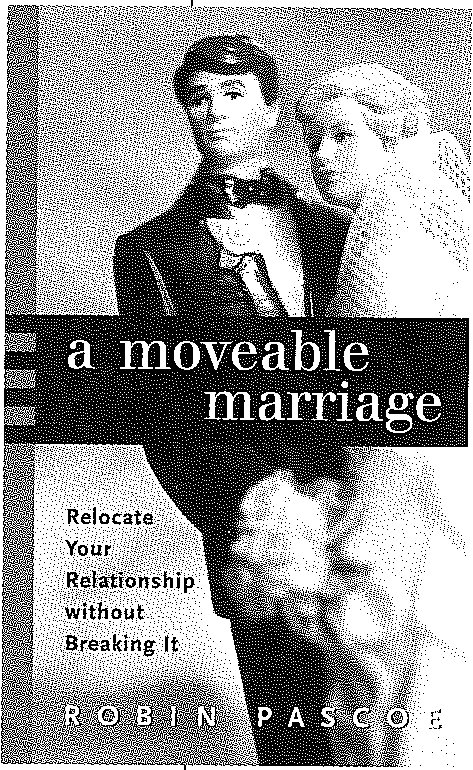
A Moveable Marriage: Relocate Your Marriage Without Breaking It is a wise and courageous treatment of sensitive issues that are frequently ignored. Without doubt, it should allow women to stop beating up both on themselves AND on their husbands. Robin Pascoe logically reasons that if it’s a move abroad “87% of international transferees are men, and 70% of them are married …. Those numbers help explain why, first and foremost, this is a book for women. (Although it won’t kill a man if he reads it too.)”
If you were a wife with four postings in Asia under your belt, a journalist and writer of three books on family issues around rotationality with an international reputation as a witty, wise and funny speaker and leader of workshops, and you were considering where to start writing a book on successful international marriages, where would you begin? If you considered your own mobile marriage to be a happy one, the easiest method might be to compile a recipe book, a list of how-to instructions based solely on your success. That is not Robin Pascoe’s method, however, and that is but one of the reasons readers of A Mobile Marriage will be deeply grateful. She started the process by designing a thoughtful questionnaire to be circulated to the expanding network of women who are members of her Web site <expatexpert.com> and to other groups and individuals interested in international mobility. She incorporated the subject into the workshops and speeches she delivered in Europe, Asia, Canada and the USA. Then she identified and researched the academic and popular writings available on marriage, and she interviewed experts and investigators on their findings. And again, she consulted women who had “talked the talk” as well as “walked the walk” of major relocations. Finally she personalized the experience by unashamedly examining her behaviour and emotions and those of her husband during their moves.
No matter how connected to each other a rotational couple is, the tensions that arise over and around the transitions and re-negotiations in an international relocation bring stresses bubbling to the surface. Take those pre-existing stresses, and subtract the spouse’s professional identity. Add the lists that are necessary to prepare the household for the move. Carve away the support provided by her friends and colleagues. Insert the responsibility for the children who are confused and emotionally needy at having their lives up-ended. Then eliminate her income-earning capacity (and the independence that brings) for a short or extended period. Add the employee’s excitement at fresh challenges on the job and a well-defined professional identity. Pile on top of all these the husband’s profound confusion at living with a woman who has been a full and reasonable partner and is now by turns furious, needy, weepy, giddy and confrontational. This totals an accumulation of pressures that is all too familiar to every peripatetic family. Pascoe approaches these concerns by examining the reasons behind them, their effects, and the responsibility each partner must accept in order to solve them.
This book is written from the vantage point of the author’s happy marriage, but Pascoe’s treatment of the effects of mobility on couples ventures much farther and far deeper. The self-indulgent behaviour she sometimes exhibited and now examines may feel ruefully familiar to other spouses whose reaction to being posted was (1) decidedly mixed, and (2) not always supportive.
No illusions are allowed — every minute in a mobile relationship is NOT golden, and above all this is an examination of realities. Sweetness and light are frequently in very short supply, and the situation facing each partner is clearly defined. However, the author’s sense of humour is irrepressible. On the same page that a family crisis is being examined, she reports on the irony and lack of logic that are also present — the reader may find herself either laughing out loud or snorting in recognition. Pascoe does not allow wives to define themselves as “victims” in successful rotational marriages, although those who are abused are urged to contact professional help immediately. The difficulties of repeated moves are examined in chapters with titles such as The Role of the Company, which doesn’t let employers off easily, Isolation and Dependence, wherein the wife’s disorientation is given due weight and her possibly extreme behaviour is administered a swift kick, and the important Money, Sex and Intimacy in which the mainstays of marriage are taken out of the closet where they have been stashed while the “more important” issues of the move are planned, to be renegotiated in the context of the inevitable confusion and exhaustion. Research findings and quotations from experts are used only when they illustrate mobile marriages. At least as important are the brutally honest contributions from Wives whose experiences, positive and negative, brilliantly clarify the subjects under examination.
If you are even considering an international assignment as a couple, be it your first or your fifteenth, scurry or run but do not walk to your nearest bookseller or Web source immediately for your own copy of A Moveable Marriage. It is helpful, it is realistic, and it is ruefully funny. If you still need to be convinced, consult Pascoe’s Web site at <expatexpert.com> to enjoy additional examples of her style, her wit and her generous wisdom as well as links to other sites and resources that support those who live the peripatetic life.
View the original scanned pages →
Originally published in bout de papier, Vol. 19, No. 4 (2003) — Winter/Spring 2002/2003 // Hiver/Printemps 2002/2003, pp. 25–27. Read the rest of this issue →



