
bout de papier, Vol. 14, No. 3 (1997) — Fall 1997 // Automne 1997, pp. 26–28
PAFSO Dinner
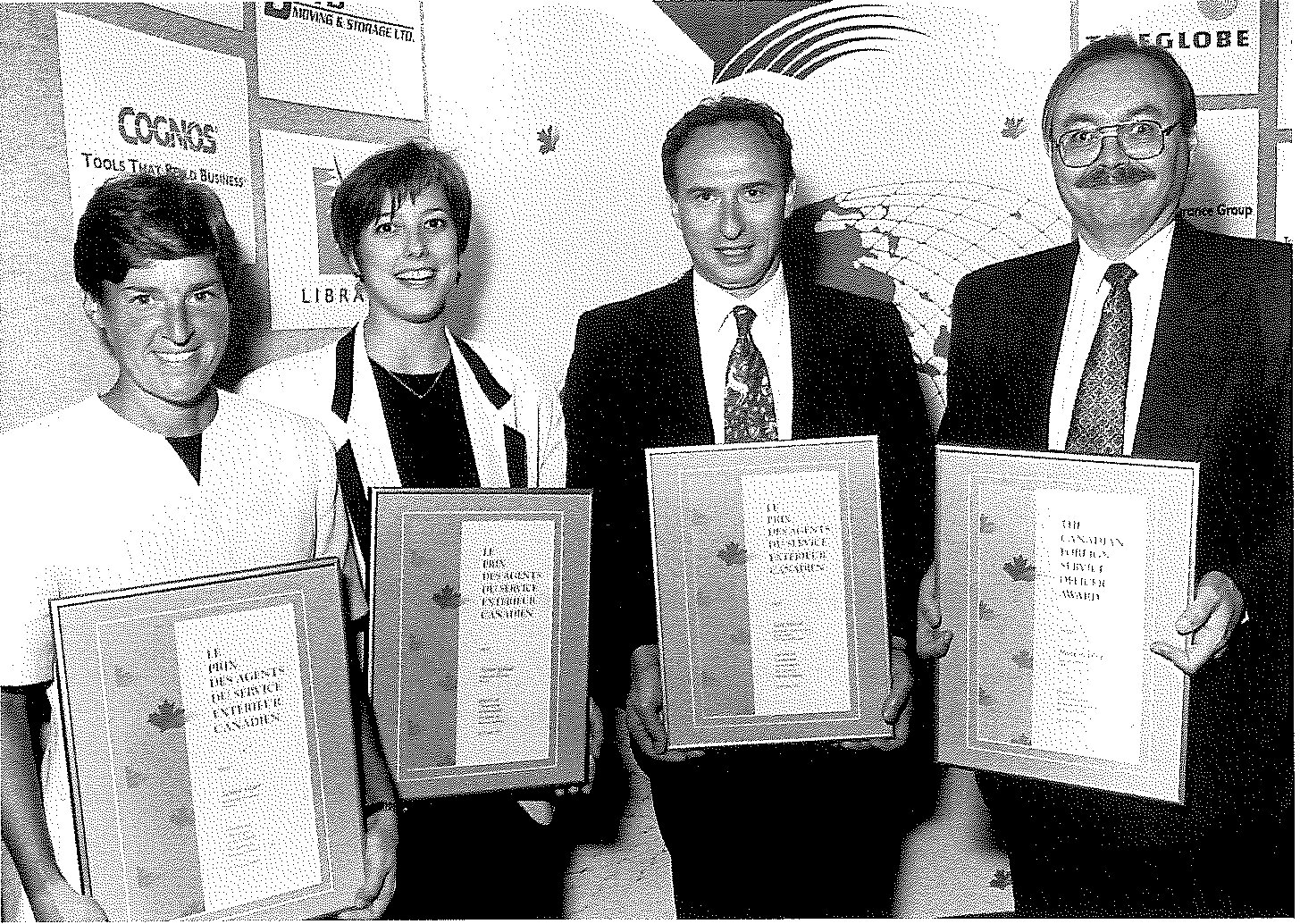
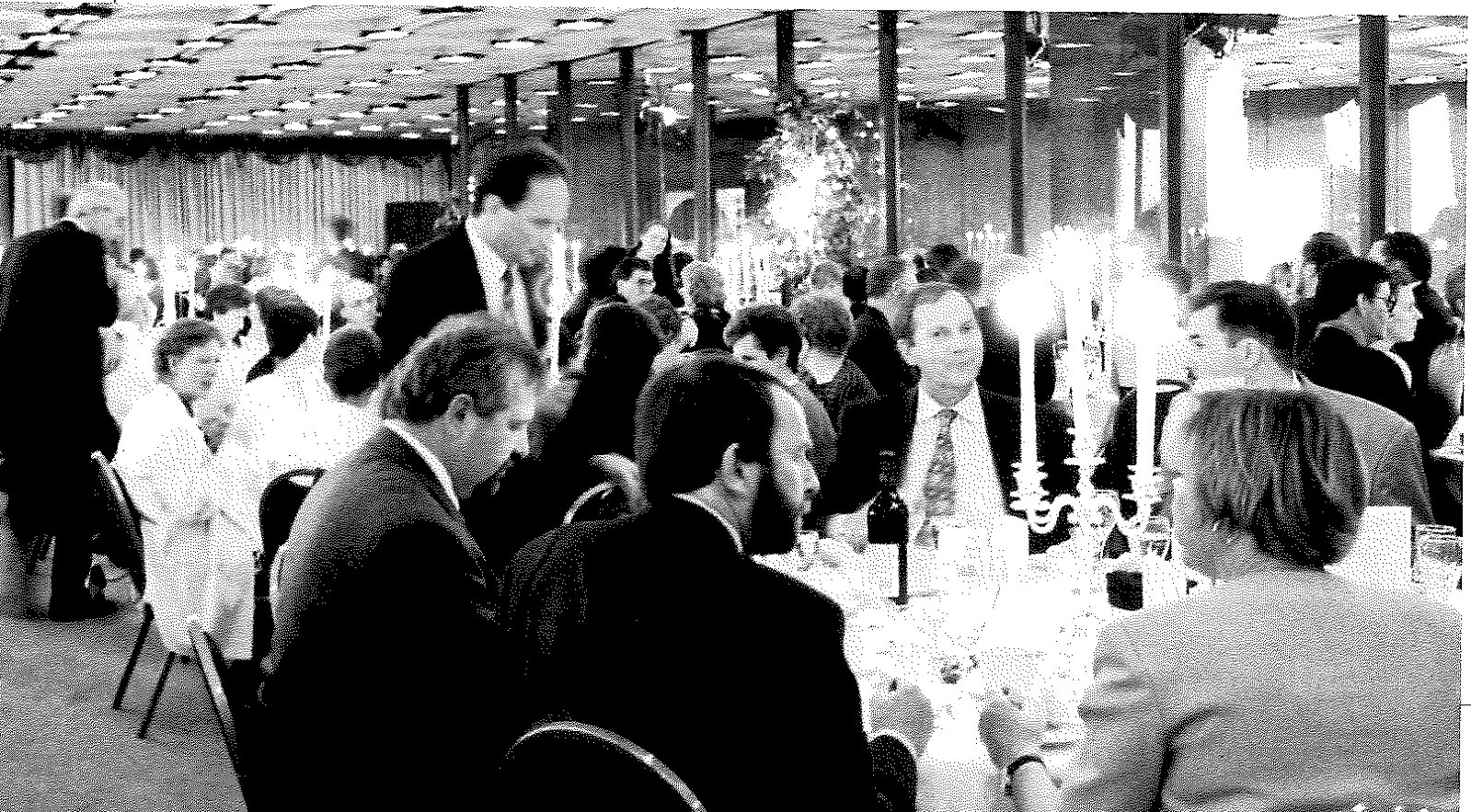
Last June 10 saw 240 people — the biggest turn-out ever — gather for a banquet at the National Arts Centre to honour the four winners of the 1997 PAFSO Foreign Service Officer Awards. Under the urbane guidance of master-of-ceremonies Alan Kessel, the evening became a joyous celebration of excellence in the Canadian foreign service setting a new standard for conviviality and as an expression of professional pride.
David Bickford, Cousellor at the Canadian Embassy in Peru received an Award for his exceptional leadership role during the hostage-taking crisis in Lima from December 1996 to its violent ending on April 10, 1997. The presentation was made by Michael Kergin, Assistant Deputy Minister, Americas and Security/Intelligence.
Louise Léger, Ambassador, Canadian Embassy in Panama, received an Award for her outstanding performance in opening a micro-embassy as our first resident Ambassador to Panama and in dramatically increasing Canada’s profile in every aspect of our relations with the country. Kathryn McCallion, Assistant Deputy Minister, munications made the presentation.
Guy Salesse, Deputy Director of Mexico Division, responsible for trade promotion was honoured for his exemplary work in conceiving, planning, and implementing a series of innovative programmes to enhance Canada’s exports to Mexico. He was presented with his Award by Rob Wright, Deputy 1997 PAFSO FS Awards – Minister of Inter- Louis Guay by Claude Lai national Trade.
Ninon Valade while Immigration Officer, Citizenship and Immigration, at the Canadian Embassy in China, was recognized for her outstanding work in developing effective immigration procedures to help Canadian parents in the process of adopting Chinese children in China. She was given her Award by Joe Bissett.
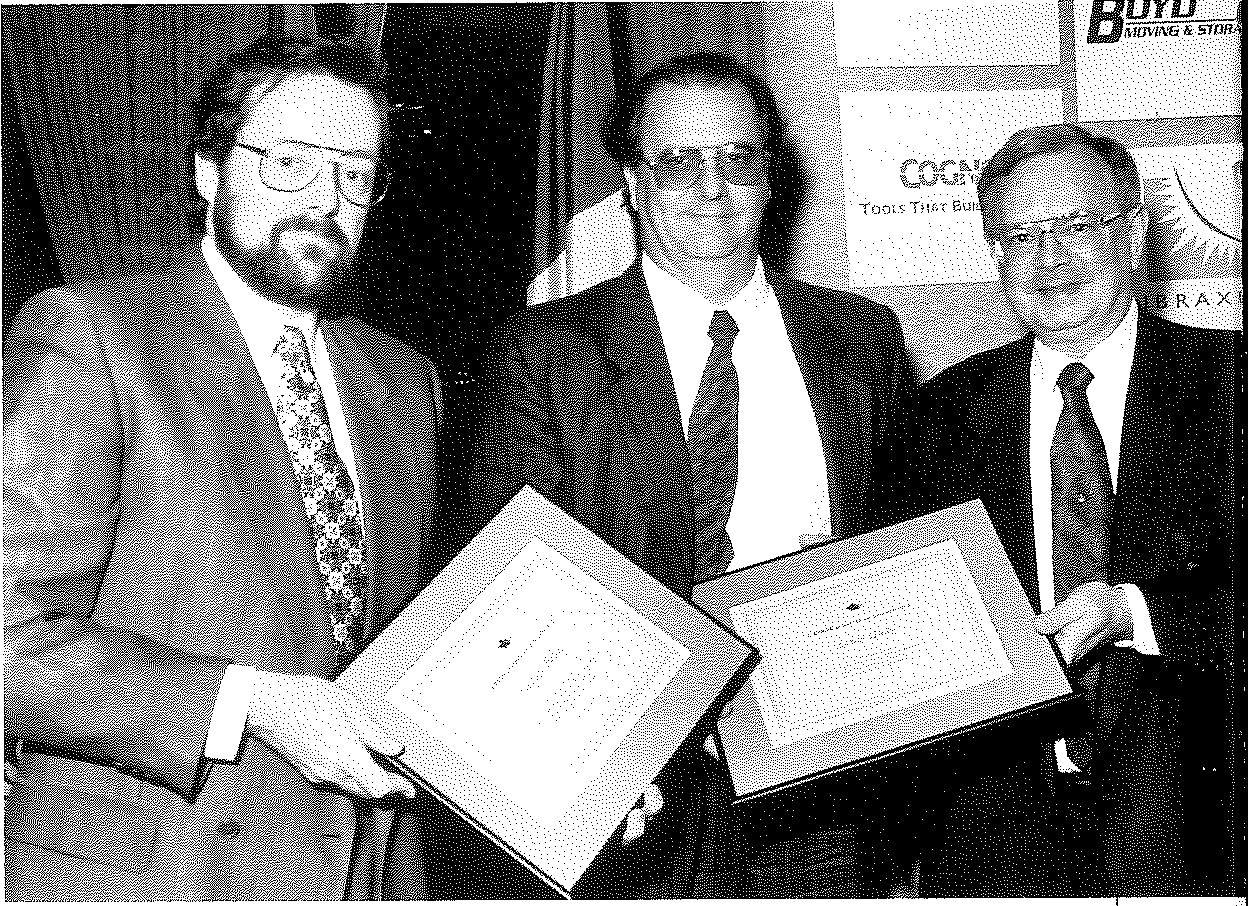
The distinguished panel of judges who selected the winners was composed of: James (Joe) Bissett, formerly a Canadian Ambassador and High Commissioner and more recently, Chief of Mission for the International Organization for Migration in Moscow; Meriel V.M. Bradford, Vice President of Government and Regulatory Affairs, Teleglobe Inc.; Mark Drake, Senior Vice-President of the Alliance of Manufacturers and Exporters Canada; Leonard Legault, Chairman of the Canadian Section of the International Joint Commission — and formerly Canadian Ambassador to the Holy See; and Jason Moscovitz, Chief Political Correspondent for CBC television news.
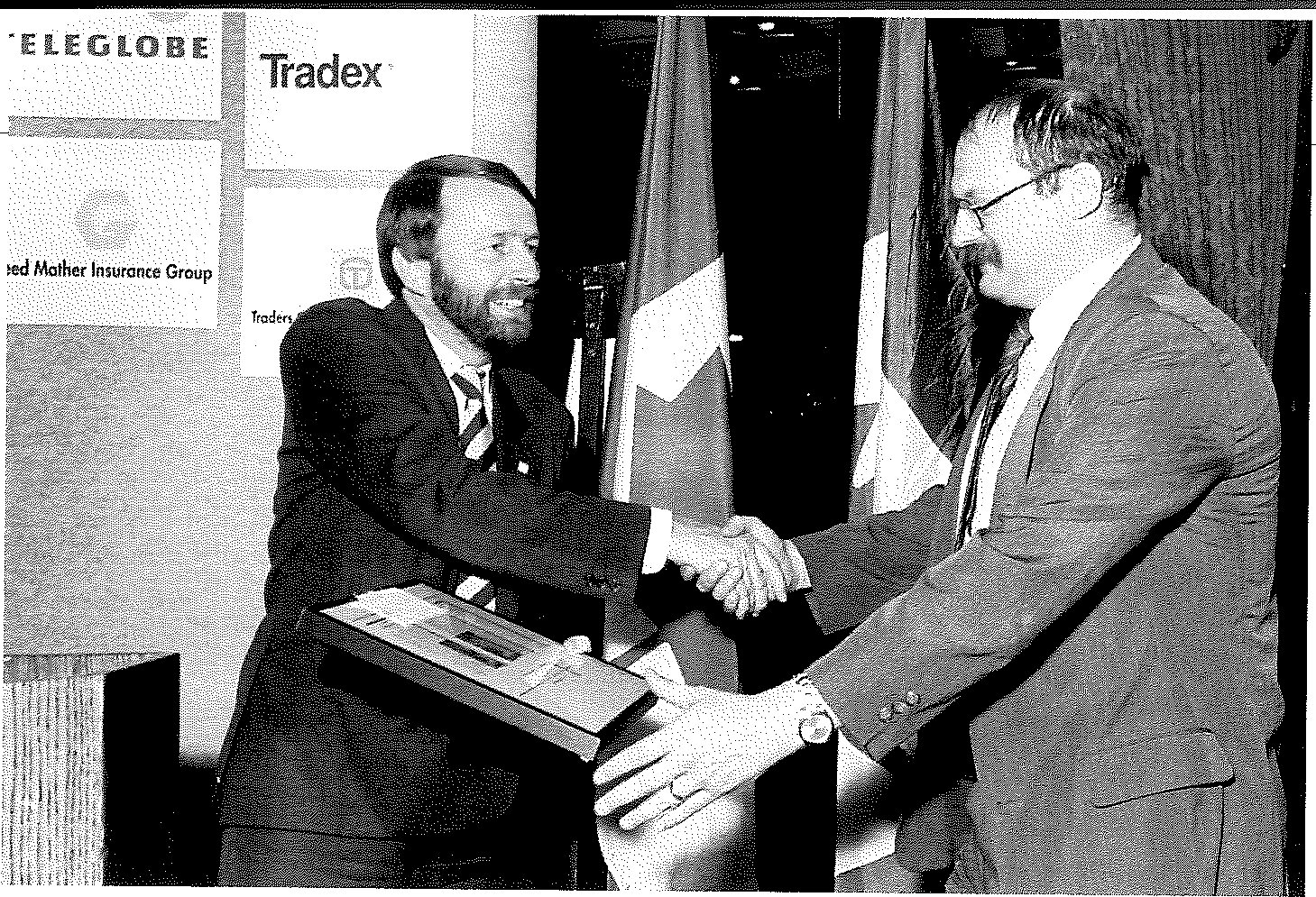
One of the highlights of the evening was a special presentation by PAFSO to Jacques Bélec and Louis Guay for their untiring defence of equity in the provision of French language education for children of foreign service personnel. Claude Laverdure, Assistant Deputy Minister for Europe, the Middle East and North Africa, presented certificates to the two officers as a mark of appreciation for their accomplishment.
PAFSO would like to acknowledge and offer its warm thanks to the Corporate Communications Division, DFAIT, the Public Affairs Branch, CIC and the following sponsors whose participation helped to make the event an outstanding success.
Air Canada
Albert at Bay Suites Hotel
Boyd Moving & Storage Ltd.
Canadian Immigration
Historical Society
Cognos Incorporated
Inniskillin Wines
Joe Clark & Associates
Lemmex & Associates
Libraxus Inc.
MKI Travel and
Conference Management Ltd.
Prospectus Inc.
Reed Mather Insurance Group/
Traders General Insurance
SAP Canada Inc.
Teleglobe Inc.
Tradex Management Inc.
William M. Mercer Ltd.
PAFSO wishes to thank Air Canada and Albert at Bay Suites Hotel for their splendid door prizes.
Special thanks also to Boyd Moving & Storage, Inniskillin Wines and Tradex for the promotional items that graced the tables.
RHOMA Prizes
Also presented on June 10 were the Retired Heads of Mission Association (RHOMA) prizes. RHOMA merits special recognition for its generosity and the creation of these prizes to encourage excellence in writing.
Nicholas Coghlan, Editor of bout de papier, presented 1st prize to Sam Hanson for his article “Solitaire” AVIA ISI (Volume 13, Number 2) and the 2nd prize to Roger Lucy for his article “Mission to Attila” (Volume 13, Number 3). Each winner received a framed copy of their story along with a cash prize. The RHOMA selection committee was composed of Michael Shenstone, Gerry Hughes and Paul Lapointe.
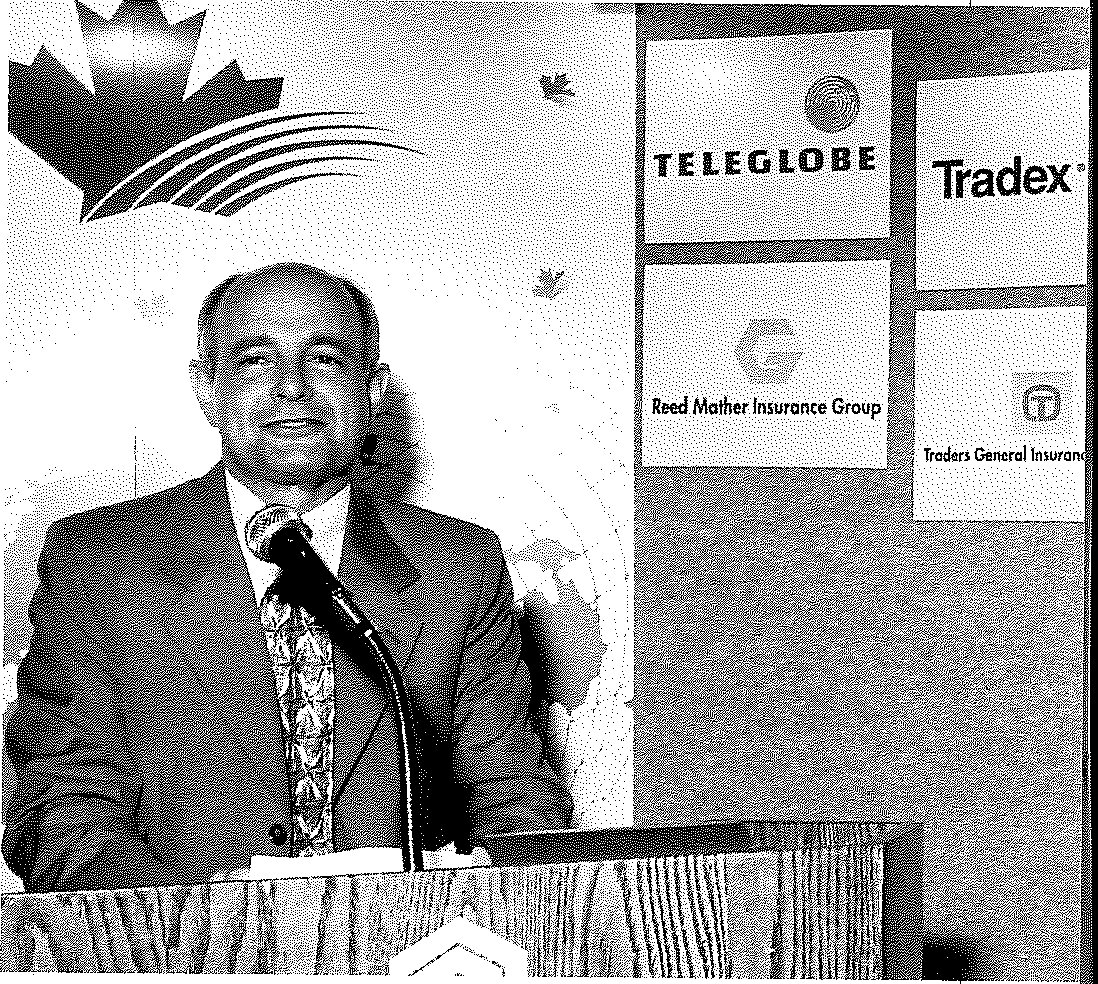
The Editor presented a special award to A Aalto, the mystery person whose intriguing puzzles have appeared regularly in the magazine for the past fifteen years. As Aalto’s identity is hidden, the award was accepted by Michael Small, a member of the editorial board and a contributor to bout de papier. The Award, a puzzle created using characters from past A Aalto puzzles appears in this issue of the magazine.
In his acceptance, Sam Hanson gives bout readers the following advice on writing:
Ine KHUMA Prize is tor good writing, and I would like to share a few thoughts
about that. When I first joined External
1997 PAFSO Awards Dinner, National Arts Centre lune 10 1997 Panorama Ranm
Affairs (as it then was), I was even younger than I am now; and, having just earned an MA in literature, I was under the illusion that I knew what good writing was.
Then I had the privilege of reading despatches by people like Marcel Cadieux, Robert Ford, Jerry Hardy, and I realized that, in addition to everything else it did, the Canadian Foreign Service was writing the best prose in Canada – in either official language. Those despatches represented a far higher standard than I had thought existed. That is as it should be: diplomats are people who deal in documents. Our writing should be the best.
I mentioned despatches. If you are much younger than I am, you have probably never seen a live one: a first-person numbered letter addressed by a head of mission to the Secretary of State for External Affairs (as s/he then was), or vice-versa. As a form of correspondence, it has ceased to exist. Numbered letters in general seem to be disappearing — along with the blue-grey airmail paper they were typed on, the typewriters they were typed with, the secretaries who typed them, and the couriers who carried them. And the fountain pen ink that was once supplied so we could draft them.
This may perhaps be cause for nostalgia, perhaps, but certainly not regret. COSICS and its SIGNET successors have provided us with a far superior medium for our messages. The challenge today is to maintain the quality of our writing in a medium in which it is not only easier to write quickly, but to write badly, lazily, sloppily.
We fancy ourselves as a corps d’élite. So we should. That’s what we are. But elites have to set their own standards, set them at a high level, and maintain those standards themselves, if they are to be worthy of the status they claim.
We should therefore continue to do what we had to do when the medium was 28 bout de papier Vol. more cumbersome: Think before you write. (Our remote predecessors must have thought well and hard before Setting quill pen to parchment.) La mauvaise rédaction ne signifie pas forcément la mauvaise pensée — il s’agit plus souvent d’une simple absence de pensée!
The main criteria when we set pen to paper — or finger to keyboard — are clarity, brevity and precision. For the message to succeed, however, the reader must be kept engaged — must want to go on reading your message in preference to some other piece of business. So the text has to be well and interestingly written.
It is worth taking some time to find le mot juste — it will help the reader to remember the message. When Cadieux wrote “le visage de l’Europe sourit de nouveau, mais il a un pli amer au coin de la bouche”,, he encapsulated several pages of closely reasoned analysis in such a striking way that it has stayed in my mind for over twenty years.
So – before you double-click on the “send” icon, read the thing through one more time. Find the time. Make the time. Get someone else to read it as well. Keep it as short as possible. Keep it as simple as possible. Above all, keep it clear: that is why we still need to write the best prose in Canada — or the world.
I recently saw the following slogan posted on a wall in the Department of Foreign Affairs and International Trade:
’Think like Kissinger – write like Gump.”
That is partly correct, but why go so far afield for examples?
“Pense comme Pearson — write like Ritchie”!
View the original scanned pages →
Originally published in bout de papier, Vol. 14, No. 3 (1997) — Fall 1997 // Automne 1997, pp. 26–28. Read the rest of this issue →



